Where Enrollment Marketing Goes Next

John Girard
Founder, Girard Advisory Group
Enrollment marketing is squeezed from both ends: AI researches schools before the inquiry, and students screen calls after it. Here is where schools are moving budget and effort, and how the TRUSTED Model ties it together.
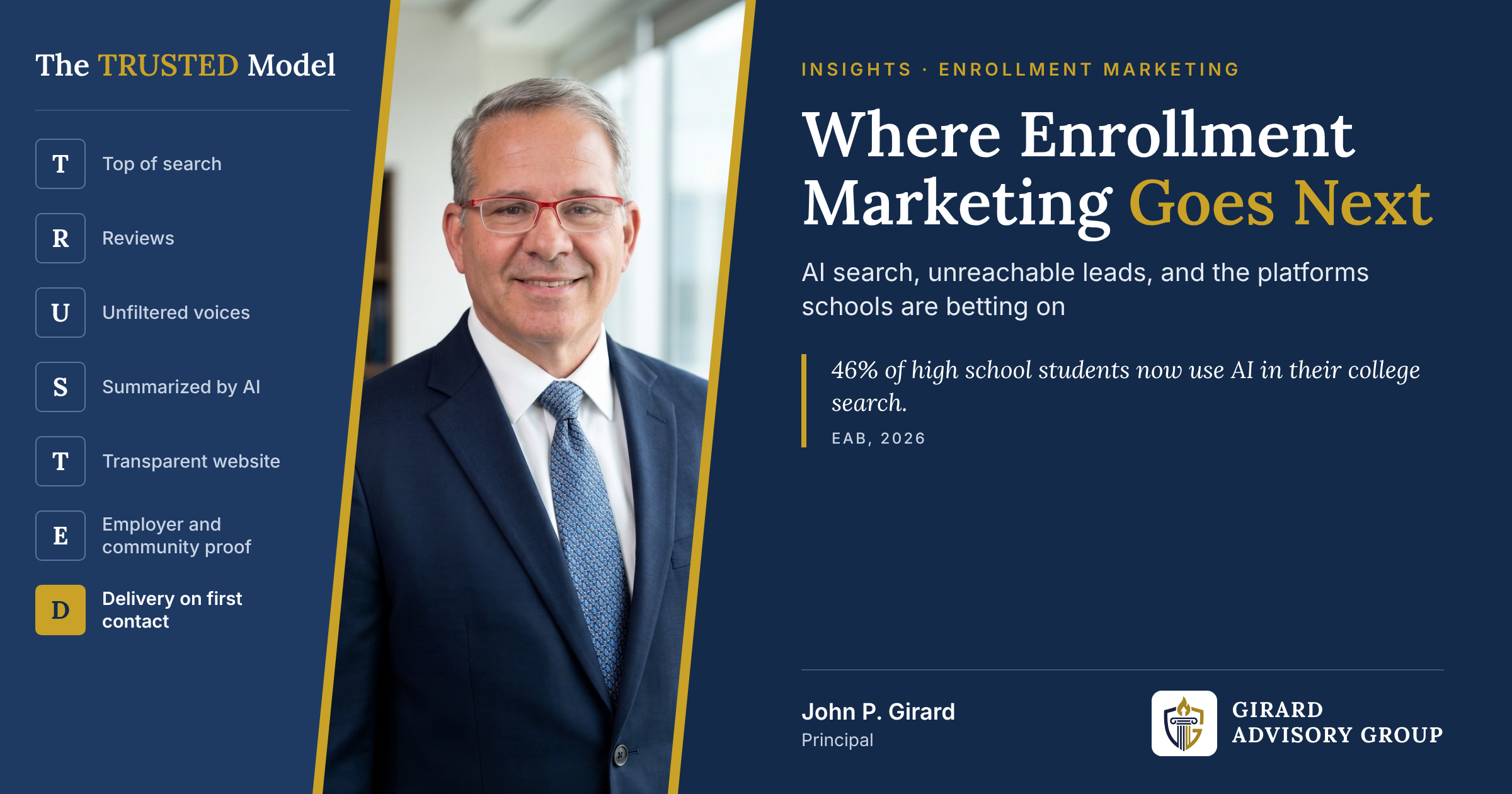
AI is answering your prospective student’s questions before you know they exist, and their phone is screening you out after they inquire. Here is where schools are moving their money and effort in response.
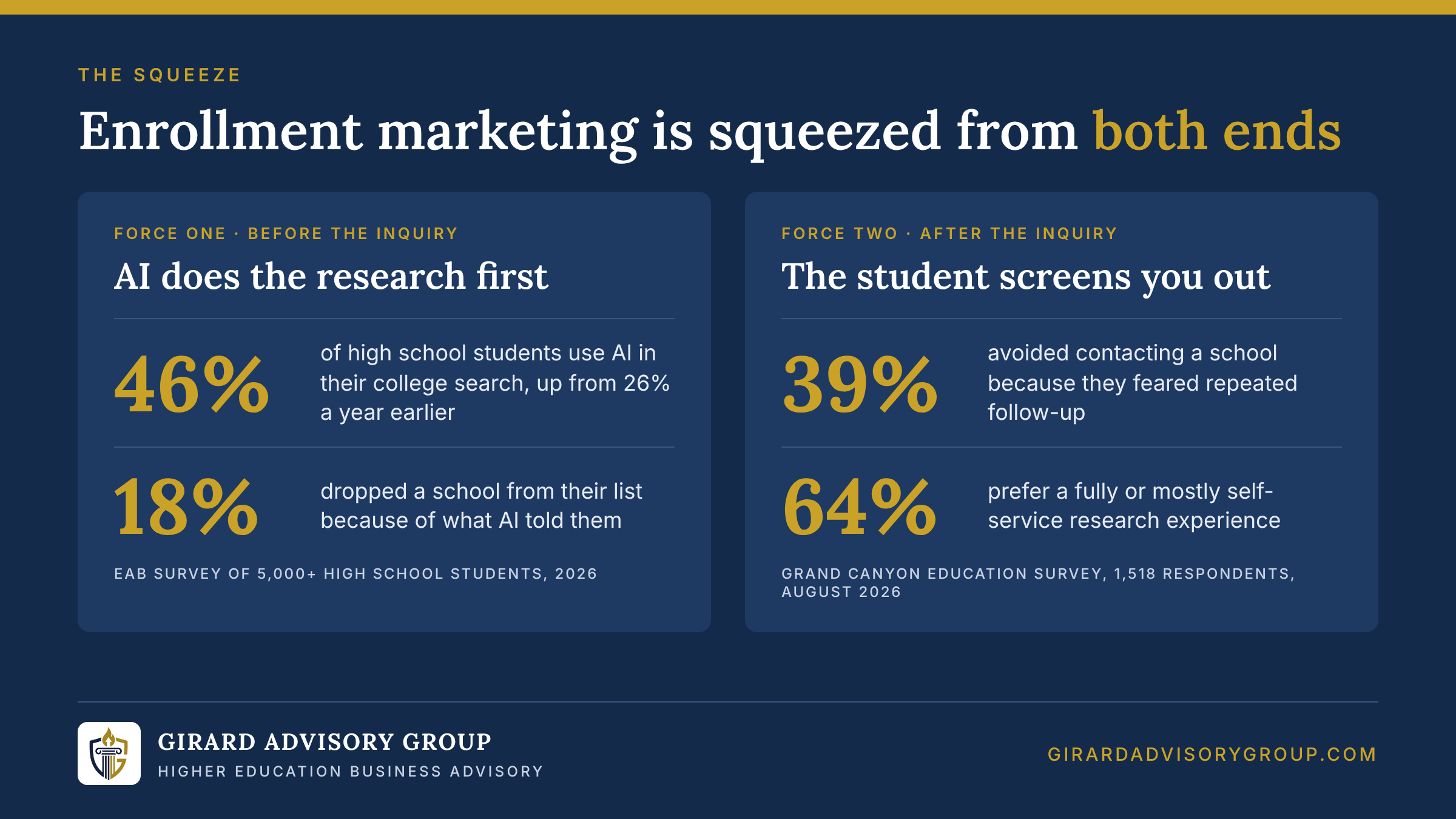
Enrollment marketing is being squeezed from both ends of the funnel. At the top, AI assistants now do the early research that used to produce a website visit and an inquiry form. At the bottom, the inquiry career colleges and vocational schools paid for is harder to reach by phone, text or email than at any point in my career.
I have written about each end separately, in AI Is Now Your Prospective Student’s First Advisor and The Contactability Problem. This post puts them together and asks the practical question: what are schools actually doing about it, and on which platforms?
The short answer is that the schools growing inquiry and enrollment have stopped treating marketing as lead purchasing. They are building reputation that AI can read, generating their own first-party demand, and making the first contact something the student asked for.
Force one: the research happens before you are in the room
AI use in the college search nearly doubled in a year. EAB’s survey of more than 5,000 high school students found 46% using tools like ChatGPT in their search, up from 26% in spring 2025 (eCampus News, reporting EAB).
The number that should get a campus leader’s attention is a different one. In that same survey, 34% said AI research raised their interest in a school, and 18% removed a school from their list because of what AI told them. Nearly one in five crossed a school off without the school ever knowing they were looking.
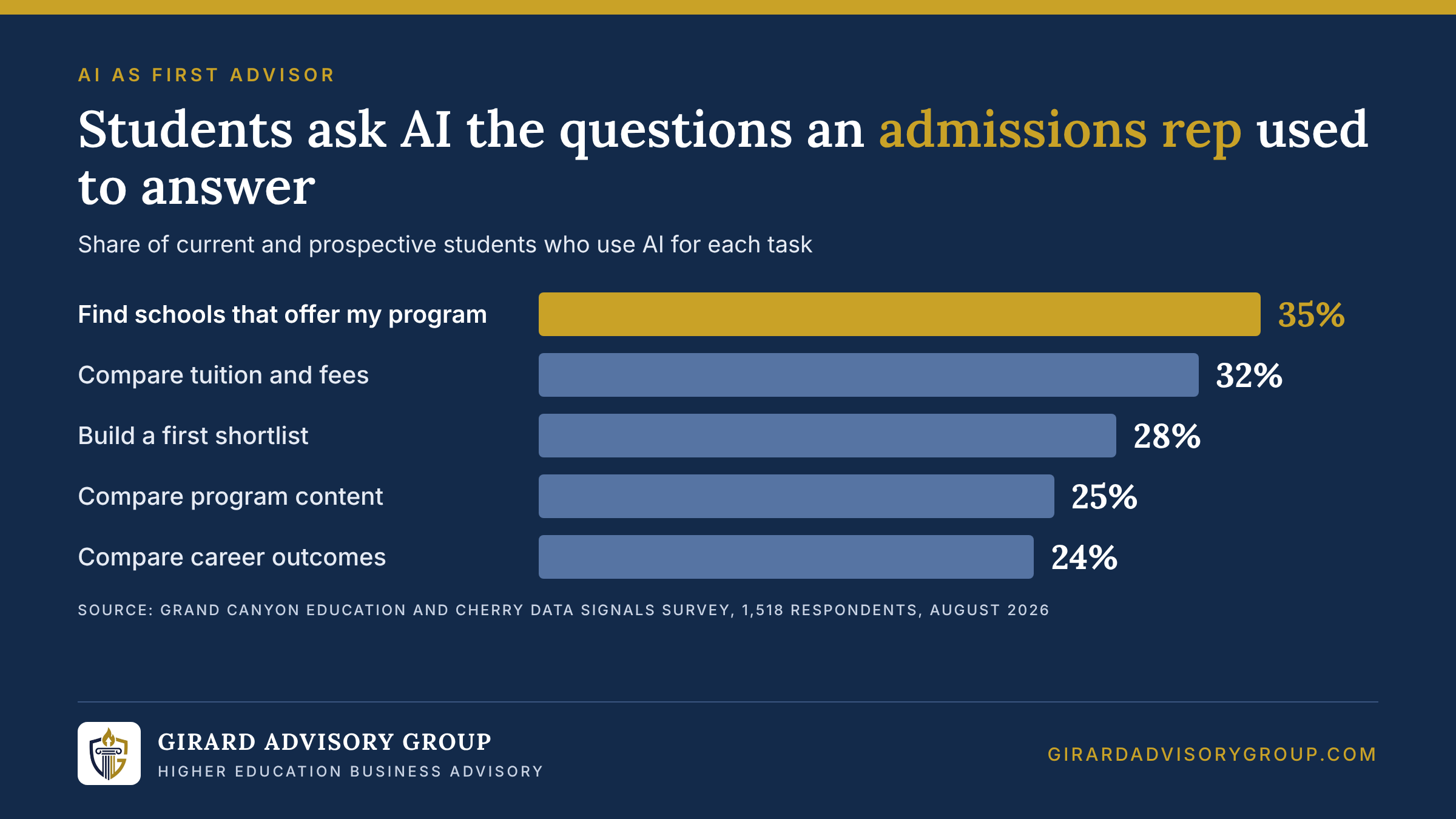
Adult and career-focused learners show the same pattern. A Grand Canyon Education survey of 1,518 current and prospective students, fielded in August 2026, found 87% had used or would consider AI for college research. Their top requests were the ones an admissions rep used to handle: which schools offer my program, what it costs, and how career outcomes compare. Treat the exact percentages with care, since the survey was commissioned by a university and is self-reported.
Search itself has changed underneath this. EducationDynamics reports that more than 78% of education-related searches now return an AI-generated overview, and describes search engines as shifting from discovery to verification. The student gets an answer first, then checks it.
Two consequences follow.
- Fewer inquiries, each one further along. A student who has already compared you against three competitors does not fill out a form to ask what programs you offer. The ones who do inquire are closer to a decision and less patient.
- Your reputation is being summarized by a third party. AI assembles its answer from your website, review platforms, regulatory records, Reddit, and video. If you have not tended those, the answer engine decides your message for you.
Force two: the inquiry you paid for cannot hear you
The phone was already losing ground before this year. Unknown numbers get ignored, carriers label outbound calls as spam, and mailbox providers tightened bulk-sender rules. What changed recently is that the filtering moved onto the device itself.
Apple’s iOS 26 added two screening features that matter to every admissions office:
- Call screening. A call from a number not in the student’s contacts can be intercepted before it rings. The caller is asked for a name and a reason, and the student reads a transcript before deciding to answer.
- Unknown-sender text filtering. Texts from numbers the student has not saved or engaged with can be routed to a separate folder with a badge and no alert.
Both are off by default in the United States, so this is not a wall. It is a growing share of your list, concentrated among the people most annoyed by unwanted calls. Branded calling helps, but a branded caller the student has never engaged with still goes through screening.
Students are also telling us directly why they stay quiet. In the Grand Canyon Education survey, 39% said they had avoided contacting a university because they feared repeated follow-up, and 64% preferred a fully or mostly self-service research experience. The industry’s own call cadence taught them to hide.
The consent rules are moving too, and many leaders have the facts half right:
- One-to-one consent is not the law. The Eleventh Circuit vacated the FCC’s one-to-one consent rule in January 2025, so the prior express written consent standard remains. State rules can be stricter, and counsel still advise buying leads only with clean, documented, school-specific consent.
- Opt-outs got sharper teeth this month. Revised FCC revocation rules take effect November 25, 2026. An opt-out from one marketing call or text applies to all future marketing calls and texts from that caller, and must be honored within ten business days.
I am not an attorney, and your compliance counsel should review your own consent language and opt-out handling. The operating point is simple: a STOP reply to one campaign has to reach every system that calls or texts on your behalf.
One model for both forces: TRUSTED
The two forces look like separate problems owned by separate departments. Marketing worries about AI and visibility. Admissions worries about contact rates. They are one problem: a student will only take a call from a school they already trust.
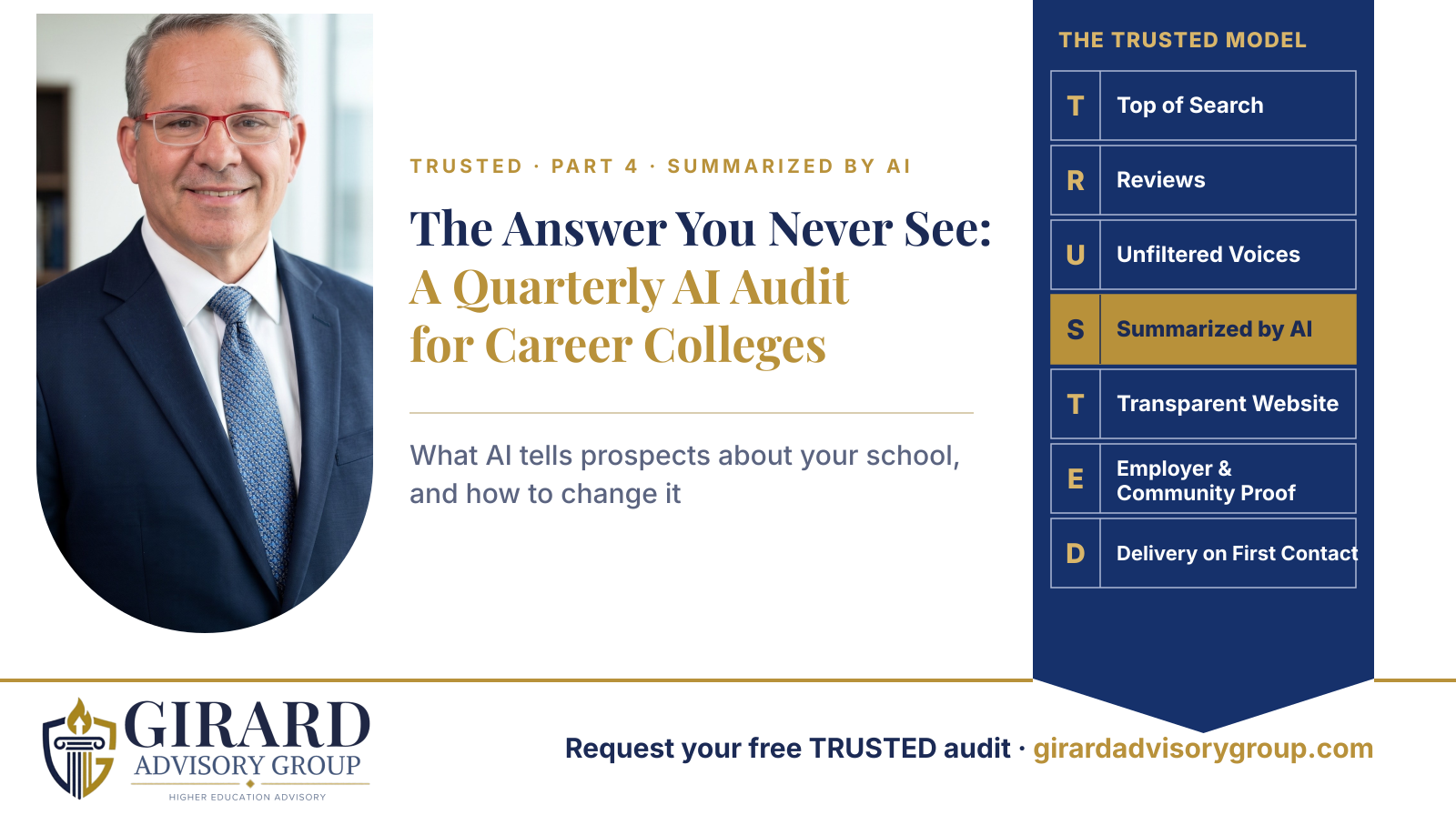
TRUSTED is the model Girard Advisory Group developed to work that problem in order. It has seven elements, and the sequence matters, because each one feeds the next.
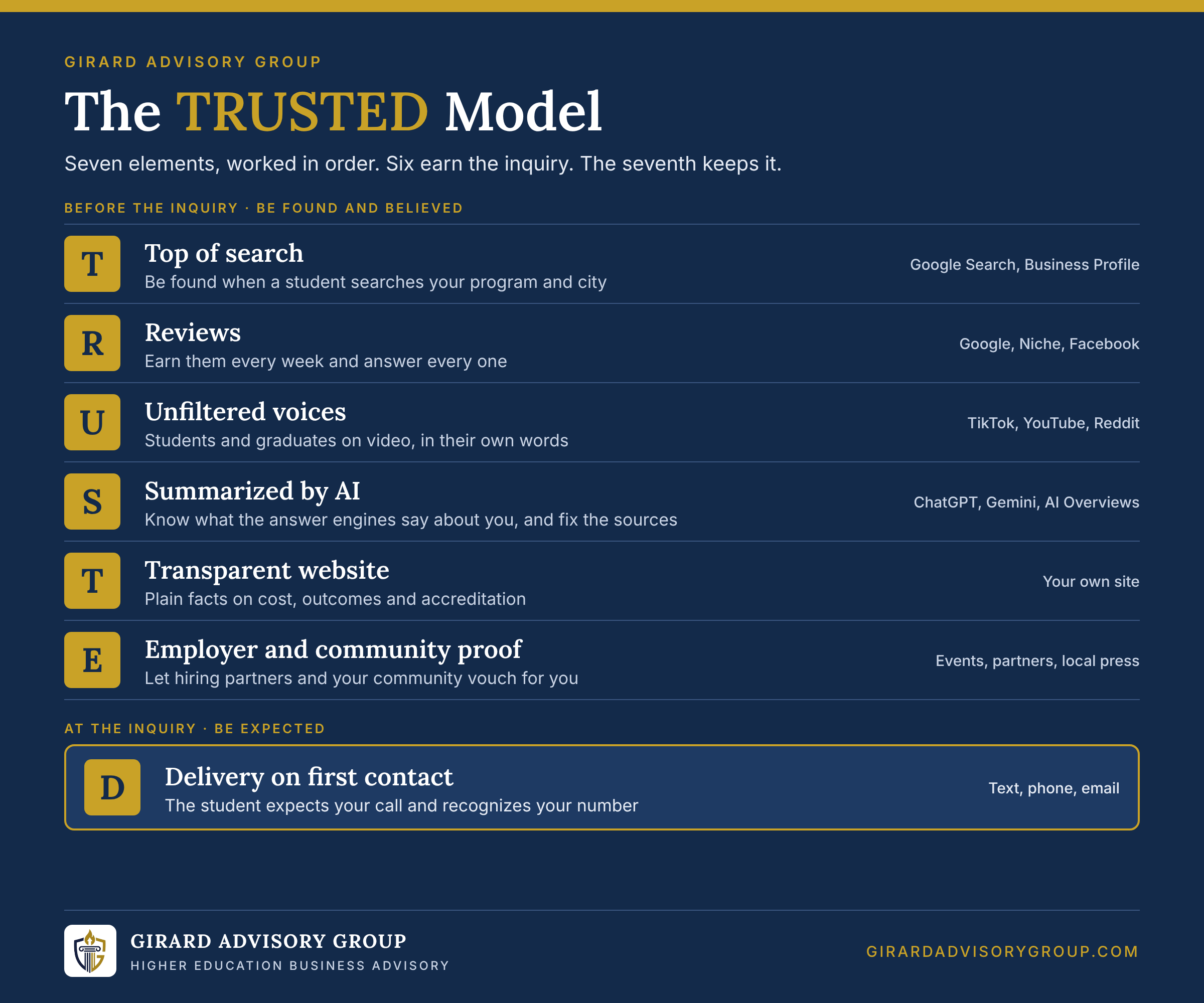
The first six elements answer force one. They are how a school gets found, believed and accurately described before any form is filled out. The seventh answers force two, and it only works when the first six have been done. A student who has read your reviews, watched your students and checked your outcomes will pick up when you call.
Read the rest of this post through that lens. The platforms in the next section are where the first six elements live. The six approaches after it are how schools are putting the model to work.
The platforms career colleges are betting on
The platform mix is shifting toward places where students form an opinion before they inquire, and away from places that only sell a name and a phone number.
| Platform | The job it does now | What schools are doing there |
|---|---|---|
| AI assistants and Google AI Overviews | First advisor: shortlists, cost and outcome comparisons | Auditing what AI says about them; publishing plain, structured facts on tuition, outcomes and accreditation |
| Google Search and Performance Max | Verification and high-intent capture | Running paid and organic as one plan; feeding enrollment outcomes, not form fills, back to the ad platform |
| YouTube | Program research and the long look inside | Program walk-throughs, campus tours, graduate stories, livestreamed info sessions |
| TikTok and Instagram Reels | Discovery of schools the student had not considered | Student-made, low-polish video; day-in-the-life content; paid short-form with lead forms |
| Reddit, Google Business Profile, Niche | Unfiltered proof that students and AI both read | Asking for reviews on a schedule and answering every one |
| Streaming TV and audio | Local awareness that makes the later call recognizable | Geo-targeted spots around start dates, paired with search and social |
| SMS and RCS business messaging | The contact channel students tolerate | Student-initiated text threads, verified sender identity, text before call |
| AI enrollment agents | Instant response when staff are off the clock | After-hours answers and appointment setting, with a human handoff |
A few of these deserve a closer look.
Short-form video is now a discovery engine. In the Grand Canyon Education survey, TikTok and YouTube were slightly more likely than search engines to introduce a school a student had not considered (26% versus 22%), and 49% had added or dropped a school because of social media. Campus tours and day-in-the-life videos beat admissions advice by more than two to one.
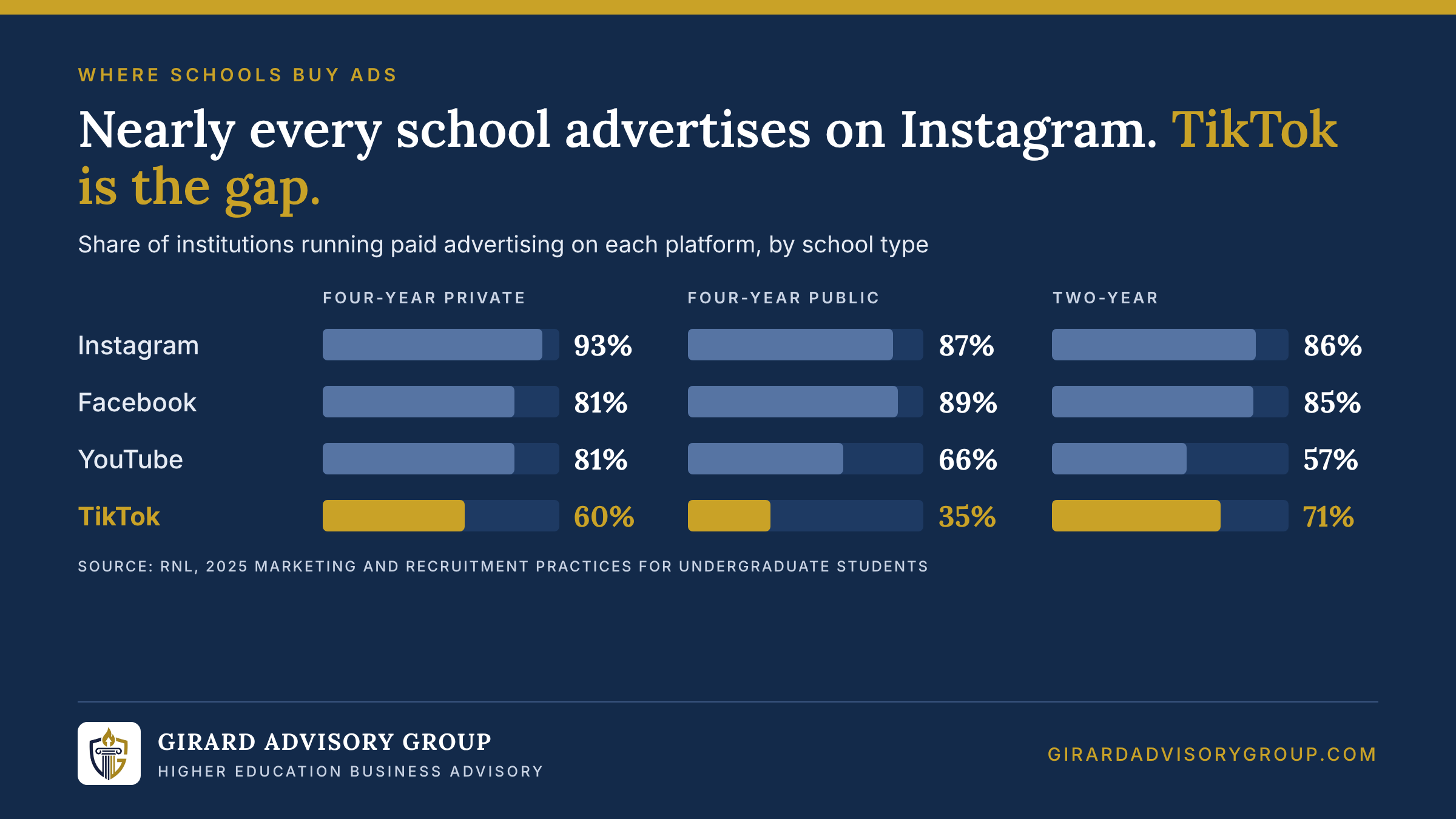
Schools are still underweight where attention is. RNL’s benchmarks show roughly nine in ten institutions buying ads on Instagram, while only 60% of privates and 35% of publics advertise on TikTok. Two-year schools are ahead at 71%. RNL’s advice is to move money toward TikTok, YouTube and search built for AI summaries.
Paid platforms are automating the buying. Google and Meta now make most targeting and placement decisions themselves. The school’s advantage shifts to the two things the machine cannot supply: a range of genuine creative, and clean conversion data that tells it which leads enrolled.
Disclosed sponsorship costs trust. In the same Grand Canyon Education survey, 46% said they trust sponsored content less once the university’s backing is disclosed. That is an argument for real students with real opinions, not for hiding the disclosure.
You can now buy your way into the conversation, but not into the answer
AI companies have started selling advertising, and it moved from pilot to open platform inside a year.
- ChatGPT. OpenAI began testing ads in February 2026 and opened a self-serve Ads Manager to U.S. businesses in May, with cost-per-click bidding and conversion tracking. The earlier $50,000 minimum is gone, which puts it within reach of a single-campus school. By late August the platform reported tens of thousands of advertisers.
- Google AI Overviews and AI Mode. You may already be buying this. Existing Search, Shopping and Performance Max campaigns are eligible automatically, through the same auction, with no separate budget.
- Microsoft Copilot. Ads are drawn from campaigns already running in Microsoft Advertising.
Not every AI company is going this way. Perplexity tried ads and walked away over trust concerns. Anthropic has committed to keeping Claude ad-free. A student comparing schools in those tools sees only what the tool has learned about you.
Three cautions before anyone moves budget.
- The ad sits beside the answer, not inside it. Both OpenAI and Google say ads are labeled and kept separate from the response. If AI describes your school poorly, a sponsored placement next to that description will not fix it.
- Category rules are unsettled. ChatGPT’s self-serve launch came with category restrictions, and Google is only now testing ads in sensitive categories such as healthcare. Confirm how each platform treats education advertisers before you plan around it.
- Measurement is thin. Ask your paid search vendor whether they can show you results from AI placements separately. If they cannot, you are buying on faith.
My read is that AI advertising will become a standard line in the enrollment media plan within a couple of cycles. It will reward the schools that already did the trust work, and it will be an expensive way to advertise a reputation problem for the ones that did not.
Six approaches that are growing inquiry and enrollment
Platforms change every year. The approaches underneath them are more durable, and these are the six I see working.
1. Win the answer before the inquiry
Schools are treating AI visibility as the top of the funnel. The practical version is an audit: write the 50 questions a prospective student would ask, run them through ChatGPT, Gemini, Perplexity and Google’s AI Mode, and record what comes back. Then fix the sources AI is reading, starting with tuition, outcomes and accreditation pages written as plain facts.
This is the “Summarized by AI” element of the TRUSTED model, and it depends on the elements before it. AI cannot summarize reviews you never earned or outcomes you never published.
2. Own your demand
Purchased and shared leads are the most exposed to both forces. The student did not choose you, does not recognize your number, and has three other schools calling. Schools are shifting budget to demand they generate themselves through search, paid social and video.
I have run this shift. Across a seven-campus network where I led marketing, annual leads grew from 11,760 to 37,344 over five years while total marketing spend fell 19.6%. Cost per lead dropped from $216 to $55, and annual starts nearly doubled, from 805 to 1,539. The gain came from building our own campaigns on Meta, TikTok, streaming and Google search.
3. Let students carry the message
Polished is not persuasive. Students trust recent graduates and current students far more than the institution, and they spot stock and AI-generated imagery quickly. Schools are handing the camera to students and building a steady review habit.
The review habit is a management system, not a campaign. We set a target of two new reviews per campus every week, held campus directors accountable for it, and answered every review within 48 hours. Average ratings moved from 3.2 to 4.8.
4. Make the first contact the student’s move
The fix for screened calls and filtered texts is to stop being an unknown sender. Schools are redesigning the inquiry so the student starts the thread, then calling only after a text has landed.
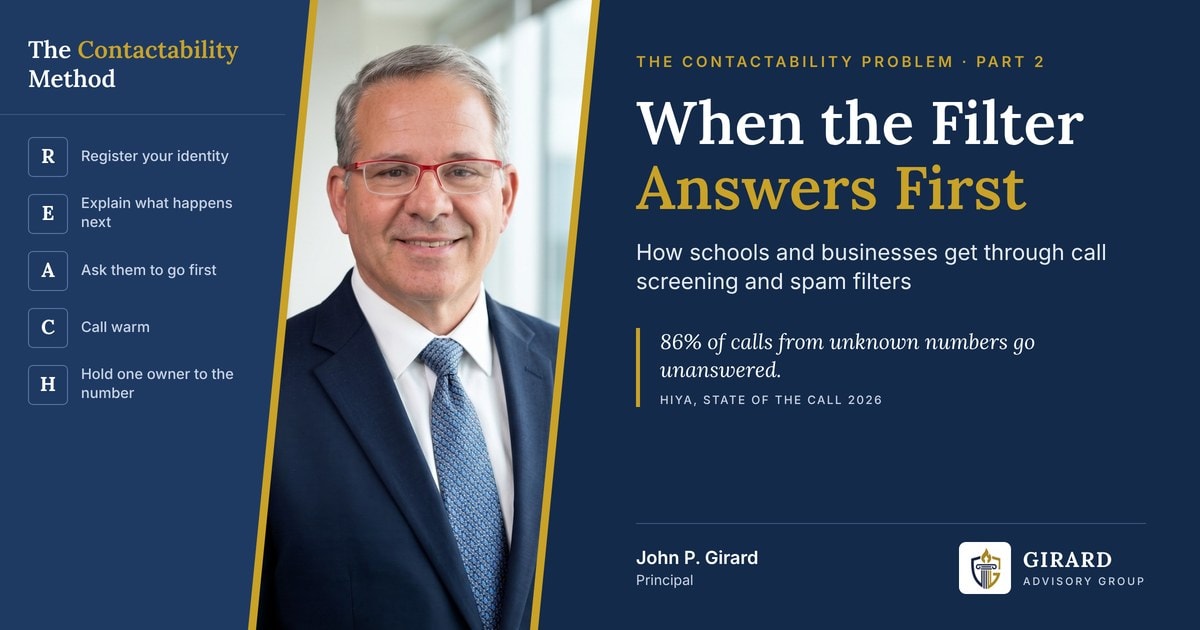
This is what The Contactability Method is built to do:
- Register your identity. Brand and register your numbers so calls and texts show who you are.
- Explain what happens next. Tell the student on the thank-you page who will reach out, from what number, and when.
- Ask them to go first. Offer a tap-to-text or save-our-contact step so your number becomes known to their phone.
- Call warm. Text first, then call a student who is expecting it.
- Hold one owner to the number. One named person owns contact rate and reports it weekly.
5. Use AI for speed, people for trust
A large share of inquiries arrive on nights and weekends, when the admissions office is closed. Schools are deploying AI agents by chat, text and voice to answer at once, handle routine questions and book the appointment. The gain is speed and coverage.
The risk is letting AI speak on cost, aid, transfer credit or outcomes without controls. Those are the claims students say they always verify, and the ones accreditors and regulators read. Keep a human handoff on anything that is a representation about the school.
6. Put people in a room
The least filtered channel is still a face. High school and career center partnerships, employer relationships, open houses and live community events produce inquiries that already know your name.
One example from my own campaigns: a three-week contest with a local radio partner, ending in a live campus remote. It produced 275 online entrants, 112 walk-ups on the day, and 27 enrollments for the next start. Every one of them had met us before admissions ever called.
Seven questions to ask your marketing and admissions teams
You do not need to run the campaigns to lead this. You need to ask questions that cannot be answered with a lead count.
- When we ask ChatGPT and Google about our school and our top program, what do they say, and who checked last?
- What share of our inquiries do we generate ourselves, and what share do we buy or share with other schools?
- What is our contact rate within 24 hours, by lead source, and who owns that number?
- Do our calls display our name, and are our texting numbers registered and verified?
- Does a STOP reply to one campaign reach every system and vendor that contacts students for us?
- How many new reviews did each campus earn last week, and how fast did we answer them?
- Are we sending enrollment outcomes back to Google and Meta, or only form fills?
If the answer to most of these is “I will have to get back to you,” that is the finding. The direction of enrollment marketing is clear: be trusted before the inquiry, and be expected when you call.
Girard Advisory Group offers a free TRUSTED assessment, an outside-in review of how your school appears to a prospective student and to the AI tools advising them. Request yours here.
Frequently asked questions
Is AI replacing search for prospective students?
Not replacing, but going first. Students increasingly get an AI answer, then use search and the school website to verify it. Your website still matters a great deal, as the place a student confirms cost, programs and accreditation.
Should a career college stop buying leads?
Not overnight. Measure contact rate and cost per start by source, then move budget toward the sources where students chose you. Most schools find shared leads look cheap per lead and expensive per enrollment.
Which social platform should a small school prioritize?
The one your students already post on, with video they make themselves. For most career-focused schools that means short-form video on TikTok and Instagram, with YouTube for longer program content. One platform done weekly beats four done occasionally.
Will AI chat and voice agents hurt the student relationship?
Used for speed and scheduling, they help, because the student gets an answer at 9 p.m. Used to replace the admissions conversation, or to make claims about cost and outcomes, they create risk. Decide in writing what the agent may and may not say.
What is the first thing to fix?
Know your numbers. Run the AI audit and pull contact rate by source. Both take under a week, and together they show whether your problem is being found, being trusted, or being reached.
Sources
- eCampus News, “This is the last ‘old’ college admissions cycle” (May 2026), reporting EAB’s February 2026 survey of more than 5,000 high school students
- EAB, “A day in the life of a prospective college student using AI in their search” (March 2026)
- Grand Canyon University, “How to choose a college: AI, social media and Reddit” (September 2026), survey of 1,518 current and prospective students by Grand Canyon Education and Cherry Data Signals
- EducationDynamics, 2026 Modern Learner Report announcement (March 2026)
- RNL, “Clicks, scrolls, and decisions: the new rules of college digital advertising”
- OHO Interactive, “8 digital marketing trends shaping higher ed in 2026”
- Twilio, “What businesses need to know about iOS 26”
- Bandwidth, “Apple’s iOS 26: what the new messaging filters mean for businesses”
- Legal Dive, “What businesses should know about consent rules when calling consumers”
- Nelson Mullins, “FCC adopts overhaul of TCPA consent revocation rules” (November 2026)
- TechWyse, “OpenAI opens ChatGPT Ads Manager to all U.S. businesses” (May 2026)
- Unite.AI, ads in Google AI Overviews and AI Mode
- Thrad, “Which AI assistants sell ads?” (July 2026)
- MacRumors, “Perplexity abandons AI advertising strategy over trust worries” (February 2026)
- The Register, “Anthropic cements its position as the not-OpenAI with no-ads pledge” (February 2026)
- Browser Media, “Ads in AI Mode and GML 2026 highlights”
- Performance figures from my own campaigns are from internal reporting for the periods stated.
Explore Topics
Written by
John Girard
John P. Girard is the founder of Girard Advisory Group and a thirty-year veteran of career and proprietary higher education, with hands-on leadership across enrollment growth, campus operations, accreditation and compliance, curriculum development, brand and marketing, and P&L management. Over three decades he has held roles spanning Campus Director, Campus President, Regional Campus Director, and National Director of Marketing & Digital Media Brand Management, leading multi-campus organizations through growth, accreditation, and operational turnarounds. That range — from the admissions floor to the boardroom — is what shapes his advisory approach: strategy that has to hold up in daily campus operations, not just on a slide. John holds a Master's degree in Teacher Education from the University at Albany, SUNY, and has served on the Board of the Ohio-Michigan Association of Career Colleges and Schools.