One Set of Numbers: Why Your Website Has to Match Your Public Record

John P. Girard
Founder, Girard Advisory Group
Prospects, AI tools, and regulators all treat your website as your official word. Part 5 of the TRUSTED series: how to make sure your cost, outcomes, and program facts say the same thing everywhere they appear.
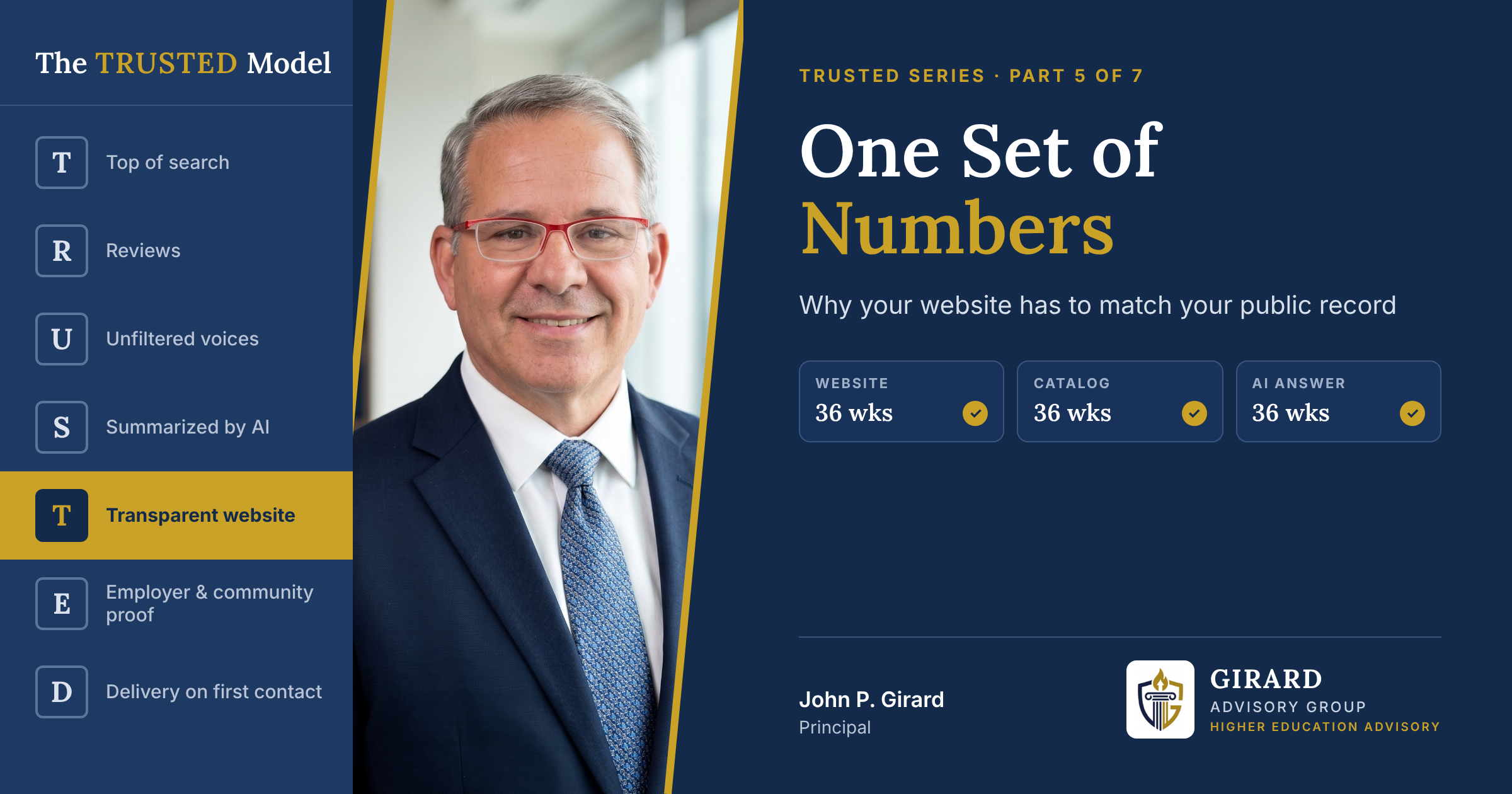
A prospect reads your Medical Assistant page. It says the program takes nine months. Your catalog says 36 weeks plus a 160-hour externship. College Scorecard shows a cost that matches neither your website nor your enrollment agreement. When the prospect asks an AI assistant, it says the length “varies” and suggests contacting the school.
None of those numbers is a lie. Each one is a little out of date, rounded differently, or written by a different department. But the prospect doesn’t see four departments. They see one school that can’t give a straight answer, and they wonder what else is fuzzy.
That is the fifth element of the TRUSTED model.
T — Transparent website: cost, outcomes, and real faces in plain sight, with the same numbers everywhere they appear.
The first four posts in this series covered the places prospects form a view of you before they reach your site: search results, reviews, unfiltered voices, and AI answers. This post covers the moment they arrive and check the story. Your website is the one surface you fully control. It is also the one prospects, AI tools, and regulators all treat as your official word.
Prospects come to your website to check one thing first: cost
The research on this is consistent, and it isn’t close.
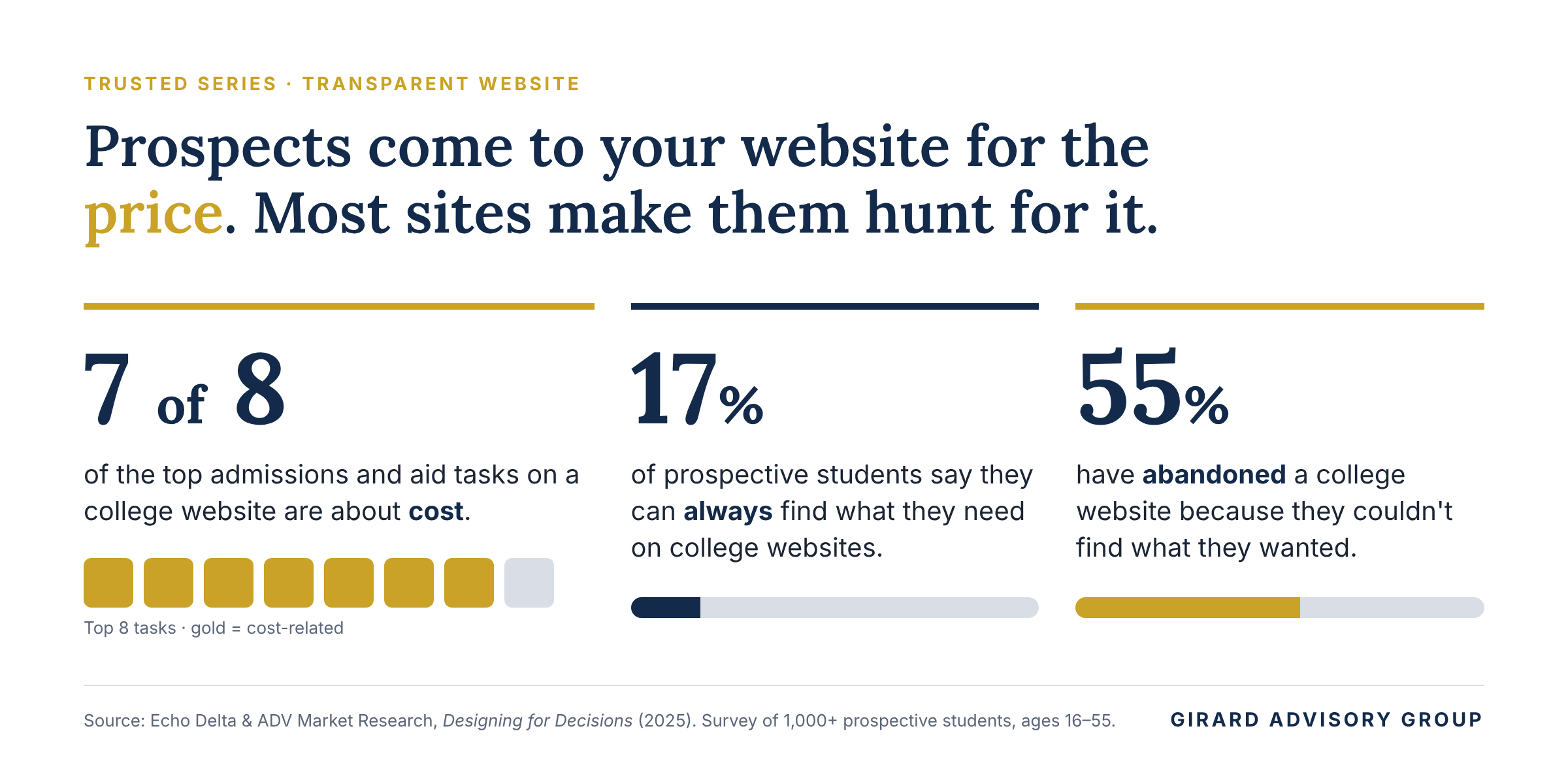
- Cost is the top task. A 2025 study by Echo Delta and ADV Market Research asked more than 1,000 prospective students, ages 16 to 55, what they came to a college website to do. Seven of the top eight admissions and aid tasks were about cost. Total cost of attendance ranked first in every segment, including adult and non-traditional students.
- Most sites make it hard. In the same study, only 17% of students said they can always find what they need, and 55% had abandoned a college website because they couldn’t.
- Hiding cost reads as hiding something. The researchers’ point was that students know you have a price. Making them hunt for it, or sending them to financial aid pages first, erodes trust.
- Proof matters too. The same study found students look for placement rates, satisfaction data, and graduate stories. College staff consistently underestimated how much.
Career college prospects are mostly adults deciding fast. They want three answers: what it costs, how long it takes, and whether graduates get jobs. If your site answers those clearly, you look confident. If it doesn’t, the prospect goes somewhere that does, or asks an AI that will answer for you.
The cross-check you don’t see
Prospects no longer take your website at its word. They compare it with your catalog, College Scorecard, College Navigator, your accreditor’s directory, review sites, and Reddit. AI assistants do the same thing in seconds, as Part 4 showed.
When the sources agree, the AI states your numbers plainly. When they disagree, it hedges, averages them, or picks the one you’d least want. A mismatch you’d never notice internally becomes the answer a prospect hears.
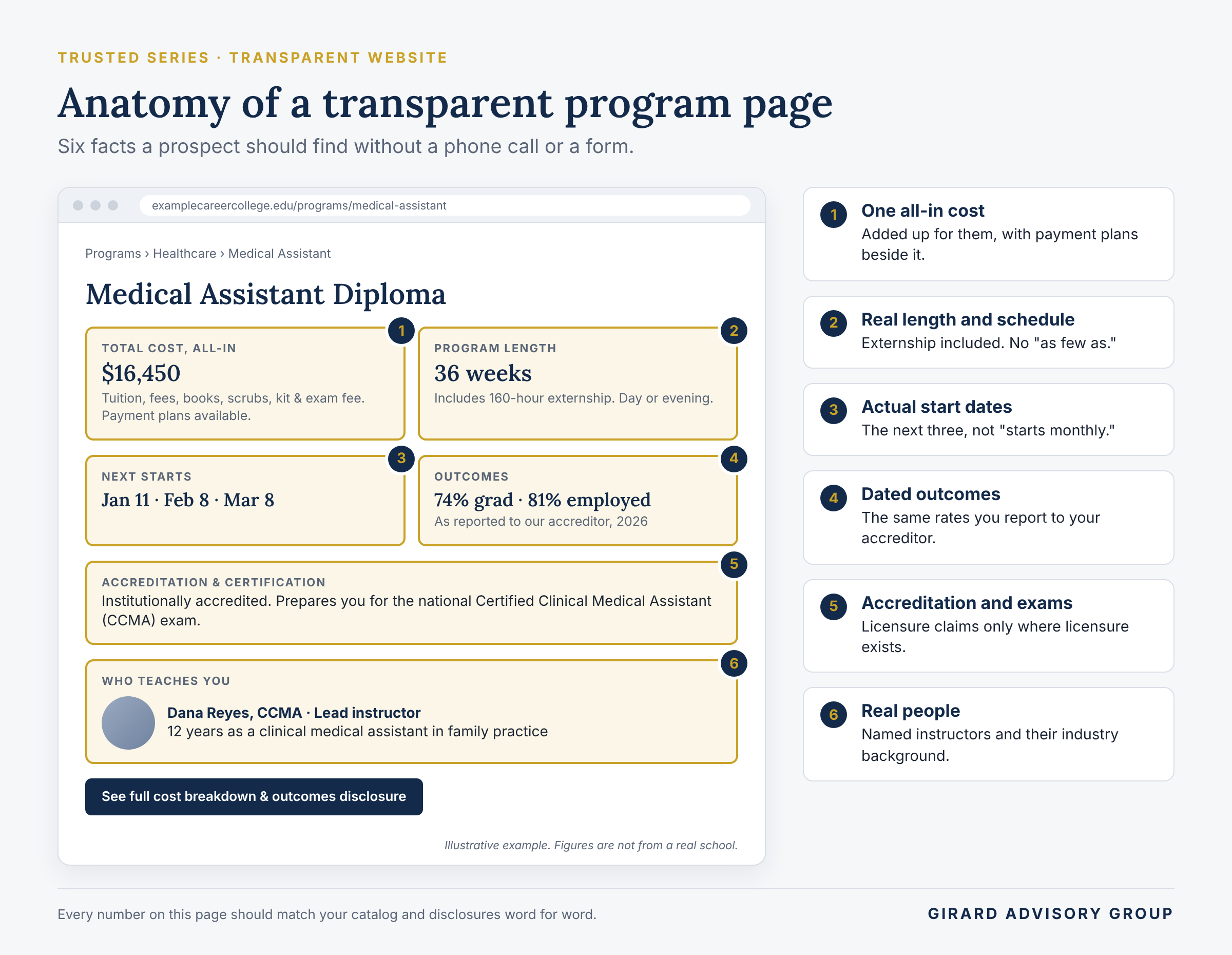
What a transparent program page shows
Every program page should answer the prospect’s questions without a phone call. Put these six facts on the page itself, not behind a “request info” form or three links deep in a disclosures menu.
| Fact | What good looks like | The common miss |
|---|---|---|
| Total cost | One all-in number: tuition, fees, books, kits, and exam costs, added up. Payment plan options beside it. | Tuition only, or cost per credit hour, leaving the prospect to do the math |
| Program length | Weeks or months, including externship or clinical hours, and day or evening schedule | “As few as nine months,” which only a full-time student with no breaks achieves |
| Start dates | The next three start dates | “Starts monthly” with no dates |
| Outcomes | Graduation and employment rates by program, as last reported to your accreditor, with the reporting period | One network-wide placement number, or salary figures from national data presented as your graduates’ pay |
| Accreditation and licensure | Accreditor named, and whether the program prepares students for a licensing or certification exam | Implying a credential leads to a license in a field that doesn’t require one |
| Real people | Actual instructors with their industry background, and current students in your labs | Stock photos and a generic “our faculty are experts” line |
Write it so AI can quote it
AI assistants pull from pages they can read cleanly. A few habits help:
- State facts as plain sentences. “The Medical Assistant program takes 36 weeks, including a 160-hour externship” is easy for an AI to quote. A cost figure inside an image or a PDF is not.
- Use the same wording everywhere. If the catalog says 36 weeks, the website says 36 weeks, not nine months.
- Date your outcomes. “As reported to ACCSC in our 2026 annual report” tells both the prospect and the AI the number is current and official.
- Add a short FAQ on each program page. Answer the questions prospects actually ask: total cost, length, schedule, outcomes, and what happens if they need to pause.
Treat disclosures as proof, not fine print
Most career colleges already publish what prospects want. It just sits on a consumer information page written for compliance, not for people. Your accreditor already requires you to disclose graduation and employment rates. ACCSC, for example, requires every school to disclose those rates for each program as last reported to the Commission.
If your outcomes are strong, that page is your best marketing asset. Link to it from every program page and write a plain-language summary at the top. If your outcomes are weak in a program, the website isn’t the place to fix that. The program is.
No surprises: the three things students wish they’d known
Most complaints and negative reviews I’ve seen in career education don’t come from the headline numbers. They come from what the student learned after enrolling. Three topics cause most of them, and each belongs on your website in plain language.
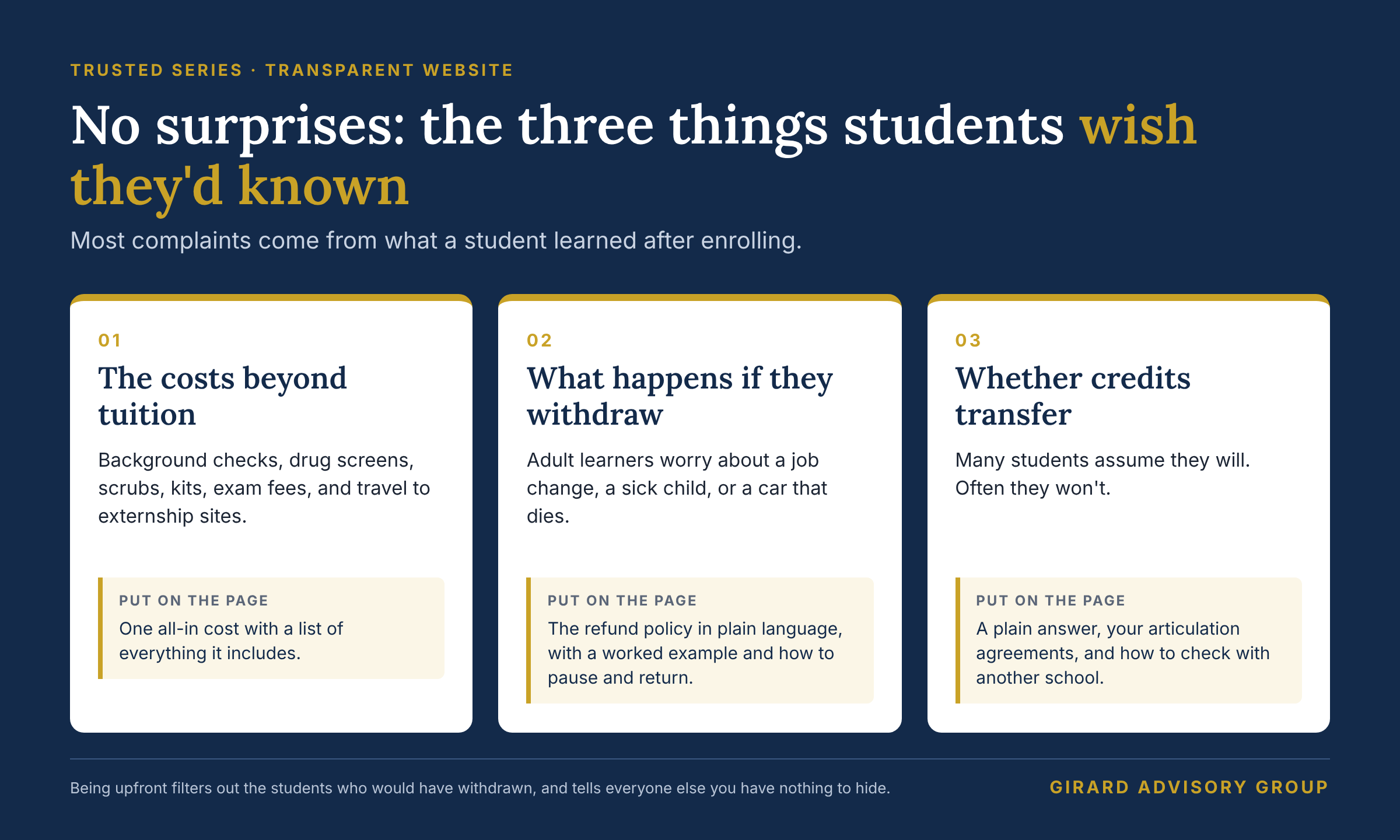
1. The costs beyond tuition. Background checks, drug screens, scrubs, tool kits, certification exam fees, and travel to externship sites can add hundreds of dollars. A student who learns about them in week four feels misled, even if they were in the enrollment agreement. Add them to the all-in cost on each program page, with a short list of what’s included.
2. What happens if a student withdraws. Adult learners worry about life getting in the way: a job change, a sick child, a car that dies. Put your cancellation and refund policy in plain language with a worked example, such as “If you withdraw after week 6 of a 36-week program, here is what you would owe.” Say whether they can pause and return, and how.
3. Whether credits transfer. Many career college credits don’t transfer to a community college or university, and students often assume they will. Say so plainly, name any articulation agreements you do have, and tell students how to check with the school they have in mind. Implying credits will transfer is a misrepresentation risk. Saying “it’s up to the receiving school” with no context reads as evasive.
None of this will scare off the right student. It filters out the ones who would have withdrawn or left a one-star review, and it tells everyone else you have nothing to hide.
One set of numbers: the consistency check
Mismatches rarely come from bad intent. They come from ownership. Compliance owns the catalog and the annual report. Financial aid owns the cost of attendance. Marketing owns the website and the ads. A vendor owns the landing pages. Admissions owns the talk track. Each updates on its own schedule, and nobody compares the results.
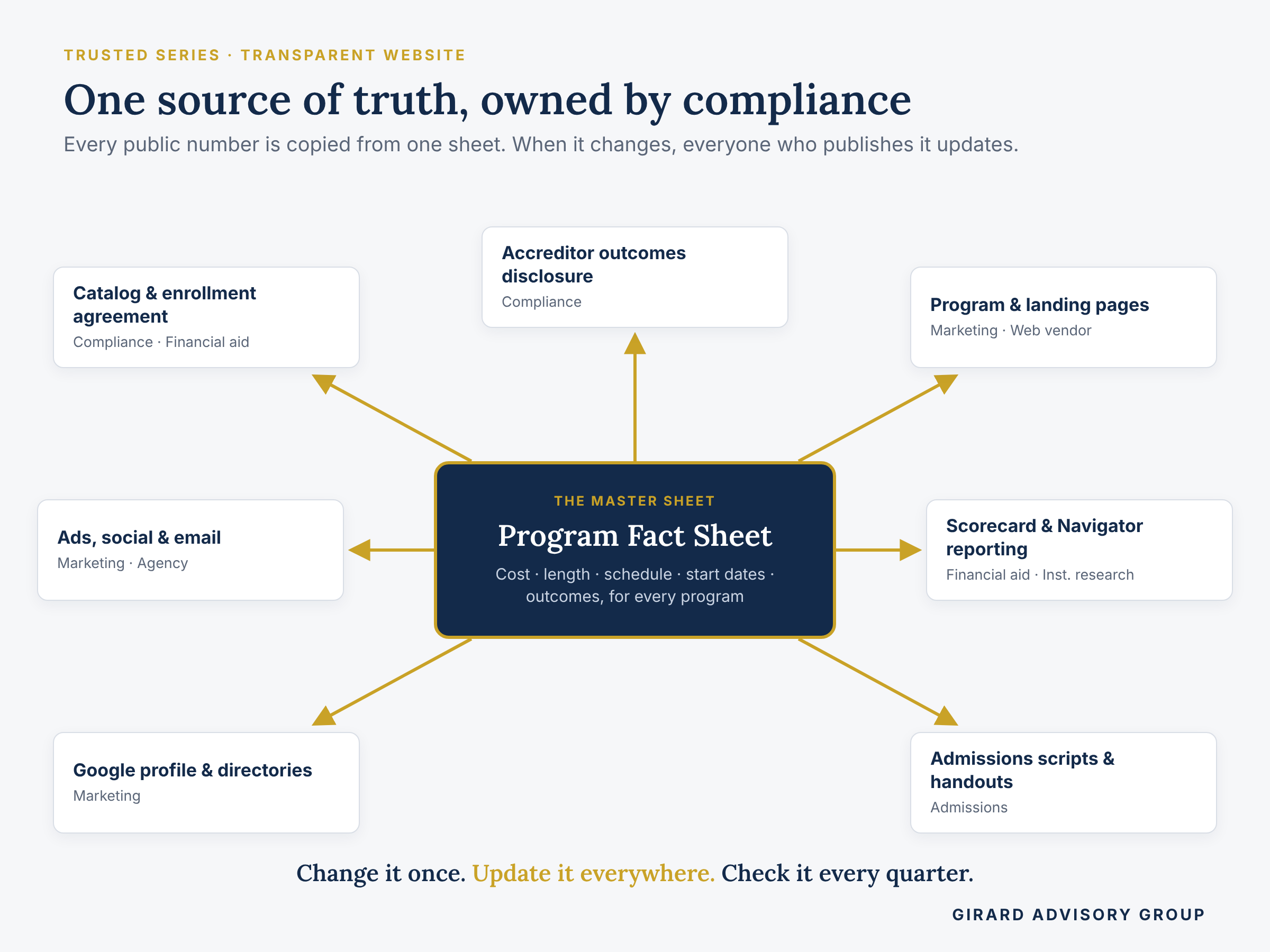
The fix is a single source of truth: one sheet, owned by compliance, holding the official cost, length, schedule, start dates, and outcomes for every program. Every public number is copied from that sheet. When it changes, everyone who publishes that number gets a list of where to update it.
Where your numbers live, and who should check them
| Where the number appears | Who usually owns it | What to check |
|---|---|---|
| Catalog and enrollment agreement | Compliance, financial aid | This is the master. Everything else should match it. |
| Accreditor annual report and outcomes disclosure | Compliance | Rates and reporting period match the program pages |
| Program pages and landing pages | Marketing, web vendor | Cost, length, start dates, and outcomes match the catalog |
| Paid ads, social posts, and email | Marketing, agency | No “as few as” claims or outdated tuition |
| College Scorecard and College Navigator | Financial aid, institutional research | Federal figures match what you report. Explain any differences on your site. |
| Google Business Profile and directory listings | Marketing | Program list, hours, and photos are current |
| Admissions scripts and handouts | Admissions | Reps quote the same numbers as the website |
Run this check every quarter, alongside the AI audit from Part 4. Also run it every time tuition changes, a program is added or dropped, or new outcomes are reported.
Retire the old pages
AI tools and search engines don’t know a page is outdated. An old tuition page, a discontinued program, or a staff bio for someone who left two years ago can still show up in answers. Find them with a site search, then redirect each one to its current replacement or remove it.
Transparency is already a compliance standard
Campus leaders sometimes treat this as a marketing preference. It isn’t. Under federal rules, a school can be penalized for a false, erroneous, or misleading statement about its programs, its charges, or its graduates’ employment. That includes statements that mislead by leaving something out.
The Department of Education’s enforcement bulletin lists examples it has seen, and several are website problems:
- Salary figures from national labor data presented as if they were the school’s own graduates’ earnings
- Cost of attendance or net price figures that are inaccurate or apply only to a minority of students
- Implying a credential leads to licensure in a field that doesn’t require it
- Placement comparisons with other schools that can’t be backed up
Public data is also about to grow. The Department plans to publish program-level data from the FVT/GE and new STATS reporting in 2027, and STATS replaces the current FVT/GE rules on July 1, 2027. More of your numbers will be public, and AI tools will read them. Schools whose websites already match their public record will have nothing to explain.
The good news: if you keep files that hold up in an accreditation visit, you already have the discipline this takes. Transparency is the same work, pointed outward.
From the field: you can’t publish a number you can’t prove
I took over a campus just after a compliance visit had placed it on accreditor reporting for graduate and placement outcomes. Enrollment was poor, outcomes were poor, and there was little accountability for either.
The outcomes problem was partly performance and partly records. Some graduates were working in the field, but the files couldn’t prove it. A placement you can’t verify doesn’t count, for the accreditor or for a prospect.
So we fixed the records before we tried to tell anyone anything. Career services ran a weekly scorecard: graduate interviews, employer visits, graduates on interviews, and the pipeline behind them. Every placement had to be verified and documented before it went into our numbers. We started a daily standup to staff our at-risk student list, because graduation rates start with attendance.
The campus came off reporting within one quarter. Retention rose from 57% to 72% that first year, every program exceeded its employment benchmarks, and the next re-accreditation visit closed with zero findings.
The lesson for this post is what that did to our marketing. Before, any outcome claim was a risk. After, the numbers on our website, in our ads, and in admissions conversations were the same numbers in our files and our accreditor reports. Admissions could quote them confidently because they were true and current. We stopped writing around our outcomes and started leading with them.
That is what transparency looks like from the inside. It isn’t a web project. It is operations, compliance, and marketing agreeing on one set of numbers, then putting them where prospects can see them.
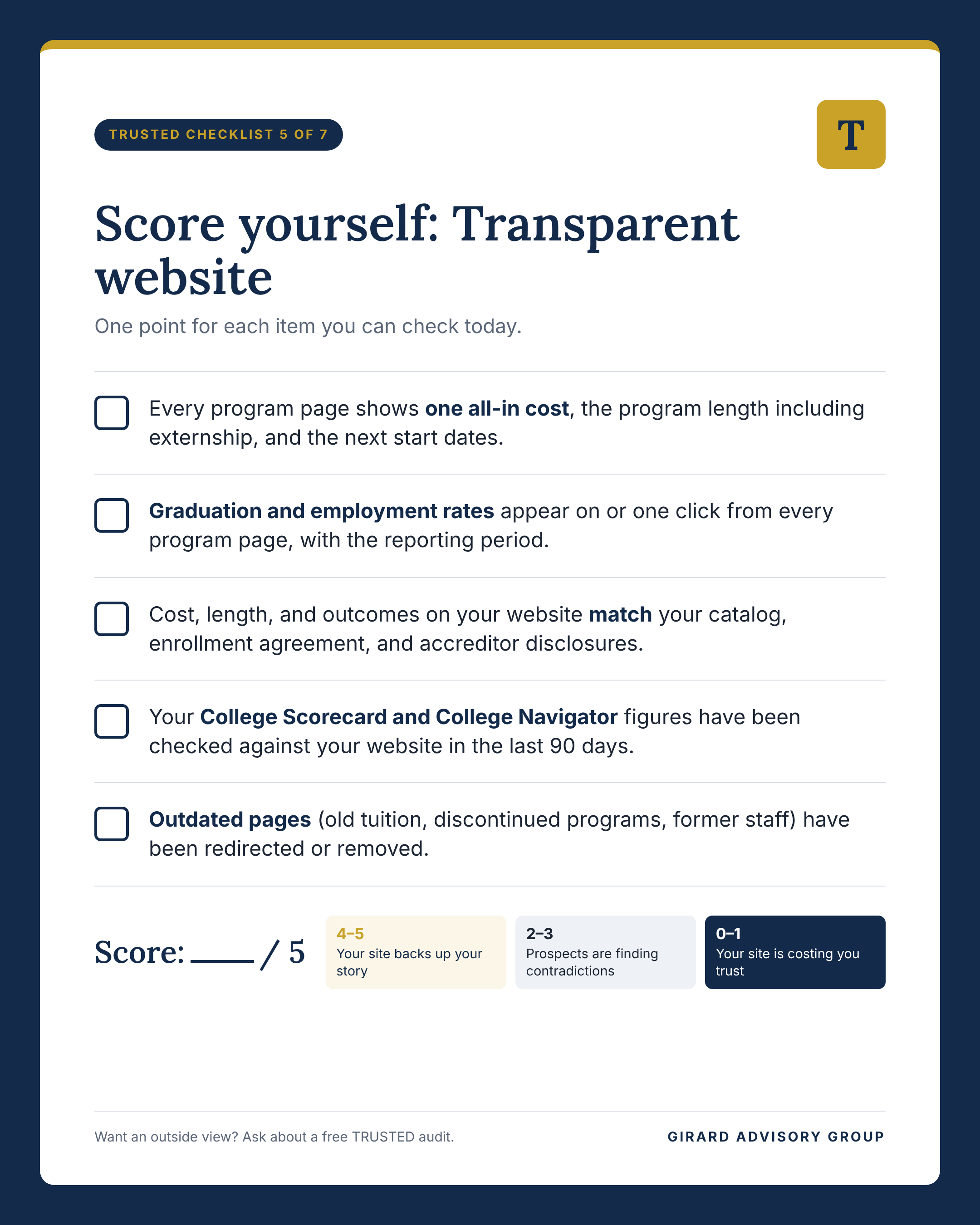
Score yourself: Transparent website
Give yourself one point for each item you can check today.
- Every program page shows one all-in cost, the program length including externship, and the next start dates.
- Graduation and employment rates appear on or one click from every program page, with the reporting period.
- Cost, length, and outcomes on your website match your catalog, enrollment agreement, and accreditor disclosures.
- Your College Scorecard and College Navigator figures have been checked against your website in the last 90 days.
- Outdated pages (old tuition, discontinued programs, former staff) have been redirected or removed.
Your score: ___ / 5. Four or five means your site backs up your story. Two or three means prospects and AI tools are finding contradictions. One or zero means your website is costing you trust you earned everywhere else.
The website is where the story gets checked
Everything before this point in the TRUSTED model shapes what a prospect expects. The website is where they check whether it’s true. If your cost, length, and outcomes are easy to find and match everywhere else, the prospect stops verifying and starts deciding. If not, every earlier surface loses some of its value.
Start with one program. Put its catalog, its program page, its Scorecard entry, and an AI answer about it side by side. Then fix what doesn’t match.
Next in the series: Part 6, Let Someone Else Say It, on employer and community proof: the people who vouch for you when you’re not in the room. You can follow all seven elements on the TRUSTED framework page.
Want an outside view? Girard Advisory Group offers a free TRUSTED audit. We compare your website against your public record, your reviews, and what AI tools say about you, then show you where the story breaks. Request your free TRUSTED audit. The complete seven-surface model is documented on the TRUSTED Pre-Inquiry Framework page.
Frequently asked questions
- Should we really put total cost on every program page?
- Yes. Cost is the first thing prospects look for, and a clear all-in number signals confidence. Show payment plan options and aid information right beside it, so the number arrives with context.
- What if our outcomes in one program are weak?
- You are already required to disclose them. Burying them doesn’t hide them from AI tools or federal data. Publish them accurately, then fix the program. Strong outcomes in your other programs will read as more credible next to an honest weak one.
- Can we use Bureau of Labor Statistics salary data?
- Yes, if you label it clearly as national or regional occupational data. Presenting it as your own graduates’ earnings is one of the examples the Department of Education flags as a misrepresentation risk.
- Our College Scorecard numbers look different from ours. What do we do?
- Federal figures often use different groups of students or time periods. Check that what you report is correct, then add a short note on your outcomes page explaining the difference. An explained difference builds trust. An unexplained one raises doubt.
- Who should own the single source of truth?
- Compliance, because it already owns the catalog and accreditor reporting. Marketing publishes from it; it doesn’t edit it.
- How often should we run the consistency check?
- Quarterly, alongside the AI audit, and whenever tuition, programs, or outcomes change.
Sources
- Echo Delta and ADV Market Research, Designing for Decisions (2025), as summarized on Enrollify and EdTech Connect, Ep. 49. Full report: echodelta.co/designing-for-decisions
- Federal Student Aid, FSA Enforcement Bulletin: Conduct that creates a risk of engaging in substantial misrepresentations (Sept. 2024)
- Federal Student Aid, Guidance on FVT/GE Data Reporting, STATS Early Implementation, and Next Steps for Publication (updated Oct. 8, 2026)
- Federal Student Aid, Student Tuition and Transparency System Information
- ACCSC, disclosure of graduation and employment rates
Explore Topics
Written by
John P. Girard
John P. Girard is the founder of Girard Advisory Group and a thirty-year veteran of career and proprietary higher education, with hands-on leadership across enrollment growth, campus operations, accreditation and compliance, curriculum development, brand and marketing, and P&L management. Over three decades he has held roles spanning Campus Director, Campus President, Regional Campus Director, and National Director of Marketing & Digital Media Brand Management, leading multi-campus organizations through growth, accreditation, and operational turnarounds. That range — from the admissions floor to the boardroom — is what shapes his advisory approach: strategy that has to hold up in daily campus operations, not just on a slide. John holds a Master's degree in Teacher Education from the University at Albany, SUNY, and has served on the Board of the Ohio-Michigan Association of Career Colleges and Schools.