Let Someone Else Say It: Building the Third-Party Proof AI Trusts Most

John P. Girard
Founder, Girard Advisory Group
Your ads barely register when AI decides what to say about you. Part 6 of the TRUSTED series: how to turn employer relationships, advisory boards, and community partnerships into the independent proof that prospects and AI tools actually trust.
Every career college says its graduates are job-ready. Every one says its instructors come from industry and its employer partners value its graduates. Prospects have heard it all before, and so have the AI tools they ask.
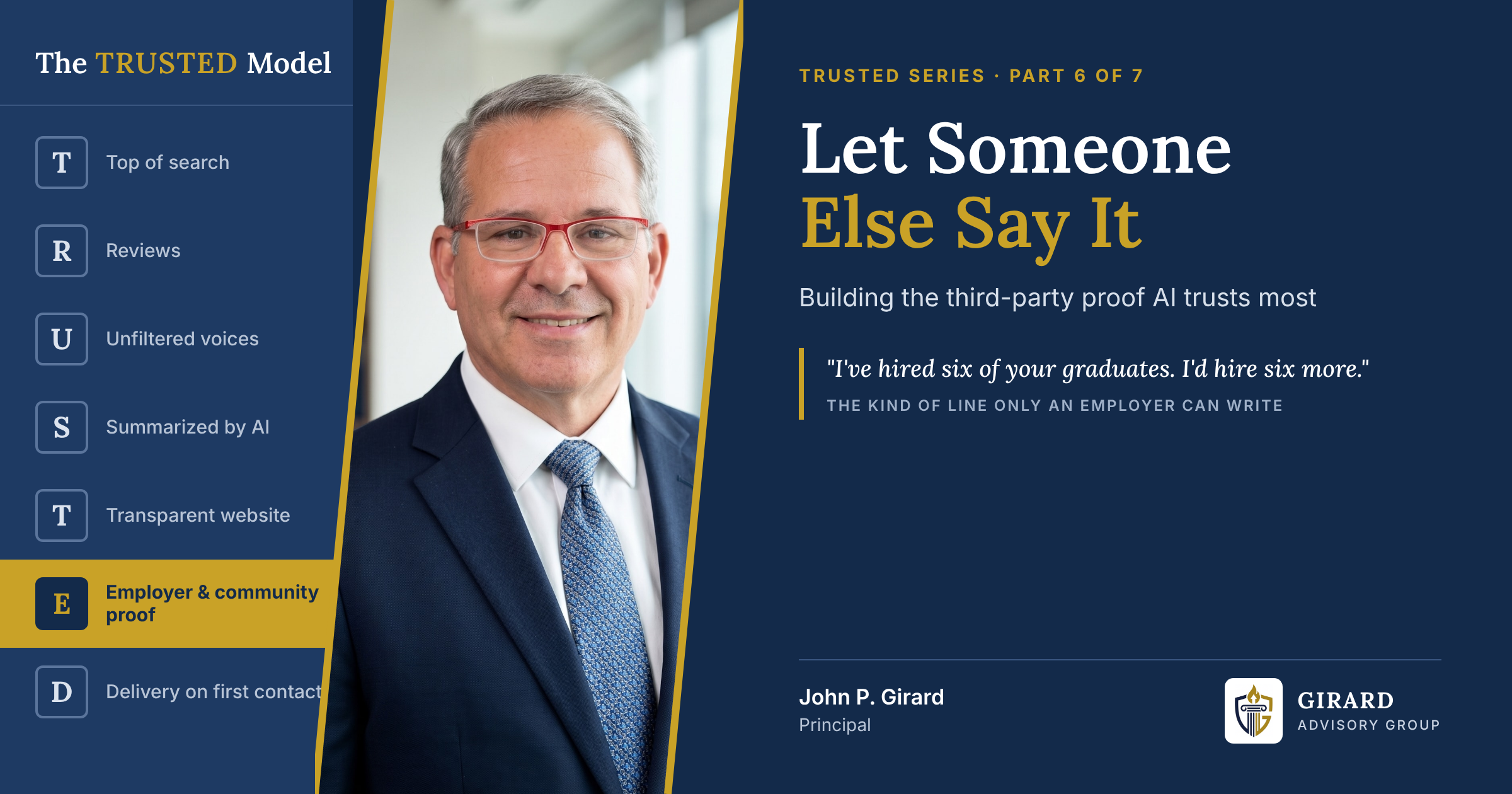
What they haven’t heard is the clinic manager who says, on her own LinkedIn, that she has hired six of your graduates and would hire six more. Or the local paper covering your students’ community project. Or the employer listed by name, with a quote, on your program page.
That is the sixth element of the TRUSTED model.
E — Employer and community proof: independent voices who vouch for you when you’re not in the room.
Parts 1 through 5 covered what you can shape directly: your search results, your reviews, your own voices, what AI says, and your website. This element is different. You can’t write it yourself. You can only earn it, make it easy for others to give, and make sure people can find it.
AI trusts what others say about you, not what you say
Part 4 showed that prospects now ask AI assistants about your school, and that AI often outranks admissions reps as a trusted source. The question for this post is where AI gets its answer. The research is blunt.
- 84% of AI citations come from earned media. Muck Rack’s Generative Pulse study analyzed more than 25 million links cited by ChatGPT, Claude, and Gemini. In its May 2026 edition, 84% came from earned sources: journalism, research, government sites, encyclopedias, and third-party content. Paid and advertorial content made up 0.3%.
- Journalism alone is about a quarter. News coverage accounted for 27% of cited links, spread across more than 20,000 outlets. That includes local and trade press, not just national papers.
- Recent coverage counts most. More than half of the journalism AI cites was published in the past 12 months, and citations drop sharply after six months.
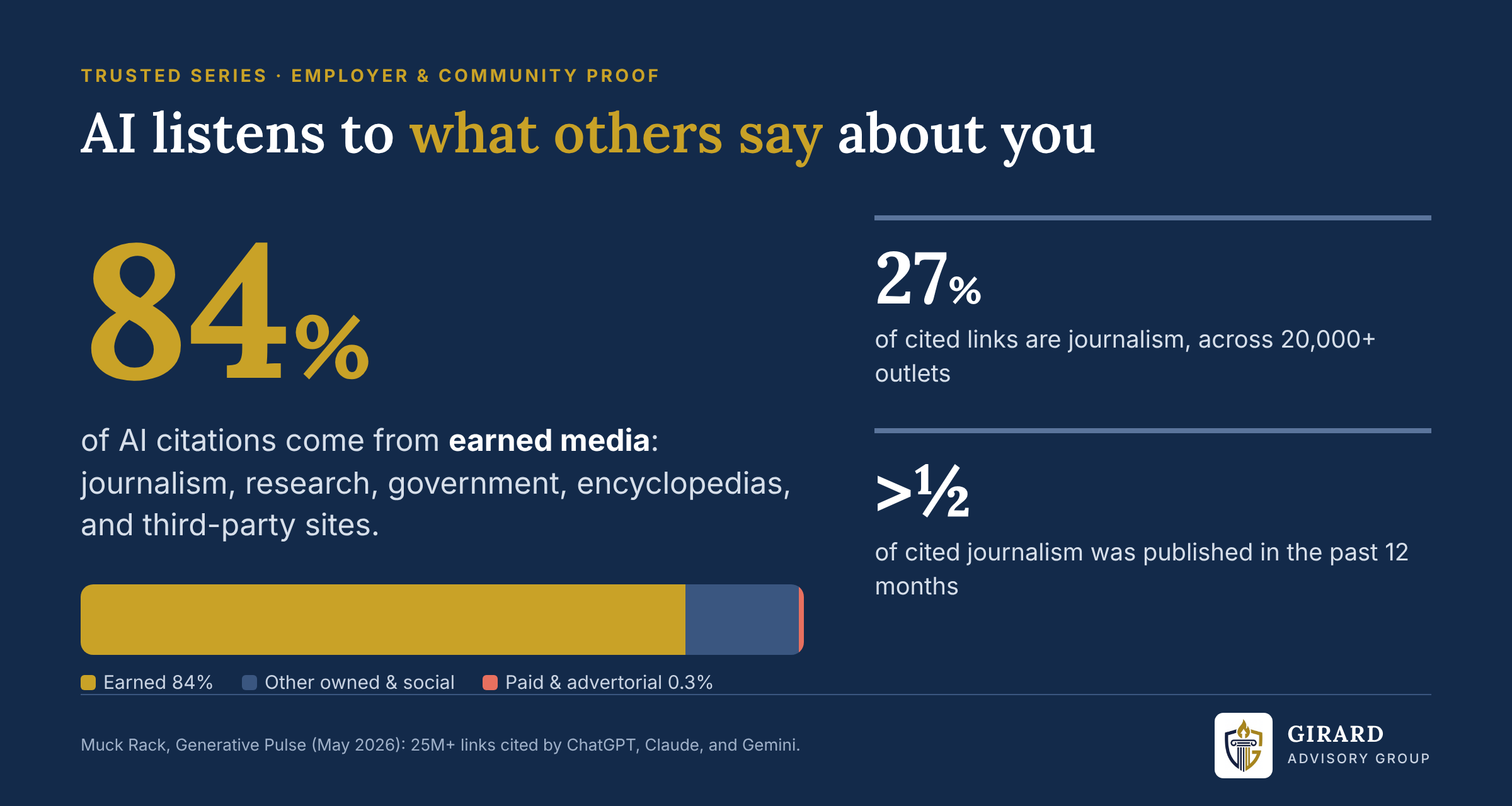
In plain terms, your ads and your own website barely register when AI decides what to say about you. What registers is what other people have written: employers, partners, reporters, community organizations, and the public records covered in Part 5.
Prospects work the same way. They discount what a school says about itself and look for someone with nothing to gain. An employer who hires your graduates, a hospital that hosts your externs, or a nonprofit you partner with is exactly that voice.
The six voices that count
Most career colleges already have these relationships. The gap is that the proof lives in email threads, advisory board minutes, and staff memory, where no prospect or AI tool will ever see it.
| Voice | What it proves | What public proof looks like |
|---|---|---|
| Employers who hire your graduates | Graduates get jobs and do them well | A named quote on the program page, a LinkedIn post welcoming a new hire, a Google review from the employer |
| Program advisory committee members | Industry shapes your curriculum | Members listed by name and company, with a short quote on what they’ve changed |
| Externship and clinical sites | Students train in real workplaces | A partner list on each program page, and a site supervisor’s quote or post |
| Graduates working in the field | The path from enrollment to career is real | Short graduate spotlights with employer and job title, shared by the graduate |
| Community partners | You’re part of the community, not just located in it | Joint events, sponsorships, and service projects the partner posts about |
| Local and trade press | Someone independent found you worth covering | News stories on graduations, partnerships, and student projects |
Your advisory committee is proof you already have
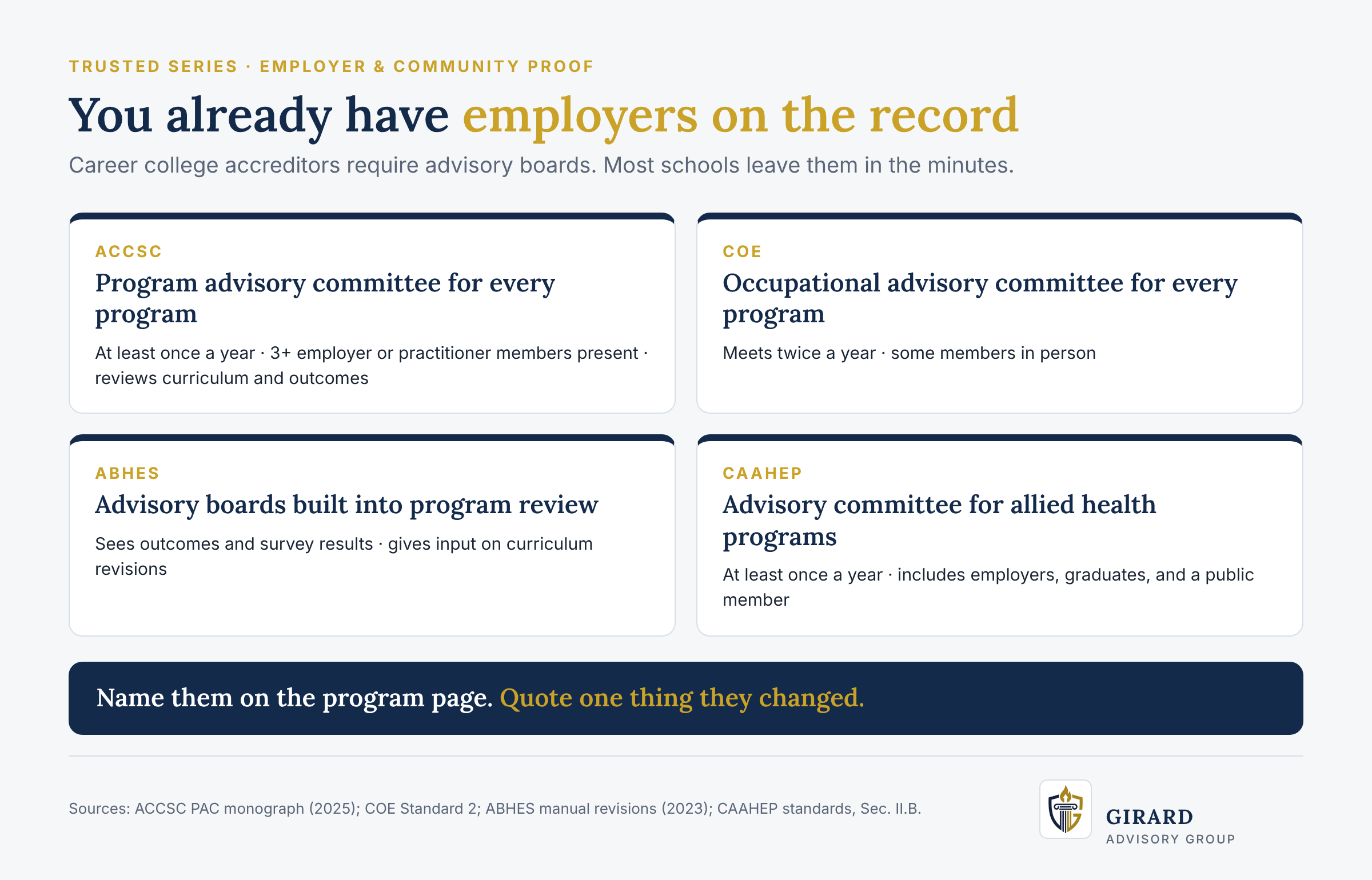
If you’re a career college, your accreditor almost certainly already makes you gather employers on the record:
| Accreditor | What it requires |
|---|---|
| ACCSC | A program advisory committee for each program, meeting at least once a year with at least three employer or practitioner members present. It reviews curriculum and graduation and employment outcomes, and minutes name each member’s title and employer. |
| COE (Council on Occupational Education) | Occupational advisory committees that meet twice a year for each program, with some members attending in person. |
| ABHES | Advisory boards built into program review: outcomes and survey results are shared with them, and they give input on annual curriculum revisions. |
| CAAHEP (programmatic, for allied health) | An advisory committee representing each community of interest, including employers, graduates, and a public member, meeting at least once a year. |
Whichever applies to you, the result is the same: independent employers reviewing your programs, already documented in minutes. ACCSC’s own guidance suggests listing members in your catalog and thanking them publicly. Most schools stop at the catalog. Ask your members whether you can name them on the program page and quote one thing they told you to change.
Turning relationships into public proof
Third-party proof doesn’t happen by accident. It takes a short, repeatable system with a named owner. Career services usually holds the employer relationships and marketing knows how to publish, so this works best as a joint job (the same bridge described in Career Services Is a Brand Function).
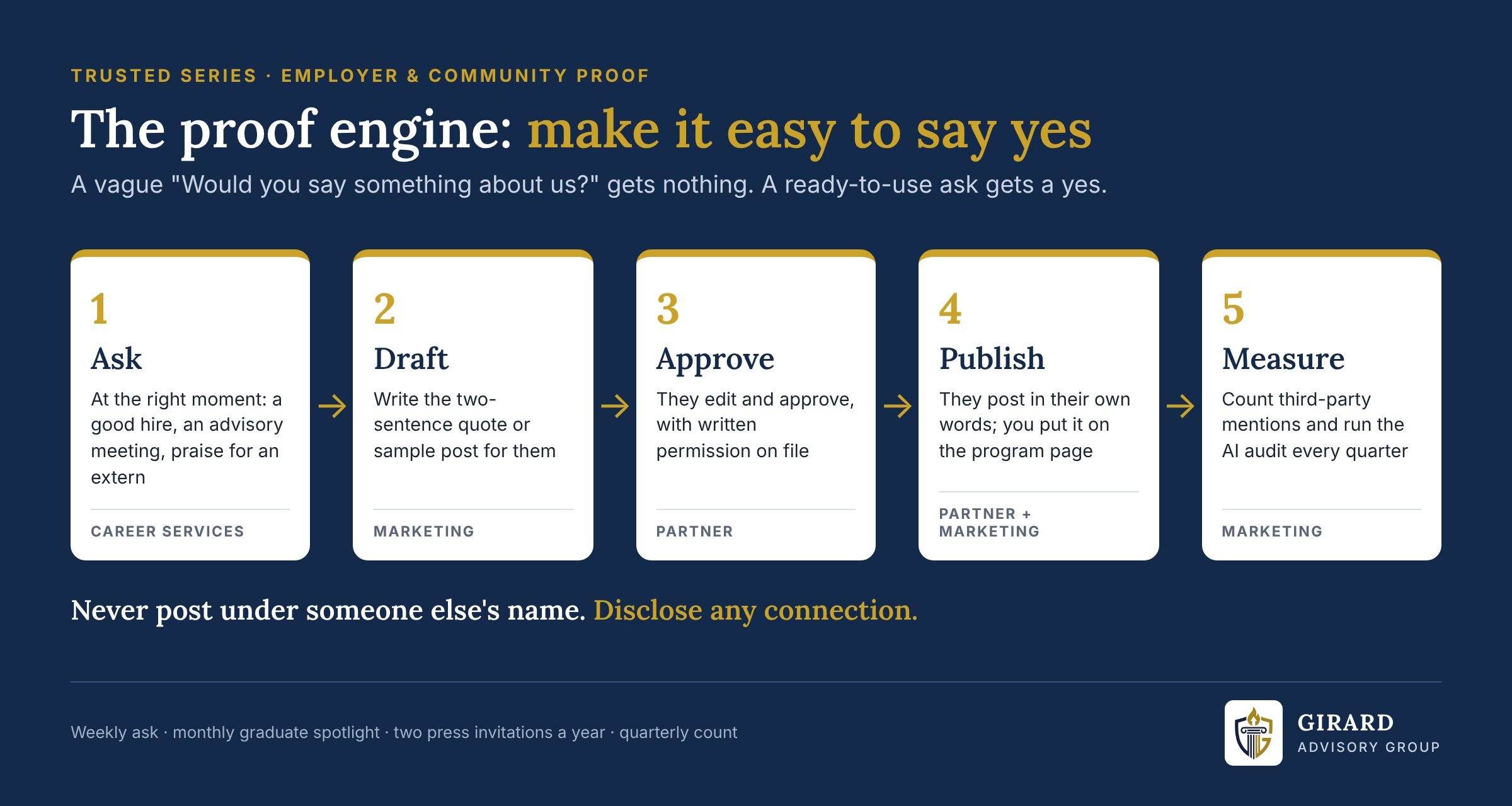
1. Make the ask easy
Employers are busy. A vague “Would you say something about us?” gets nothing. A specific, ready-to-use ask gets a yes.
- Ask at the right moment: right after a hire works out, after an advisory meeting, or when a site supervisor praises an extern.
- Offer three easy options: a two-sentence quote you can use on the program page, a Google review, or a LinkedIn post welcoming the new hire that tags your school.
- Do the work for them: draft the quote from what they told you, send it for approval, and send a sample post they can edit. Never post it under their name yourself.
2. Run a simple calendar
| Cadence | Activity | Owner |
|---|---|---|
| Every week | Ask for one employer or partner review or quote (part of the weekly review KPI from Part 2) | Career services |
| Every month | Publish one graduate spotlight with employer and job title | Marketing |
| After each advisory meeting | Post a recap naming members and one change they drove | Program director and marketing |
| Twice a year | Invite local press to a campus event: graduation, an employer hiring day, or a community project | Campus director |
| Every quarter | Count third-party mentions and run the AI audit from Part 4 | Marketing |
3. Make it findable
Proof locked in a PDF or a slide deck does nothing for prospects or AI. Put partner names and quotes on the program page as plain text, list advisory members with their companies, and link to press coverage from a “News” page. Recent coverage carries the most weight with AI, so a steady flow of small stories beats one big feature every few years.
4. Stay inside the guardrails
Third-party proof is persuasive because it’s independent. Keep it that way.
- Get written permission for every name, quote, logo, and photo. Students and graduates need written consent before you share anything from their education records, and FERPA rules apply.
- Disclose any connection. If a partner gets anything in return, such as a sponsorship, a fee, or a seat on your board, say so. FTC endorsement rules require it.
- Never write reviews or posts for others. Draft a quote for approval, but the person must publish it themselves, in their own words.
- Keep it representative. One employer’s praise can’t imply that all graduates get hired. Pair quotes with the outcomes rates from Part 5 so the story matches the numbers.
From the field: the partners who told our story for us
At a campus I led in the Cleveland area, our accredited Veterinary Technology program worked hand in hand with the Cleveland Animal Protective League. Our students and staff worked directly with APL staff, and for several years our campus sponsored the APL’s annual Telethon. I worked with the APL’s leadership on it each year.
That partnership did something no ad could. When a respected animal welfare organization stands next to your program in public, prospects don’t have to take your word that the program is real. The partner’s own audience, the people who care most about animals, saw our students as part of the APL’s mission. We later added an Animal Welfare Management program to build on it.
We built the same kind of proof when we launched three new allied health programs: Surgical Technology, Diagnostic Medical Sonography, and Cardiovascular Sonography. Each one needed programmatic accreditation, which meant recruiting clinical sites and standing up an advisory board for every program. Those hospitals and imaging centers weren’t just requirements to check off. They were employers on the record, saying our curriculum met their standards and our students were welcome in their departments. Naming them gave prospects a reason to believe in programs that didn’t have graduates yet.
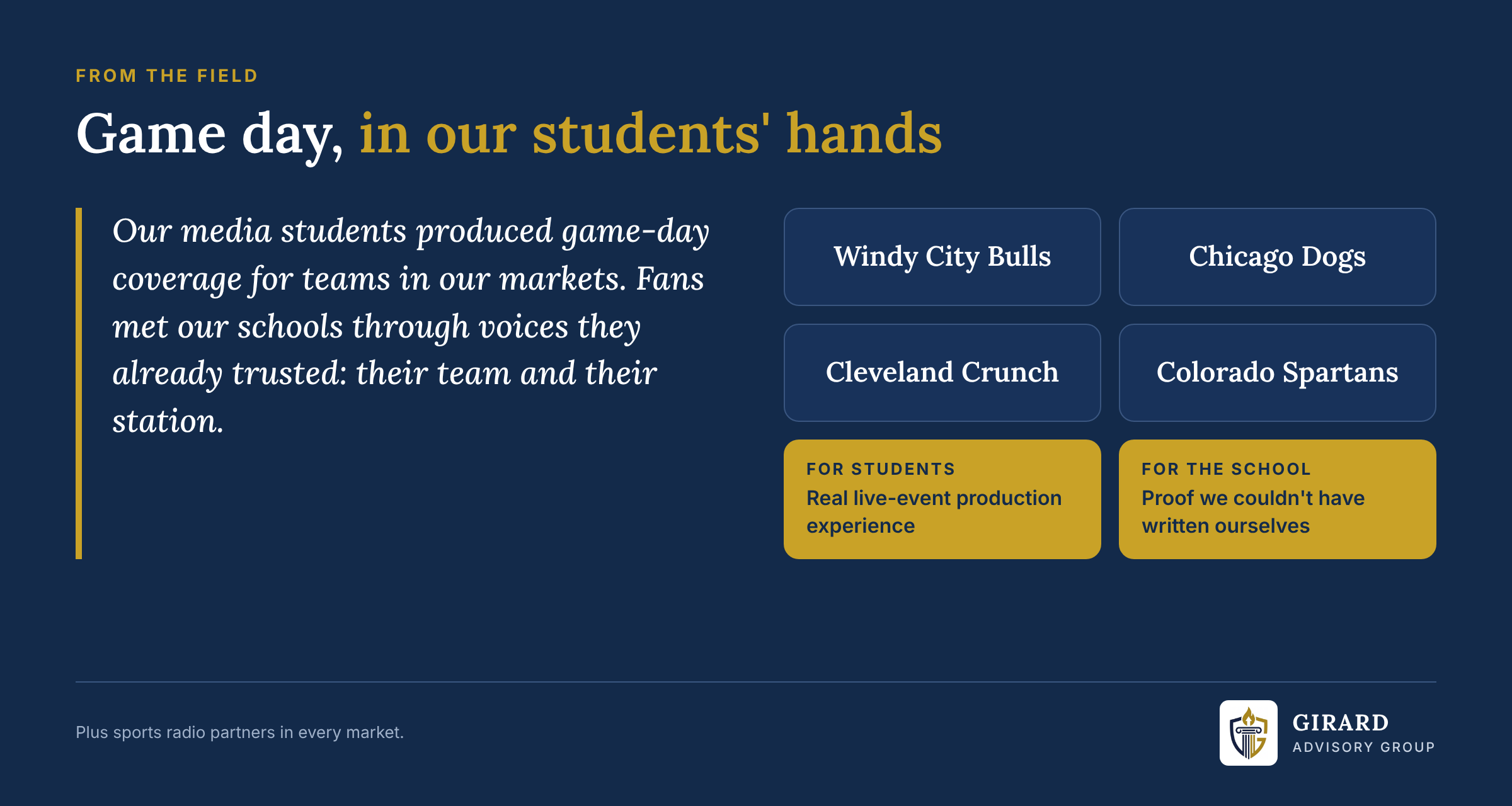
Years later, at a seven-campus network of media schools where I led marketing, we took the same approach into each market’s sports and community scene. Our students worked game-day media production for teams like the Windy City Bulls and the Chicago Dogs, the Cleveland Crunch, and the Colorado Spartans indoor football team, alongside the sports radio stations we already worked with in each city, plus many other community collaborations like Columbus Fashion Week. That did two things at once. Students got real production experience in a live environment, and our schools showed up in front of fans and attendees through voices they already trusted: their team, their station, or the event itself. When a team credits your students for its game-day broadcast, that is proof you couldn’t write yourself.
The lesson is the same in all three cases. The strongest proof came from people with their own reputations at stake. Our job was to build relationships worth talking about, then make it easy for partners to talk.
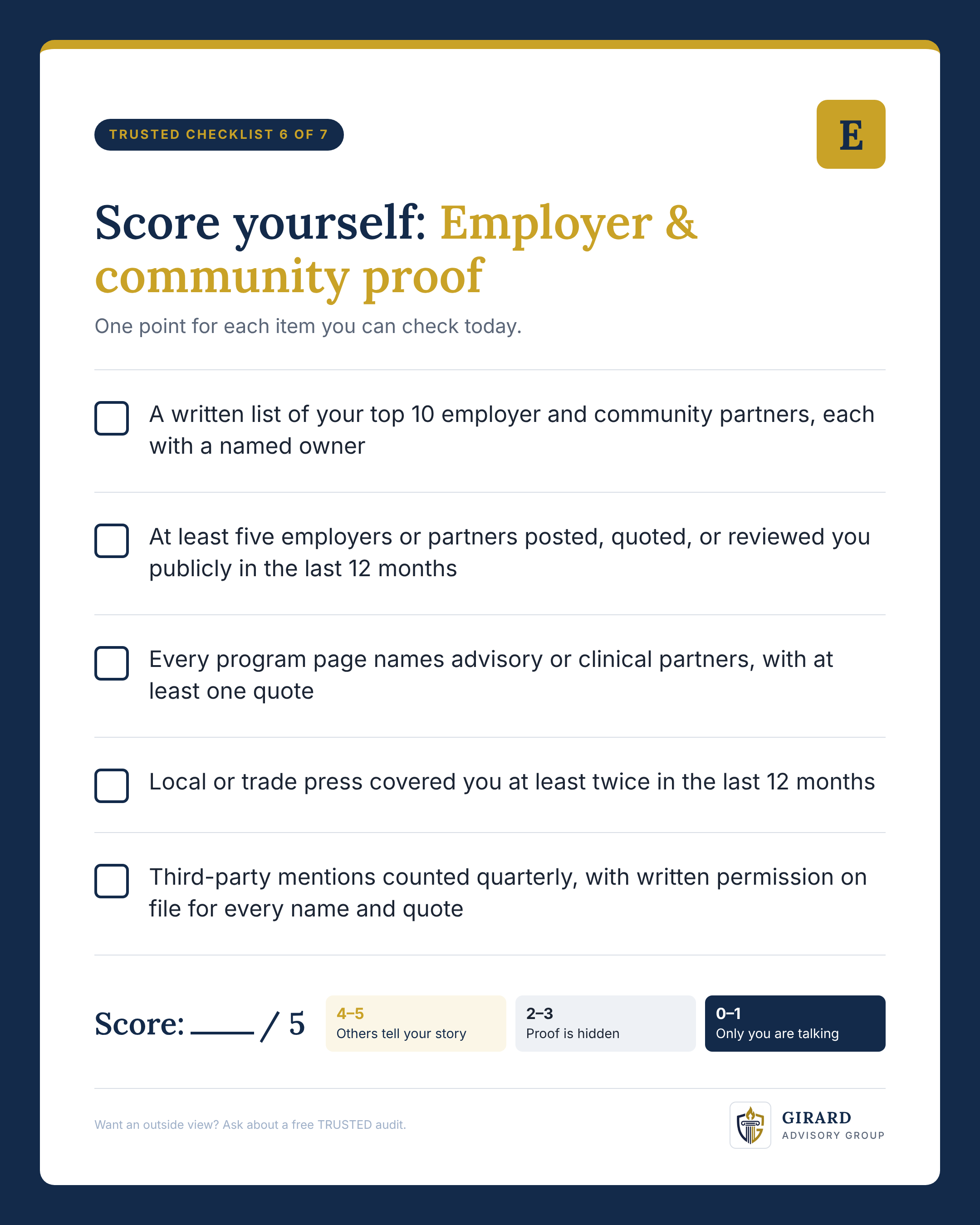
Score yourself: Employer and community proof
Give yourself one point for each item you can check today.
- You have a written list of your top 10 employer and community partners, with a named owner for each relationship.
- At least five employers or partners have posted, quoted, or reviewed your school publicly in the last 12 months.
- Every program page names its advisory committee members or clinical and externship partners, with at least one quote.
- Local or trade press has covered your school at least twice in the last 12 months.
- You count third-party mentions every quarter, and every name and quote you publish has written permission on file.
Your score: ___ / 5. Four or five means other people are telling your story. Two or three means the relationships exist but the proof is hidden. One or zero means prospects and AI tools are hearing only from you.
Earn it, then make it easy to give
You can’t buy this element of the TRUSTED model, and you can’t write it yourself. That is exactly why prospects and AI trust it. Most schools already have the relationships. What they lack is a habit of asking, a place to publish, and someone who owns both.
Start this week with one employer who has hired your graduates. Ask for two sentences you can put on the program page, and offer to draft them.
Next in the series: Part 7, Keep the Promise the AI Made, on delivery on first contact: what happens when a prospect finally reaches out. You can follow all seven elements on the TRUSTED framework page.
Want an outside view? Girard Advisory Group offers a free TRUSTED audit. We look at who is vouching for your school publicly, what AI tools draw on when they describe you, and where your partnerships could be working harder. Request your free TRUSTED audit. The complete seven-surface model is documented on the TRUSTED Pre-Inquiry Framework page.
Frequently asked questions
- Why does AI care what employers and press say about us?
- AI assistants lean heavily on independent sources. In Muck Rack’s analysis of more than 25 million AI citations, 84% came from earned media and just 0.3% from paid content. Your ads barely register. Other people’s words do.
- We already have employer partners. Isn’t that enough?
- Only if anyone can see them. A partnership that lives in an email thread or advisory minutes does nothing for a prospect. The work is turning existing relationships into public, findable proof.
- Can we write the quote for the employer?
- You can draft it from what they told you and send it for their approval. You can’t publish it as theirs without that approval, and you should never post reviews or social posts under someone else’s name.
- Do we need permission to name our advisory committee members?
- Yes. Ask each member in writing, and confirm how they want their name, title, and company shown. Most say yes, since it’s good visibility for them too.
- How do we get local press to cover a career college?
- Give them a story with people in it: an employer hiring day, a graduation with families, or students doing a community project. Invite a reporter early, offer a student and an employer to interview, and send photos the same day.
- What if a partner is a sponsor or gets something from us?
- Disclose it. Under FTC endorsement rules, any material connection between your school and the person vouching for it should be clear to readers.
Sources
- Muck Rack, Generative Pulse: What Is AI Reading?, May 2026 edition, as reported in AI Magazine
- ACCSC, Next Level Program Advisory Committees monograph (Oct. 2025)
- Council on Occupational Education, Alert on Standard 2 occupational advisory committees
- ABHES, Accreditation Manual revisions, call for comment (June 2023)
- CAAHEP, Standards and Guidelines for Medical Assisting Programs (2015), Section II.B
Explore Topics
Written by
John P. Girard
John P. Girard is the founder of Girard Advisory Group and a thirty-year veteran of career and proprietary higher education, with hands-on leadership across enrollment growth, campus operations, accreditation and compliance, curriculum development, brand and marketing, and P&L management. Over three decades he has held roles spanning Campus Director, Campus President, Regional Campus Director, and National Director of Marketing & Digital Media Brand Management, leading multi-campus organizations through growth, accreditation, and operational turnarounds. That range — from the admissions floor to the boardroom — is what shapes his advisory approach: strategy that has to hold up in daily campus operations, not just on a slide. John holds a Master's degree in Teacher Education from the University at Albany, SUNY, and has served on the Board of the Ohio-Michigan Association of Career Colleges and Schools.