The Middle States Standards Just Changed. Here’s What Your Evaluation Team Will Actually Be Looking For.

John P. Girard
Founder, Girard Advisory Group
MSCHE’s Fifteenth Edition took effect July 1, 2026 — seven standards became five, and fifteen Requirements of Affiliation became four. Here’s what changed, who it applies to, and where institutions will get tripped up.
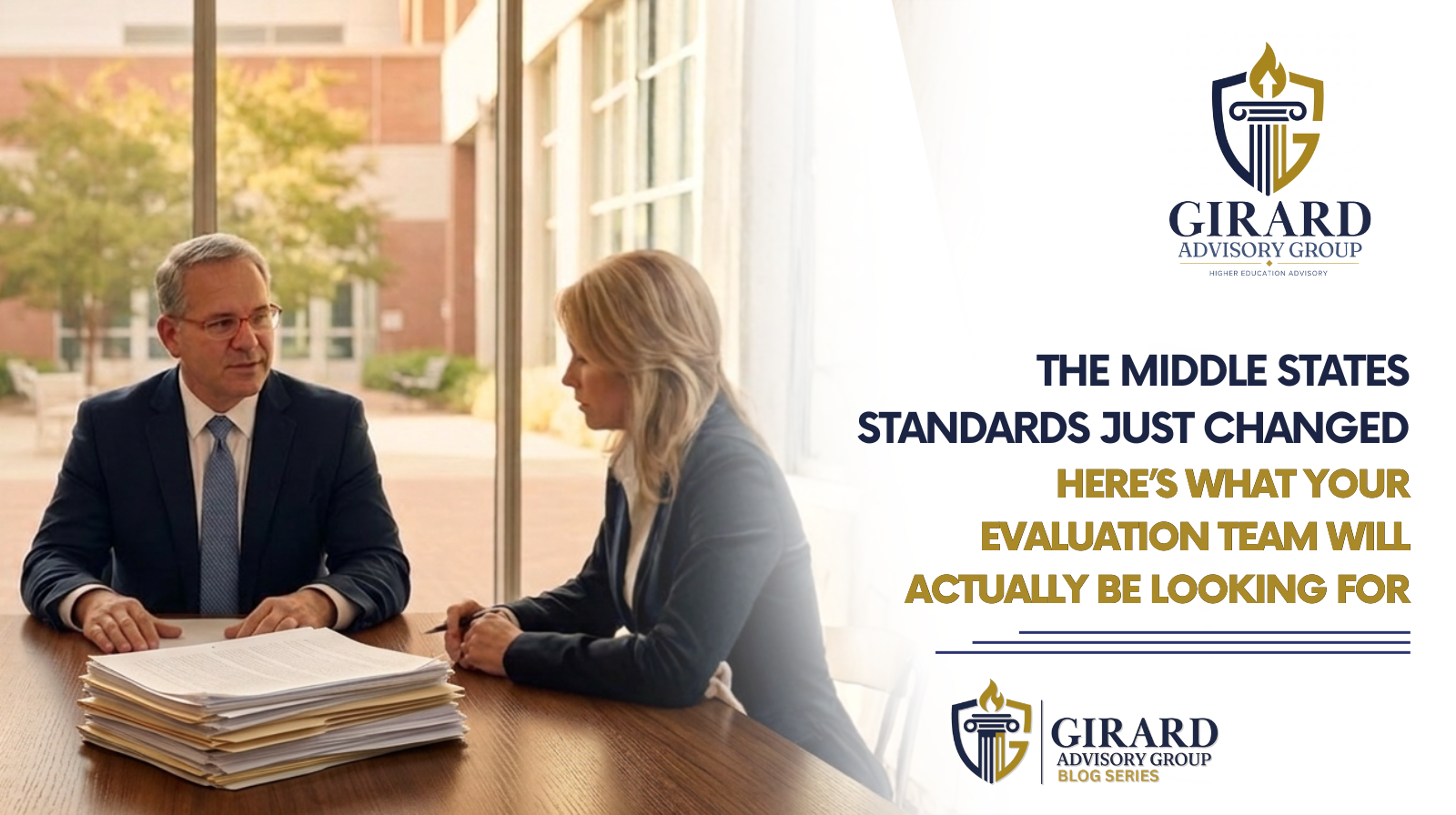
On July 1, 2026, the Middle States Commission on Higher Education put the Fifteenth Edition of its Standards for Accreditation and Requirements of Affiliation into effect. Seven standards became five. Fifteen Requirements of Affiliation became four. Federal compliance verification moved out of an appendix and into the body of each standard.
If you are entering Self-Study Institute this fall, you are in the first cohort working under the new framework — with an evaluation visit landing in 2029–2030. If you are already mid-self-study, you stay on the Fourteenth Edition. And if you have a follow-up action dated after July 1, you are reporting under the new standards whether you planned to or not.
I have spent thirty years in career and proprietary higher education — the most heavily scrutinized, most placement-accountable corner of this industry — and sat through more than a dozen re-accreditation cycles, including a run of visits that closed with zero findings. That is a different accreditor and a different world in some respects. But the thing that separates institutions that pass comfortably from institutions that scramble is identical everywhere, and it has nothing to do with which edition of which standards you are working under.
MSCHE accreditation self-study: the mirror principle
This is the piece I think gets misunderstood most often, particularly by leaders coming into a Middle States institution from elsewhere.
A peer evaluation team is not arriving to discover your institution. They have already read your account of it. They spent weeks with your self-study report and your evidence inventory before anyone booked a flight. The visit exists to answer one question: is the document true?
That reframes what preparation means. You are not preparing to be inspected. You are preparing to be verified. And the institutions that get verified easily are the ones whose self-study was descriptive rather than aspirational — the ones that wrote down what they actually do, because what they actually do already satisfies the standard.
The failure mode is subtle and extremely common. A committee writes the self-study over eighteen months. Somewhere in month nine, a section describes an assessment process that is more like an intention than a practice. Nobody lies. The language just drifts toward the version of the institution everyone wishes were true. Then a team of experienced peer evaluators arrives, pulls the thread, and spends three days finding the gap between the document and the campus.
You cannot close that gap in the month before a visit. You close it by writing honestly in month nine — or better, by not having a gap to write around.
The five MSCHE Fifteenth Edition standards in plain language
| Standard | The question it actually asks |
|---|---|
| 1. Mission and Governance | Do you know who you are, and is your board doing its job? |
| 2. Ethics and Integrity | Do you tell the truth and follow your own policies? |
| 3. Design, Delivery, and Assessment of the Student Learning Experience | Are your programs rigorous, well-taught, and actually measured? |
| 4. Support of the Student Experience | Do you recruit honestly, support students, and can you prove they succeed? |
| 5. Planning, Resources, and Institutional Improvement | Can you afford your mission, and are you planning for it? |
Two consolidations drive the reduction from seven. The old Standard V, Educational Effectiveness Assessment, folded into new Standard 3 — assessment now lives inside the standard about learning rather than sitting beside it. The old Standard VII, Governance, Leadership, and Administration, folded into new Standard 1, joining governance to mission.
Both moves make the same point: MSCHE is telling you assessment is not a separate activity and governance is not a separate activity. They are properties of the thing itself.
Where institutions will get tripped up by the MSCHE Fifteenth Edition
Evidence inventories mapped to the wrong edition
If your institutional research shop has spent three years organizing evidence by the old standard numbers, that structure does not port cleanly. Standard III evidence now splits across new 3.x sub-criteria, and old Standard V evidence has to be rehomed inside Standard 3 as well. This is tedious, unglamorous crosswalk work, and it is the kind of thing that gets deferred until it becomes urgent.
Do the crosswalk early. It is a two-week project in year one and a crisis in year three.
Artificial intelligence
This is genuinely new, and most institutions are exposed. Standard 3.4 asks for three things a lot of institutions cannot currently produce: a real institutional policy governing AI use in coursework and in instruction, AI literacy built into faculty development, and integrity mechanisms that actually account for generative tools.
What most institutions have instead is a patchwork — a syllabus statement here, a provost’s memo there, an academic integrity policy written in 2019 that predates the problem entirely. A patchwork is not a policy, and an evaluation team working through 3.4 will notice the difference between an institution that made a decision and an institution that accumulated one.
Third-party providers and OPMs
The new standards are considerably more demanding here than the old ones, and the expectations cut across Standards 3, 4, and 5 — instruction, student support services, and outsourced business functions each get their own treatment. The documentation burden is real, but the thing to focus on is the shift underneath it: MSCHE is asking for evidence of continuing oversight, not evidence that a contract was once signed.
One item inside that deserves separate attention. If a written arrangement crossed a substantive change threshold and never went to the Commission for approval, that is not a documentation gap you can close by producing the contract. It is a compliance problem you will be asked to explain, and it is worth finding on your own schedule rather than theirs. Standards 3.3 and 5.4 carry the full expectations — read them against your actual provider list, not your remembered one.
Financial health
Standard 5.2 wants four years of audits with management letters, primary reserve ratio, net operating revenue ratio, return on net assets, viability ratio, and composite financial index. For institutions with related entities, it wants audits for the parent as well, plus a clear demonstration of where the money actually comes from.
The standard is unambiguous about what it wants from an institution running deficits: a clear, well-founded plan to reverse them on a stated timeline. Not an acknowledgment of the trend. Not a strategic plan that assumes enrollment recovers. A plan with parameters and assumptions someone outside the institution could evaluate.
That is a higher bar than many institutions have historically had to clear in writing, and it is the section of the self-study where aspirational language does the most damage.
Verification of Compliance is now everywhere
Federal regulatory verification appears as a sub-section inside four of the five standards — 2.5, 3.6, 4.6, and 5.7. Title IV responsibilities, credit hour policy, transfer of credit, distance education student identity verification, cost and aid disclosures, third-party written arrangement disclosures.
Practically, this means federal compliance is no longer one person’s chapter to write at the end. It is distributed across four working groups who need to know it belongs to them.
Building a Middle States-ready institution: operating habits that produce clean reviews
The general operating habits that produce clean reviews are the same across accreditors, and I have written about them at length in Surviving a Site Visit: What Accreditors Actually Look For — self-auditing on a reviewer’s cycle rather than your own, cross-training so compliance knowledge is not held by one person, and keeping policy and practice describing the same institution.
Two habits are specific to a Middle States cycle and worth naming here.
- Run the crosswalk in year one. Map your evidence to the Fifteenth Edition structure before you are writing under deadline. Two weeks of work early, a genuine crisis late.
- Write the self-study in the present tense about things that are actually happening. If a section is hard to write honestly, that is not a writing problem. That is the finding — and you found it before the team did, which is the entire advantage.
The bottom line
A new edition of the standards changes the map. It does not change the terrain.
The institutions that will move through the Fifteenth Edition comfortably are the ones already doing the unglamorous work — documenting as they go, assessing because it is useful rather than because it is required, keeping their catalog and their practice describing the same institution. For them, the transition is a crosswalk exercise and a couple of genuinely new policies around AI and third-party oversight.
For everyone else, the new standards will surface what the old ones would have surfaced eventually. Just on a schedule someone else set.
A standards revision is one of the few moments when an institution has permission to look hard at itself without anyone treating it as a crisis. Institutions that use the transition that way tend to find their self-study easier to write and considerably easier to defend.
The Fifteenth Edition did not change what makes an institution accreditable. It just reset the clock on when you find out.
Working through a Fifteenth Edition crosswalk or preparing for a visit under the new standards? Let’s talk.
Standards references throughout this article are drawn from the Middle States Commission on Higher Education Standards for Accreditation and Requirements of Affiliation (Fifteenth Edition), effective July 1, 2026. Institutions should consult the full text and their Commission Staff Liaison for guidance specific to their circumstances.
Frequently Asked Questions: MSCHE Fifteenth Edition
What changed in the MSCHE Fifteenth Edition?
The seven standards were consolidated into five, and the Requirements of Affiliation were reduced from fifteen to four. Educational Effectiveness Assessment (old Standard V) merged into the new Standard 3 on learning experiences, and Governance, Leadership, and Administration (old Standard VII) merged into the new Standard 1 on mission. Federal compliance verification was distributed into sub-sections within four of the five standards. New expectations were added around artificial intelligence use in coursework and instruction, and around third-party provider oversight.
Which edition of the MSCHE standards applies to my institution?
Three questions settle it. When did you enter Self-Study Institute — fall 2026 or later puts you on the Fifteenth Edition, with a visit in 2029–2030 or beyond. Earlier than that, and you finish your current cycle on the Fourteenth. The third question is the one that catches people: do you have any open follow-up? Commission actions dated after July 1, 2026 fall under the Fifteenth Edition regardless of where you sit in your self-study cycle, which means an institution can be writing a self-study under one edition while reporting on a monitoring requirement under another.
What are the four Requirements of Affiliation under the Fifteenth Edition?
MSCHE cut fifteen requirements down to four, and what survived are essentially gatekeeping questions: are you legally permitted to grant degrees, do you have students actually enrolled and receiving instruction, have you produced graduates (for institutions pursuing candidacy or initial accreditation), and can you conduct accreditation business in English. Everything else that used to live in the Requirements of Affiliation is now handled through the standards themselves or through Commission policy. One eligibility line is worth flagging: an institution that awards only certificates, diplomas, or licenses cannot hold MSCHE accreditation at all, which rules out a substantial share of the career school sector regardless of quality or outcomes.
What is Verification of Compliance and where does it live in the Fifteenth Edition?
Verification of Compliance covers applicable federal regulatory requirements — Title IV responsibilities, credit hour policy, transfer of credit, distance education identity verification, cost and financial aid disclosures, and third-party written arrangement disclosures. In the Fifteenth Edition it appears as a sub-section inside Standards 2, 3, 4, and 5 rather than as a separate consolidated section, which means responsibility for it is distributed across self-study working groups rather than sitting with one person or office.
What do the new MSCHE AI expectations require under Standard 3.4?
Three things: an institutional position on how AI may be used in coursework and in teaching, AI literacy treated as part of faculty development rather than as an IT issue, and academic integrity mechanisms that were built with generative tools in mind. The operative word throughout is institutional. A collection of individually reasonable syllabus statements is not a policy, and evidence of implementation matters as much as the document itself. Most institutions currently have a patchwork — a syllabus statement here, a provost’s memo there, an academic integrity policy written before generative AI existed. That is what an evaluation team will be looking for, and it is what they will find.
How is a Middle States evaluation visit different from a compliance audit?
An MSCHE evaluation visit follows a multi-year institutional self-study. The peer evaluation team reads the self-study report and evidence inventory before arriving, and the visit primarily serves to verify that the self-study accurately represents the institution. This differs from an audit-style review in which a team arrives to independently examine records without a prior institutional narrative to test against. The practical implication: preparation means ensuring your self-study is accurate, not rehearsing answers to questions you anticipate.
What happens if an institution is found non-compliant with MSCHE standards?
A non-compliance action — warning, probation, or show cause — means the Commission has identified one or more areas where the institution does not meet the standards, requirements of affiliation, Commission policies and procedures, or federal compliance requirements. The institution remains accredited throughout, and is typically required to submit a monitoring report by a stated date. Two points are commonly misunderstood: there is no required sequence (show cause can follow a warning directly), and probation is not an adverse action and is therefore not subject to appeal. An adverse action means the institution has not remedied the non-compliance within the allowable period — generally 36 months — and is appealable. Institutions are also required to disclose non-compliance and adverse actions to current and prospective students within seven calendar days of receipt.
Explore Topics
Written by
John P. Girard
John P. Girard is the founder of Girard Advisory Group and a thirty-year veteran of career and proprietary higher education, with hands-on leadership across enrollment growth, campus operations, accreditation and compliance, curriculum development, brand and marketing, and P&L management. Over three decades he has held roles spanning Campus Director, Campus President, Regional Campus Director, and National Director of Marketing & Digital Media Brand Management, leading multi-campus organizations through growth, accreditation, and operational turnarounds. That range — from the admissions floor to the boardroom — is what shapes his advisory approach: strategy that has to hold up in daily campus operations, not just on a slide. John holds a Master's degree in Teacher Education from the University at Albany, SUNY, and has served on the Board of the Ohio-Michigan Association of Career Colleges and Schools.