I Matter: Being Seen Is Not Enough

John P. Girard
Founder, Girard Advisory Group
Mattering has three parts. Institutions reliably stop after the first. The second and third are where retention is actually decided. The fifth and final post in the CARING+ Model of Campus Engagement series.

This series has worked backward through the five statements of the CARING+ Model. “I Can Do,” the belief that a student can finish. “I Grow,” the visible evidence that confirms it. “I Trust,” the confidence that lets a student accept the evidence. “I Belong,” the connection that keeps a student in the room. This post is about the first statement, and the one every other condition depends on.
“I matter” means I bring value, make a difference, and count. It is the statement most institutions think they have covered, because they have confused it with being noticed. A campus that greets students by name, sends birthday emails, and puts “every student matters” on the wall has addressed the first and easiest part of mattering and left the other two untouched. Students can tell. Being noticed is not the same as being needed, and being needed is what the statement actually describes.
The argument of this post is that mattering has three parts, that institutions reliably stop after the first, and that the second and third are where retention is actually decided.
Three parts, and institutions stop at one
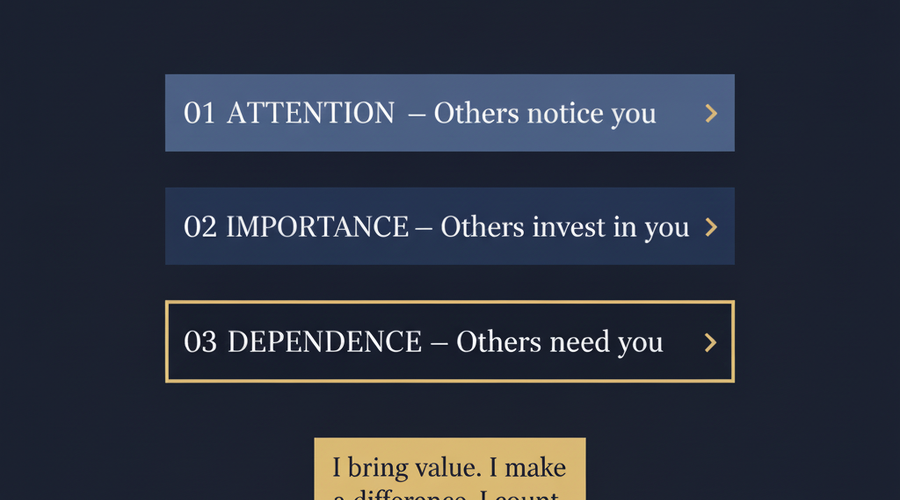
The research on mattering began outside education, with the sociologist Morris Rosenberg, who defined it as the feeling that we are a significant part of the world around us and identified three components: attention, the sense that others notice us; importance, the sense that others care what happens to us and invest in us; and dependence, the sense that others rely on us and would miss our contribution (Rosenberg and McCullough, 1981). Later work added a fourth, ego-extension, the sense that others take pride in our successes and feel our failures, which in a campus setting is the instructor who is visibly glad when a student passes (Elliott, Kao, and Grant, 2004).
Nancy Schlossberg brought the construct into higher education and gave it its most useful framing for campus leaders. Students in transition, she argued, feel marginal: unsure whether they fit, whether anyone would notice if they left, whether the institution has any stake in them. Marginality is not a personality trait. It is the natural state of a person entering a new environment, and it persists until the environment demonstrates, through repeated behavior, that the person matters. The institution’s job is to move students from marginality to mattering, and Schlossberg was explicit that this is done by what the institution does, not by what it says (Schlossberg, 1989).
Map the three components onto a campus and the problem becomes visible. Attention is what campuses do: names, greetings, welcome events. Importance is what some campuses do: an advisor who follows up, an instructor who asks what happened. Dependence is what almost no campus does: treating the student as someone whose contribution the institution actually needs, whose perspective changes a decision, whose absence would leave a gap in the room and not just in the roster.
The CARING+ statement is built on all three. I count is attention. I bring value and I make a difference are dependence. The model put the hardest components in the student’s own words, which is why a campus that stops at attention has not produced the condition, however warm its front desk.
The research that followed has confirmed how much this matters. Students’ sense of mattering at their institution predicts persistence, engagement, and wellbeing beyond what belonging alone accounts for, and the effect is strongest for students who arrive with the most reason to feel marginal (Flett, Khan, and Su, 2019). Prilleltensky’s formulation is the one worth keeping: mattering is feeling valued and adding value, and the second half is not optional (Prilleltensky, 2020). An institution that makes students feel valued without giving them a way to add value has built half the condition and will be surprised when it does not hold.
Care is completed by the person receiving it
There is one more idea underneath this post, and underneath the whole model. The philosopher of education Nel Noddings distinguished between caring about someone, which is an attitude the carer holds, and caring for someone, which is a relationship completed only when the person cared for receives it as care (Noddings, 1984). An institution can care about its students in every policy document it owns. Whether it cares for them is decided by the students, in their experience of each interaction, and by nothing else.
This is the principle the CARING+ Model was built on, before anyone involved had read Noddings. The model shifts the focus from intention to experience because intention is not what students encounter. Staff who care deeply about students and are too overloaded, too anonymous, or too procedural to show it have produced, from the student’s side, an institution that does not care. The feeling state is the fact. Everything in this post is about closing the gap between the care a campus holds and the care its students receive.
Why this matters more at a career college
The students who most need to be shown they matter are concentrated at career and technical colleges, for the same reasons the previous post gave for belonging. First-generation students, lower-income students, students of color, and returning adults arrive with more experience of institutions that treated them as cases, numbers, or problems, and less reason to assume this one will be different. Many have been told, by a prior school or a prior employer, that they did not count. The question is already open when they walk in, and the institution’s default behavior answers it within days.
Career colleges also run on systems that are built for efficiency and read, from the student’s side, as indifference. Automated communication. Policy language. Processes that treat every student identically because that is what compliance requires. The student ID requested at every window. None of this is hostile, and all of it says the same thing: you are a record. A commuter student who spends four hours a night on campus and encounters six systems and no person has been shown, six times, that they do not matter, before the first instructor says a word.
And there is a structural reason the dependence component is hardest here. Traditional colleges give students roles: clubs to run, organizations to lead, committees to sit on, newspapers to edit. These are mattering machines, because they make the institution visibly depend on students. A career college has few of them, for the same reasons it has few clubs. Which means the dependence component has to be built inside the program and the offices, deliberately, or it will not exist.
The order matters
Mattering is built in the order Rosenberg described, and each layer depends on the one before.
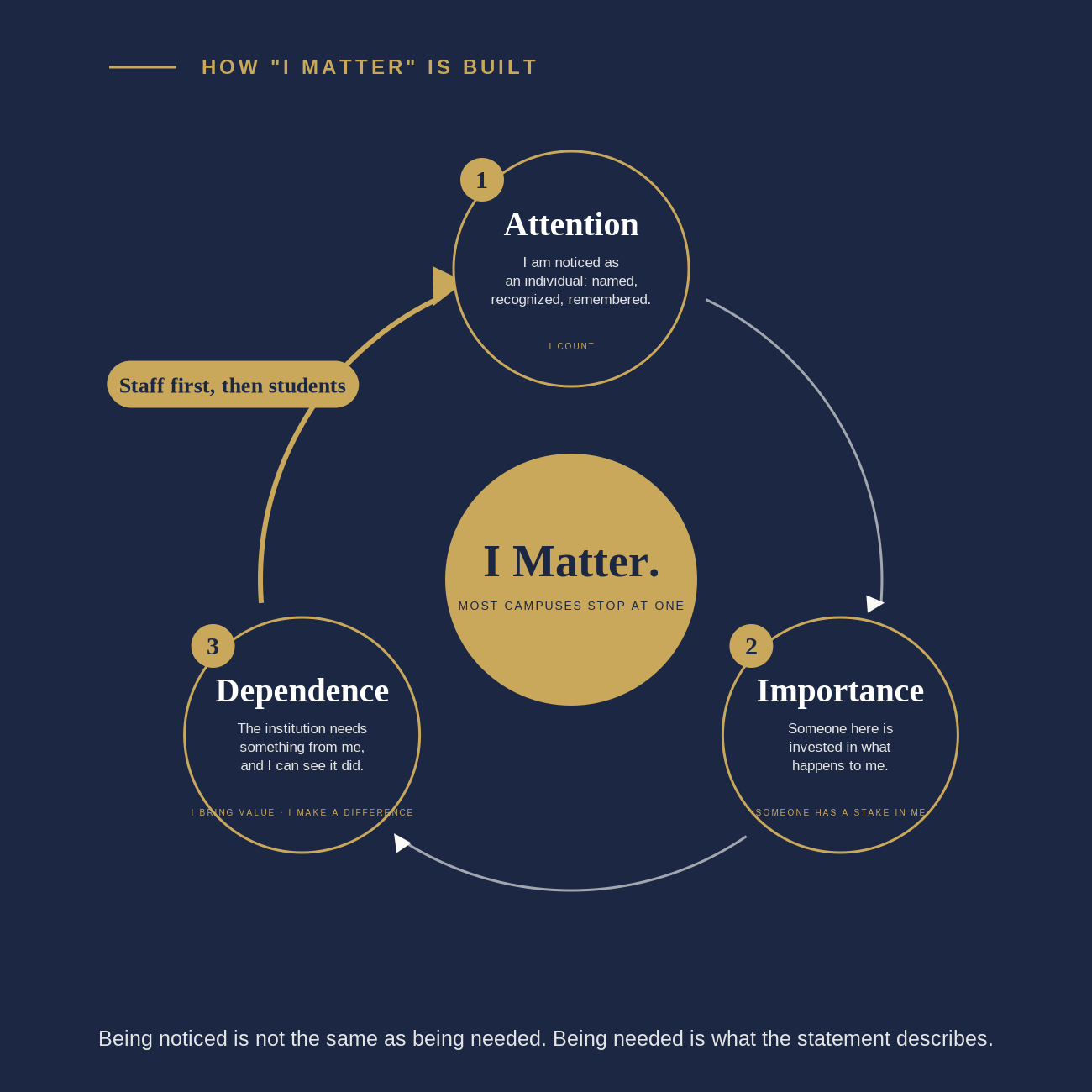
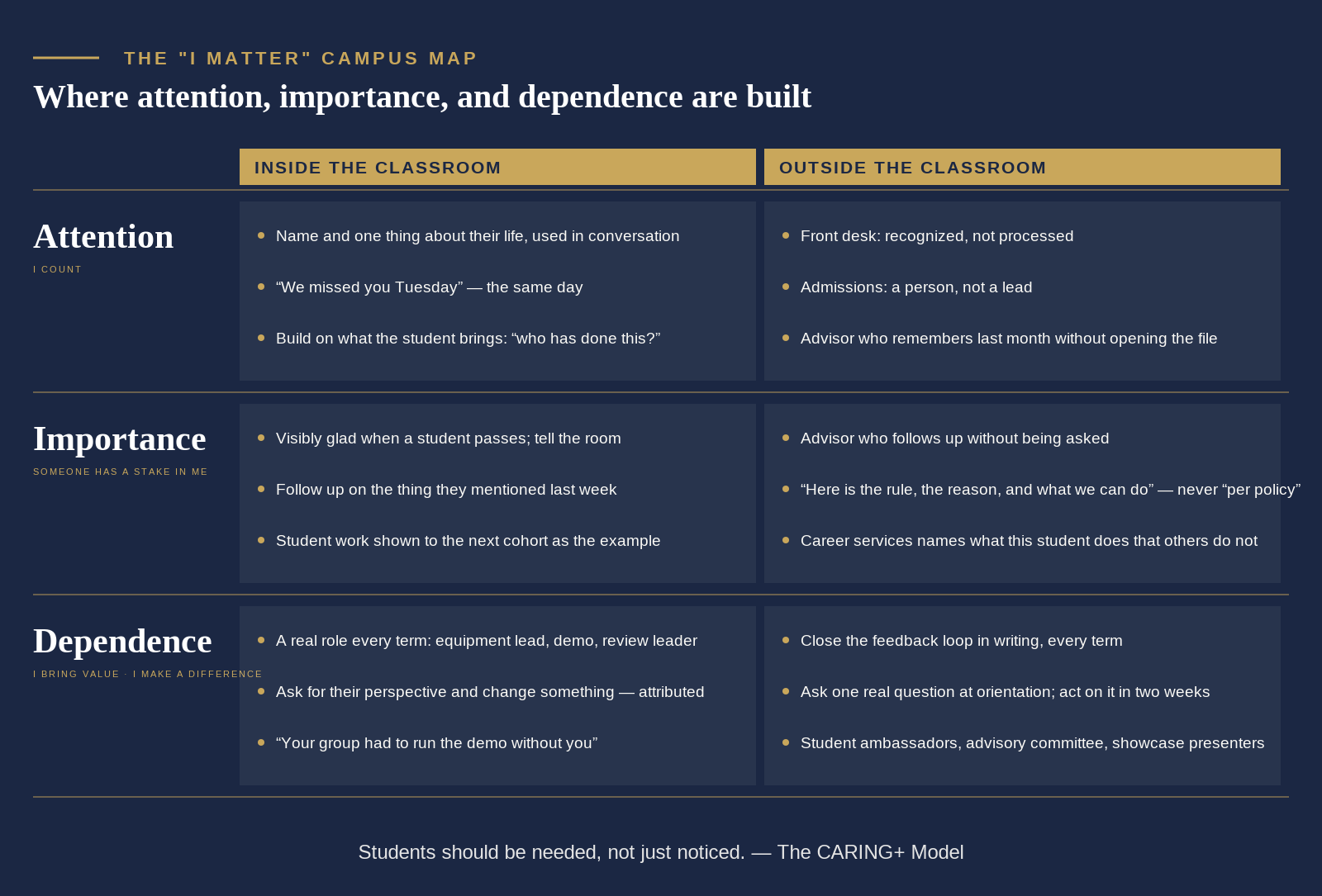
Attention comes first. The student is noticed as an individual: named, recognized, remembered. This is the layer campuses are good at, and it is necessary. A student who is not noticed cannot proceed to the next two. But it is the floor, not the goal.
Importance comes second. Someone at the institution is visibly invested in what happens to this student: follows up, asks, remembers what was said last time, is glad when things go well and concerned when they do not. This is where the model’s reciprocal framing enters: a student experiences importance only from a person who has the capacity to invest, which is why overloaded, anonymous, or demoralized staff cannot produce it however much they care.
Dependence comes third, and it is the goal. The institution needs something from the student: their perspective, their help, their feedback, their presence. The student’s contribution changes something, and the student can see that it did. This is the layer that produces I bring value and I make a difference, and it is the layer that makes mattering durable. A student who is needed does not leave easily, because leaving would mean letting someone down.
A campus that builds attention and calls it mattering produces students who feel pleasant about the institution until the first hard week. A campus that builds all three produces students who stay through it.
Roles: how a community comes to miss someone
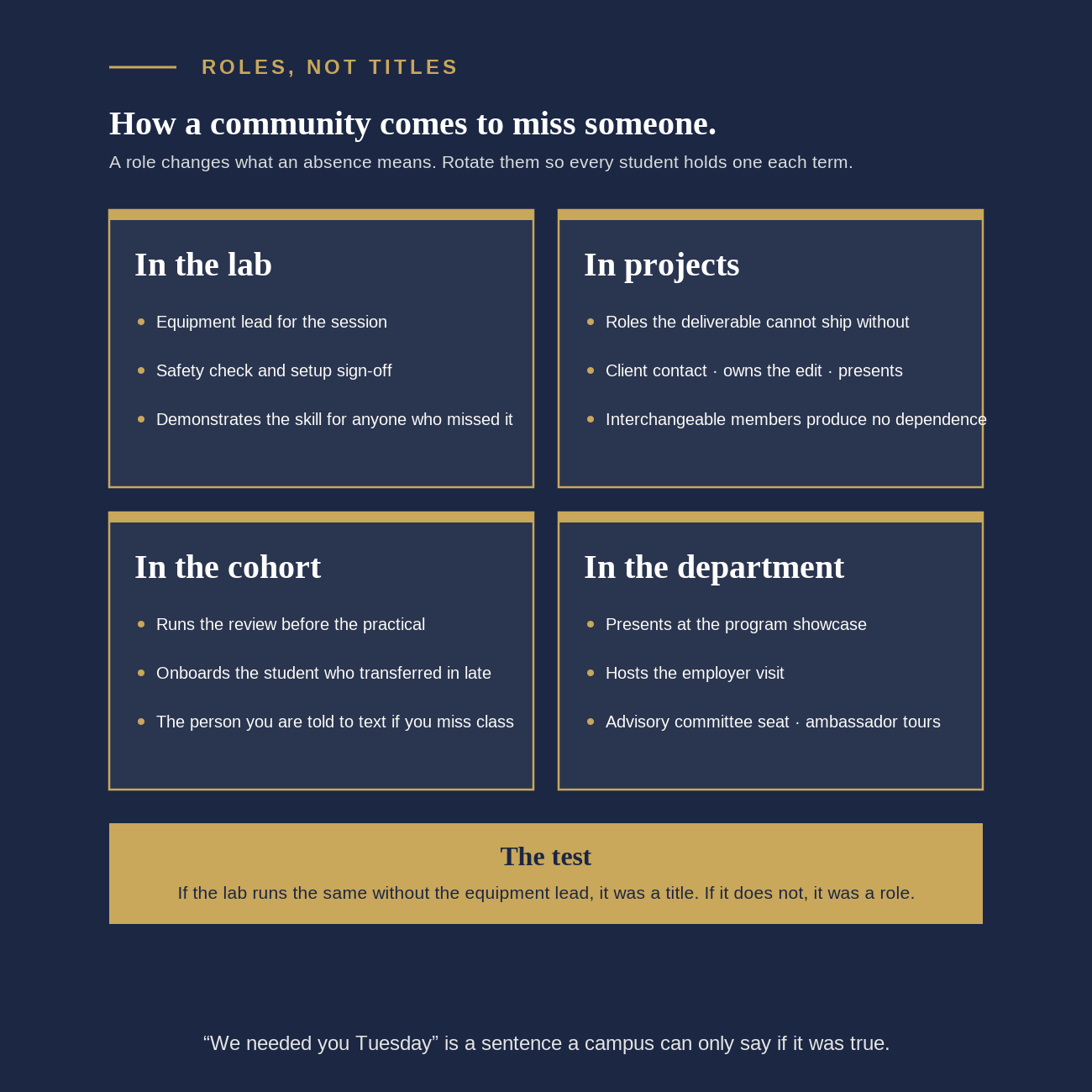
The most reliable way to build the dependence layer is also the simplest to describe: give every student a meaningful role that other people count on. In a lab, a project, a cohort, a departmental event. The role does the work that no amount of warmth can, because it changes what an absence means. A student with no role who misses a night is noticed, at best. A student who runs the equipment check, or holds the data for the group project, or is the one presenting at the program showcase, is missed, and the people who missed them say so. “We needed you Tuesday” is a sentence a campus can only say truthfully if it was true.
Roles also solve the problem the previous section raised. Career colleges have few of the clubs and organizations that traditional campuses use to make students needed, so dependence has to be built inside the program, and the program has plenty of places to put it:
In the lab. Equipment lead for the session. Safety check. The student who signs off on setup before the group begins. The student who demonstrates the skill for anyone who missed it. Rotated weekly so that by midterm every student has held one.
In projects. Team roles that are real, with a deliverable that cannot be completed if one person is absent: the student who holds the client contact, the one who owns the edit, the one who presents. Group projects where any member can do any part produce no dependence. Group projects with roles produce it in a week.
In the cohort. The student who runs the review before the practical. The one who onboards the student who transferred in late. The one the instructor names as the person to text if you miss class. Peer roles make students depend on each other, which is dependence twice.
In the department. Student presenters at the program showcase. Student hosts for the employer visit. Student voices on the program advisory committee. Student ambassadors who give the tour to prospective students and their families. Each puts a student in a position where the department is visibly relying on them in front of other people.
The test of a role is whether its absence would be felt by someone other than the student. If the lab runs the same without the equipment lead, it was a title. If it does not, it was a role, and the student who held it has learned, from the community’s reaction, that they made a difference. That is the statement, built.
Inside the classroom
Know the name and one thing more, then use both. The previous post made the name standard a belonging practice. Here it is the attention layer, and the second half is what moves it toward importance: the instructor who knows that a student works nights at the hospital, and who asks how the shift went, has shown the student that someone is keeping track of their life.
Ask for the student’s perspective, and act on it. This is the dependence layer in its simplest form. An instructor who asks “how did that lab go for you, and what would you change?” and then changes it, visibly, the following week has told the student that their judgment altered the course. The change does not have to be large. It has to be attributable: “we are doing it this way because of what Marcus said last week.”
Give every student a role the class depends on, and rotate it. Equipment lead, safety check, demo for the group, review before the practical, the person a new student is told to ask. The standard is that every student holds a real role at some point in the term, and that the role is one whose absence the room would feel.
Mark the absence as a loss to the room, not just to the student. “We missed you Tuesday” is attention. “We missed you Tuesday; your group had to run the demo without you and it did not go as well” is dependence. The second tells the student their presence had consequences for other people, and it is only available to an instructor who gave the student a role in the first place.
Show that you are glad. The ego-extension component. An instructor who is visibly pleased when a student passes the check-off, who tells the room, who remembers it a week later, has shown the student that their success mattered to someone else. Students know the difference between an instructor who records a pass and one who is glad of it.
Build on what the student brings. Working adults arrive with experience the curriculum rarely acknowledges. The student who managed a kitchen knows more about workflow than the textbook; the student who raised three children knows more about de-escalation than the module. Instructors who ask “who has done something like this?” and let the answer teach the room have told the student that their life before the program has value inside it.
Tell students when their work is used. A student’s project shown to the next cohort as an example, a student’s question that became part of the lecture, a student’s suggestion that is now in the lab manual. Each is evidence that the student made a difference that outlasted them.
Outside the classroom
Admissions: a person, not a lead. Mattering begins in the first phone call. A prospective student who is asked about their goals, their constraints, and their worries, and whose answers shape the conversation, has been treated as someone whose particulars matter. One who is walked through a script has been treated as a lead. Students remember which one happened, and they carry it into enrollment.
Orientation: ask them something, and use the answer. Most orientations tell. An orientation that asks each new student one real question — what they are most worried about, what would make the first term work for them — and then does something visible with the answers in the first two weeks, has established dependence before classes begin. “You told us Wednesday nights were hard; we moved the lab” is the sentence.
Advising: the person who is invested. The advisor is where the importance layer lives or dies. An advisor who remembers what the student said last month, who follows up without being asked, who is visibly concerned when things slip and visibly glad when they recover, has shown the student that someone at the institution has a stake in them. An advisor who opens the file to find out who the student is has shown the opposite. Caseload is part of this; so is the decision to invest.
Financial aid and the business office: the student’s situation, not the policy. No office is more likely to make a student feel like a case. The counselor who says “per policy” has told the student the institution’s rules matter more than their situation. The counselor who says “here is what the rule is, here is why, and here is what we can do within it for your situation” has said the opposite, with the same rule.
Front desk and every encounter: recognized, not processed. The student ID requested every time. The form handed over without a word. The question answered without looking up. Each is a small demonstration that the student is a record. The front desk that greets by name, asks about the exam, and remembers the answer is doing the attention layer every day, and it is the office most students see most often.
Feedback that changes something, visibly. Every campus surveys students. Few close the loop. A student who is asked for feedback and never hears what happened to it has learned that the asking was a formality. A campus that reports back, “you told us this, here is what we changed, here is what we could not change and why,” has built dependence at scale. This is the single most underused mattering practice in higher education, and it costs one email a term.
Student roles the institution depends on. Ambassadors who give the tours. Peer tutors. Orientation leaders. Students on the program advisory committee with the employers. Students who train the new front-desk hire on what students actually need. Each role makes the institution visibly rely on a student, and each is a mattering machine a career college can build without a club.
Career services: the student’s story, told back to them. Career services is where a student’s whole program is assembled into a case for their value to an employer. Done well, it is the moment a student hears, from someone who knows the market, exactly what they bring. Done as résumé formatting, it is a service. The difference is whether the staff member can name, specifically, what this student does that others do not.
Leadership: the staff have to matter first. The CARING+ post said it plainly: staff who do not feel they matter cannot reliably create that feeling for students. Staff who are not asked, whose feedback vanishes, who learn of decisions after the fact, who are processed by their own institution, will process students. The campus where this model was developed found that the change in how associates treated each other was the most surprising result, and the leaders there would say it was not a side effect. It was the mechanism. Mattering flows downhill. A director who asks staff what they think and visibly acts on it, who knows their lives, who is glad when they succeed, has built the only reliable source of mattering a campus has.
What undermines the condition
Attention mistaken for mattering. Names, greetings, and slogans, with no investment and no dependence behind them.
The student as record. The ID at every window, the form without a word, the automated message where a person should be.
“Per policy.” The rule stated as the reason, with no acknowledgment of the situation it is landing on.
Feedback into the void. Surveys collected, nothing reported back. The asking becomes the insult.
Interchangeability. Students treated identically in the name of fairness, until no one is treated as a particular person.
No role to hold. A campus where students are only ever recipients, never contributors.
Staff who do not matter. People processed by their own institution, who process students in turn.
Making it observable
Following the six lenses of the model, a campus can ask of any instructor or staff member:
- Does this person know each student’s name and one thing about their life, and use both?
- Has this person asked a student for their perspective this term and visibly acted on it?
- Can this person name a student whose contribution the class or office depends on?
- When a student succeeds, is this person visibly glad, and does the student know it?
- Does this person say “per policy,” or does this person explain the rule and address the situation?
- Does this person feel that they matter to the institution, and would their colleagues say so?
The behavioral interview question: Tell me about a time you changed something because of what a student or colleague told you. How did they know? Candidates who build mattering will describe the change and how it was attributed. Candidates who do not will describe listening.
The student feedback question, in the student’s voice: Has anything at this school changed because of something you said or did? Ask it at midterm. A campus where most students answer no has built attention and nothing else, and it will show in the next term’s retention.
Where to begin
- Close the feedback loop. Report back to students, every term, what they said, what changed, and what did not and why. One email.
- Give every student a meaningful role in a lab, a project, or a departmental event at some point in the term — one whose absence someone else would feel — and rotate them.
- Replace “per policy” with the rule, the reason, and the situation. Train it; audit it at the front desk and in financial aid.
- Ask one real question at orientation and do something visible with the answers in the first two weeks.
- Ask staff what they think, act on it visibly, and let students see that it happened.
None of these requires new budget. All of them require the campus to decide that students should be needed, not just noticed.
What an administrator should know before adopting this
Attention is cheap and already in place; do not spend the rollout on it. Most campuses will audit themselves on mattering and find they greet students by name. That is the floor. The rollout should go directly to the importance and dependence layers, where the gap is, and the measure should be the midterm question, not front-desk warmth.
Dependence requires giving something up. Acting on student input means a decision an administrator or instructor would have made alone is now shaped by a student, and visibly so. Some staff will experience this as a loss of authority. It is not; it is the thing that makes authority trusted. But it should be named, and leaders should model it first by acting on staff input in the same visible way.
Closing the feedback loop will surface things the campus cannot fix. That is the point of saying so. “We could not change this, and here is why” builds more mattering than silence, and more than a change made grudgingly. Students do not expect everything to change. They expect to know what happened to what they said.
The staff layer is not optional. Of the five conditions, this is the one where the reciprocal standard is most literal. A leadership team that processes its staff will get a staff that processes students, and no training will override it. Before the rollout, the campus director should be able to answer the student question for their own team: has anything changed here because of what a staff member said?
What requires training
Explaining the rule instead of citing it. “Per policy” is a reflex, especially in financial aid and the registrar’s office, and it is usually a defense against a conversation the staff member does not feel equipped for. The training is a script with three parts — the rule, the reason, and what can be done within it — rehearsed on the five situations that come up most.
Attributing change. Staff who act on student input rarely say so. “We changed this because of what you told us” is a learned sentence, and it is the one that produces dependence. Without it, the change happens and the mattering does not.
Being visibly glad. This sounds like it should not need training, and in practice it does. Many instructors record a pass and move on, because that is professional. Showing that a student’s success mattered to you, in the moment and in front of others, is a skill, and it is the ego-extension component made real.
The feedback report. Someone has to own closing the loop, and they need a format: what we heard, what we changed, what we could not and why. One page, every term, to every student. The first one is the hardest; after that it is a template.
Drawing on what students bring. Faculty need practice asking “who has done something like this?” and letting a student’s experience carry part of the lesson. It is a different stance from delivering content, and instructors who have never done it will not start without being shown how.
The five together
This series has treated the five statements one at a time, which is how a campus has to build them. But students experience them at once, in the same interaction, and it is worth closing with how they fit.
“I matter” is the foundation: the student is noticed, invested in, and needed. On that foundation, “I belong” connects the student to a person, to peers, and to the profession. “I trust” lets the student accept what the institution tells them, including the hard things, because the institution has shown it means what it says. “I grow” gives the student visible evidence that the work is producing competence. And “I can do” is the belief that results: I can accomplish, complete, and achieve. When all five are present, students are more likely to be confident, happy, and successful, and that is the whole aim of the model.
The plus is what holds them together. Every one of the five is a condition staff cannot reliably produce for students unless they experience it themselves. A campus that wants students to matter, belong, trust, grow, and believe they can do has to be a campus where the staff do, and the leaders who built this model would say that was the lesson that surprised them most and mattered most.
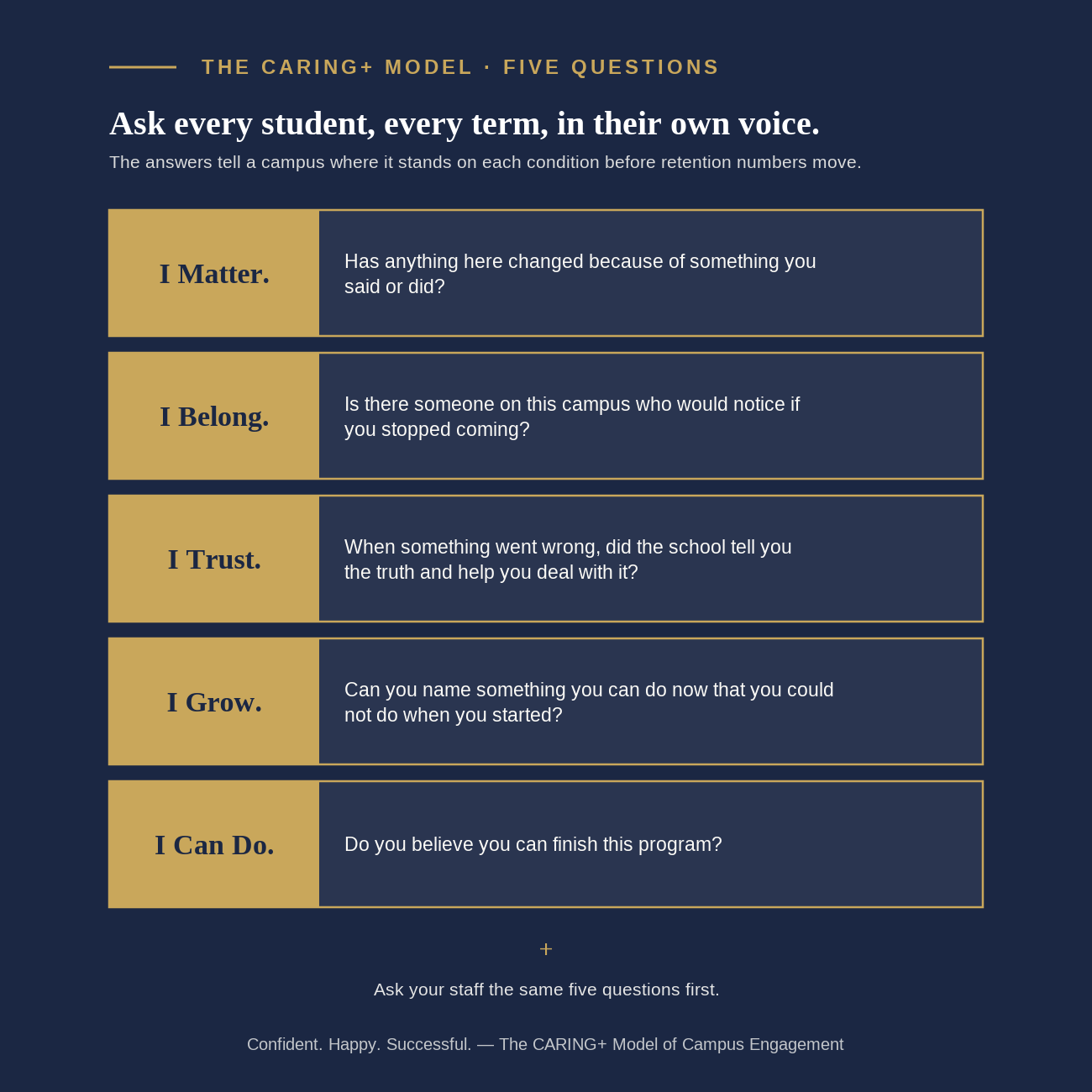
Five questions, in the student’s voice, asked every term, will tell a campus where it stands:
- Has anything here changed because of something you said or did?
- Is there someone on this campus who would notice if you stopped coming?
- When something went wrong, did the school tell you the truth and help you deal with it?
- Can you name something you can do now that you could not do when you started?
- Do you believe you can finish this program?
None of them requires new budget. All of them require the campus to decide that a student’s belief about their own capability is an outcome the institution is responsible for, and to build the conditions that produce it.
Frequently asked questions
How is “I matter” different from “I belong”? “I belong” is about connection: to a person, to peers, to a community. “I matter” is about significance: being noticed, invested in, and needed as an individual. A student can be well connected and still feel interchangeable; a student can be needed by an instructor and still feel isolated from peers. The research treats them as distinct constructs with distinct effects, and the model builds them with distinct practices. In most campuses, belonging is further along than mattering, because the dependence layer is rarely built.
Isn’t acting on student feedback a risk to standards? Only if “acting on” means “doing whatever students ask,” which it does not. Closing the loop includes saying what will not change and why. Students who are told “we heard you, and here is why the practical stays as it is” have been shown they matter; students who are told nothing have not. The standard is unchanged in both cases. The mattering is not.
We have small staffs and large caseloads. How do we build the importance layer? By deciding where it lives. Not every staff member can invest in every student, but every student can have one person who does. The previous post’s advising note — one line per student with their life and their risk — is the instrument. The question for a campus is not whether staff have time to care about every student; it is whether every student has been assigned to someone who will.
What about online students? The layers are the same and the defaults are worse, because online systems are built to process. The attention layer requires an instructor who uses names and responds personally. The importance layer requires someone whose job is to follow up with specific students, not to monitor a dashboard. The dependence layer requires asking students for input and reporting back what changed, which is easier online than in person and almost never done.
Where should a campus start if it is adopting the whole model? With the staff. Every condition in the model is built by people who experience it themselves, and the reciprocal standard is the reason the model worked where it was developed. A campus director who wants to know whether the model will take should ask the five questions above of their own team first. Where the staff’s answers are no, start there.
Sources
Elliott, G. C., Kao, S., and Grant, A.-M. (2004). “Mattering: Empirical Validation of a Social-Psychological Concept.” Self and Identity, 3(4), 339–354.
Flett, G. L. (2018). The Psychology of Mattering: Understanding the Human Need to Be Significant. Academic Press.
Flett, G. L., Khan, A., and Su, C. (2019). “Mattering and Psychological Well-Being in College and University Students: Review and Recommendations for Campus-Based Initiatives.” International Journal of Mental Health and Addiction, 17(3), 667–680.
Noddings, N. (1984). Caring: A Feminine Approach to Ethics and Moral Education. University of California Press.
Prilleltensky, I. (2020). “Mattering at the Intersection of Psychology, Philosophy, and Politics.” American Journal of Community Psychology, 65(1–2), 16–34.
Rendón, L. I. (1994). “Validating Culturally Diverse Students: Toward a New Model of Learning and Student Development.” Innovative Higher Education, 19(1), 33–51.
Rosenberg, M., and McCullough, B. C. (1981). “Mattering: Inferred Significance and Mental Health Among Adolescents.” Research in Community and Mental Health, 2, 163–182.
Schlossberg, N. K. (1989). “Marginality and Mattering: Key Issues in Building Community.” New Directions for Student Services, 1989(48), 5–15.
A one-page reference covering the three layers, the six observable behaviors, the five diagnostic questions, and the five practices that require no new budget.
Explore Topics
Written by
John P. Girard
John P. Girard is the founder of Girard Advisory Group and a thirty-year veteran of career and proprietary higher education, with hands-on leadership across enrollment growth, campus operations, accreditation and compliance, curriculum development, brand and marketing, and P&L management. Over three decades he has held roles spanning Campus Director, Campus President, Regional Campus Director, and National Director of Marketing & Digital Media Brand Management, leading multi-campus organizations through growth, accreditation, and operational turnarounds. That range — from the admissions floor to the boardroom — is what shapes his advisory approach: strategy that has to hold up in daily campus operations, not just on a slide. John holds a Master's degree in Teacher Education from the University at Albany, SUNY, and has served on the Board of the Ohio-Michigan Association of Career Colleges and Schools.