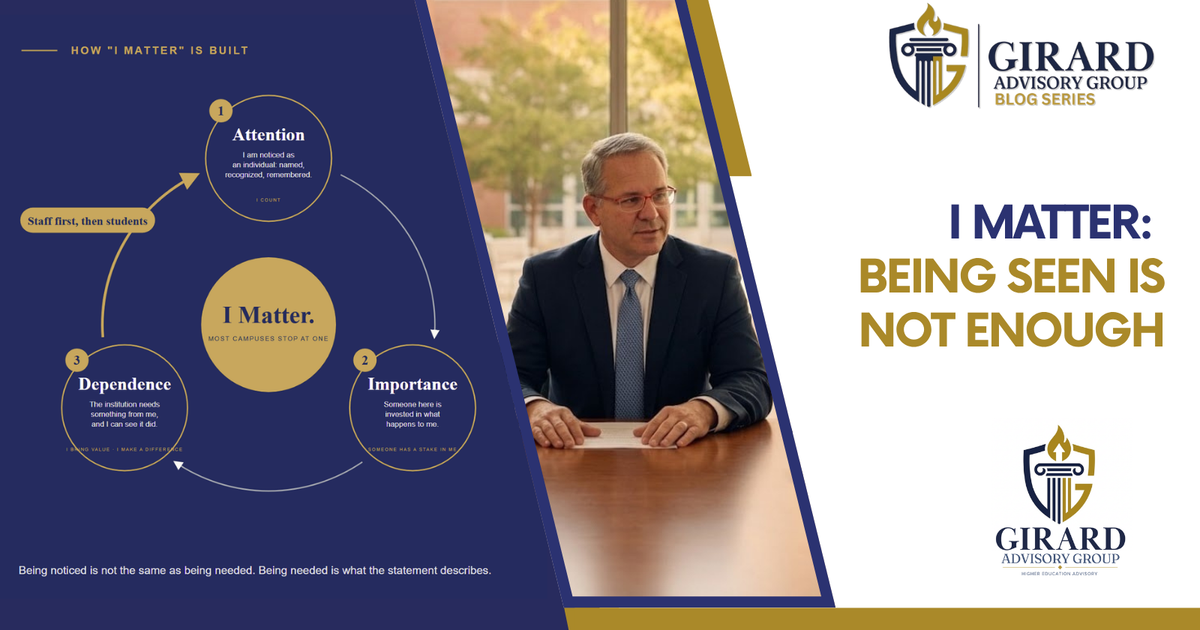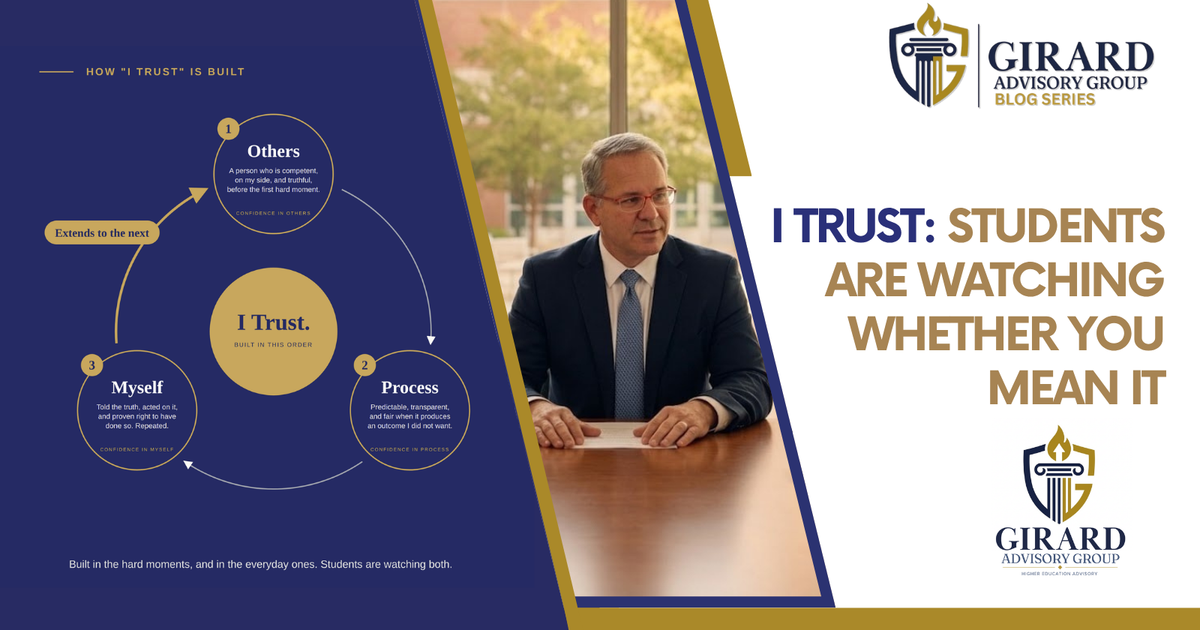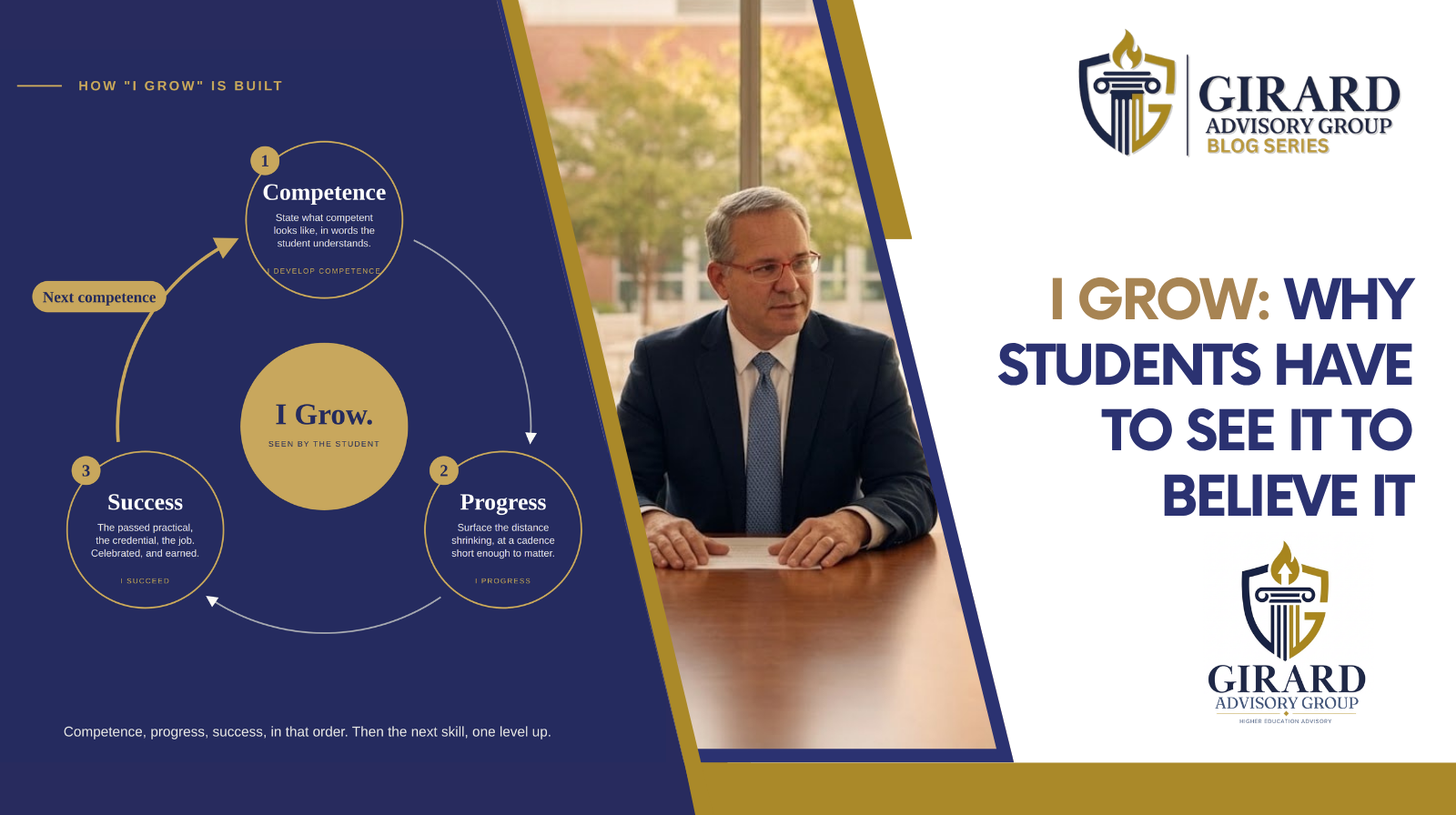
I Belong: Who Notices When a Student Is Gone?

John P. Girard
Founder, Girard Advisory Group
Belonging is not something a student finds. It is something an institution builds — deliberately, through structures and behaviors that leave as little as possible to chance. The fourth in a series on the five conditions of the CARING+ Model.
The first three posts in this series covered “I Can Do,” the belief that a student can finish; “I Grow,” the visible evidence that confirms it; and “I Trust,” the confidence that lets a student accept the evidence. This post is about the condition that keeps a student in the room long enough for any of that to happen.
“I belong” means I fit in, feel connected, and am part of a community. Of the five statements, it is the one institutions most often treat as the student’s job. Orientation introduces the clubs, the lounge, the study groups, and then the campus waits to see who connects. Some students do. Many do not, and the ones who do not are disproportionately the students who arrived least sure they belonged in the first place.
That is the argument of this post: belonging is not something a student finds. It is something an institution builds, deliberately, through structures and behaviors that leave as little as possible to chance. Campuses that understand this retain students that other campuses lose, and they do it without a single new program.
Belonging Is Decided in the Hard Weeks
Every student has a stretch, usually early, when the work gets hard, the schedule strains, and something goes wrong. What happens next depends less on the difficulty than on how the student interprets it. A student who feels they belong reads a failed check-off or a bad week as a normal part of a hard program. A student who is unsure they belong reads the same event as evidence: people like me do not make it here.
Researchers call this belonging uncertainty, and it is not evenly distributed. Students who are the first in their family to attend college, students returning after years away, students whose prior schooling told them they were not college material, and students who see few people like themselves on campus arrive with the question already open. For them, every setback is a referendum on whether they should be there at all (Walton and Cohen, 2007).
The research on this is unusually strong for a behavioral finding. A brief intervention that reframed early struggle as normal and temporary, using stories from older students who had felt the same way, improved grades and persistence for underrepresented students over three years, and the effect ran through changed interpretation of daily adversity rather than through any change in the adversity itself (Walton and Cohen, 2011). A decade later, a trial across twenty-two institutions confirmed the effect on first-year completion and clarified where it works: the intervention helps students whose group had reason to doubt their belonging, and it helps most where the campus environment actually offers the belonging the message promises (Walton et al., 2023). The message alone does little. The message plus a campus that backs it up changes who finishes. The closest test to a career-college setting came at a broad-access, largely commuter university, where a version of the intervention customized to that campus’s own students raised persistence for socially disadvantaged students by several points over two years (Murphy et al., 2020).
That last finding is the one leaders should hold onto. Telling students they belong is not the intervention. Building a campus where the telling turns out to be true is.
Why This Matters More at a Career College
The belonging research was mostly conducted at selective residential universities, and a leader at a career college could be forgiven for wondering whether it transfers. It does, and the transfer runs in one direction: everything the research says matters more here.
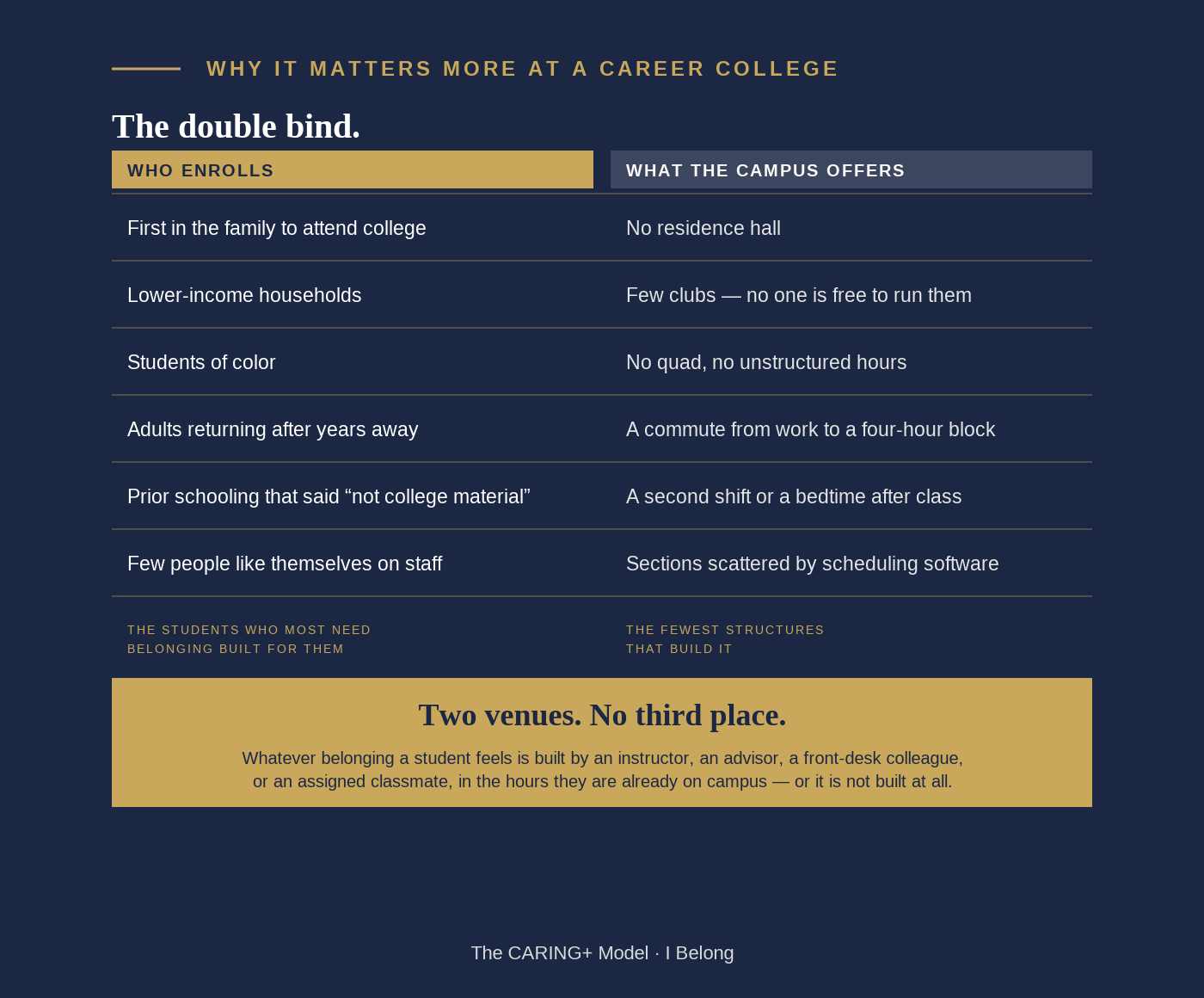
Consider who enrolls. Career and for-profit colleges serve higher proportions of first-generation students, students from lower-income households, students of color, and adults returning after years away than the four-year sector does. These are precisely the students the research identifies as arriving with the belonging question already open. The students most likely to interpret a hard week as “people like me do not make it here” are concentrated on career college campuses, not distributed evenly across higher education.
Now consider what the campus offers them. The traditional college builds belonging through residence halls, clubs, athletics, and the unstructured hours of a student who lives where they study. A career college student commutes, often from work, often to a four-hour evening block, and leaves for a second shift or a child’s bedtime. There are few clubs, because there is no one free to run or attend them. There is no residence hall. There is no quad. The structures the four-year sector uses to produce belonging, and the ones most of the research assumes, are largely absent.
That combination is the double bind. Career colleges enroll the students who most need belonging built for them and offer the fewest of the traditional structures that build it. The consequence is not that belonging is impossible here. It is that belonging here has exactly two venues: the classroom and the offices a student passes through on the way to it. There is no third place. Whatever belonging a career college student feels is going to be built by an instructor, an advisor, a front-desk staff member, or a classmate assigned to them, in the hours they are already on campus, or it is not going to be built at all.
There is one more piece. Students who see few people like themselves on the faculty and staff have one more reason to doubt they fit, and career colleges have both the exposure and the opportunity here. Industry-active instructors who came up through the same trade, from the same neighborhoods, are the most credible belonging signal a campus can offer. So are the graduates a campus brings back. A student who is taught by someone who looked like them at nineteen and now runs the department has been shown, not told, that they belong in the field.
This is also why some national data finds belonging a weaker predictor of persistence at two-year and open-access institutions than at four-year ones (Gopalan and Brady, 2020). The likeliest reading is not that belonging matters less to those students but that the surveys measure the campus-life version of it, which those students rarely experience. The belonging that keeps a commuter enrolled is built in class and in the advising office, and a campus that wants to measure it has to ask about that.
Why Institutions Leave Belonging to Chance
Most campuses believe in belonging and organize against it without noticing. Sections are assembled by scheduling software, so the same students rarely sit together twice. Faculty teach four sections and learn few names. Advisors carry caseloads that make the check-in a form rather than a conversation. Front-desk staff turn over. The student who misses a week returns to a room where no one registered the absence.
None of this is malice. It is what happens when belonging is treated as an outcome that emerges from a welcoming atmosphere rather than as a condition produced by specific structures. The atmosphere is real, and it is not enough. Belonging that depends on a student’s own initiative, personality, or luck will be present for the students who need it least and absent for the ones who need it most.
The research on nontraditional students has been saying this for thirty years. Rendón’s validation theory, built from interviews with first-generation and adult students, found that these students rarely connect through their own involvement, the way the traditional model assumes. They connect when someone at the institution, usually an instructor or a staff member, actively affirms them as capable and as belonging, early and often. Validation is initiated by the institution, not the student, and where it does not happen, these students tend to drift rather than engage (Rendón, 1994). Bean and Metzner’s model of nontraditional student attrition reached a related conclusion from the other direction: for commuter and adult students, the forces pulling them away are external, in work, family, and finances, so the social integration that campus life is supposed to produce matters less than whether the institution itself, in class and in its offices, holds them (Bean and Metzner, 1985). The two findings together are the case for building belonging structurally, inside the program, rather than hoping it forms in a lounge the student never has time to visit.
Strayhorn’s synthesis of the college belonging research makes the point directly: sense of belonging is a basic need that has to be met before students can perform, it is heightened in contexts and at moments when a student feels marginal, and it has to be continually re-established, because it fades when the conditions that produced it are withdrawn (Strayhorn, 2019). A campus cannot build belonging at orientation and move on. It has to keep building it, and the only way to keep building anything is to make it someone’s job.
The Order Matters
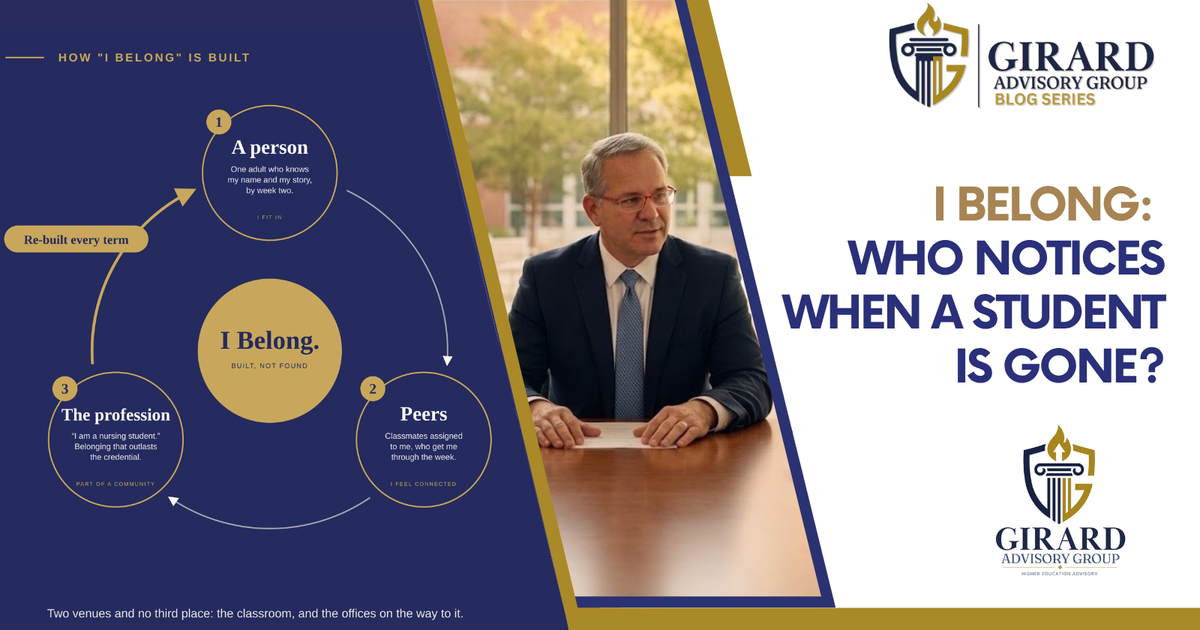
Belonging is built in layers, and the layers have an order.
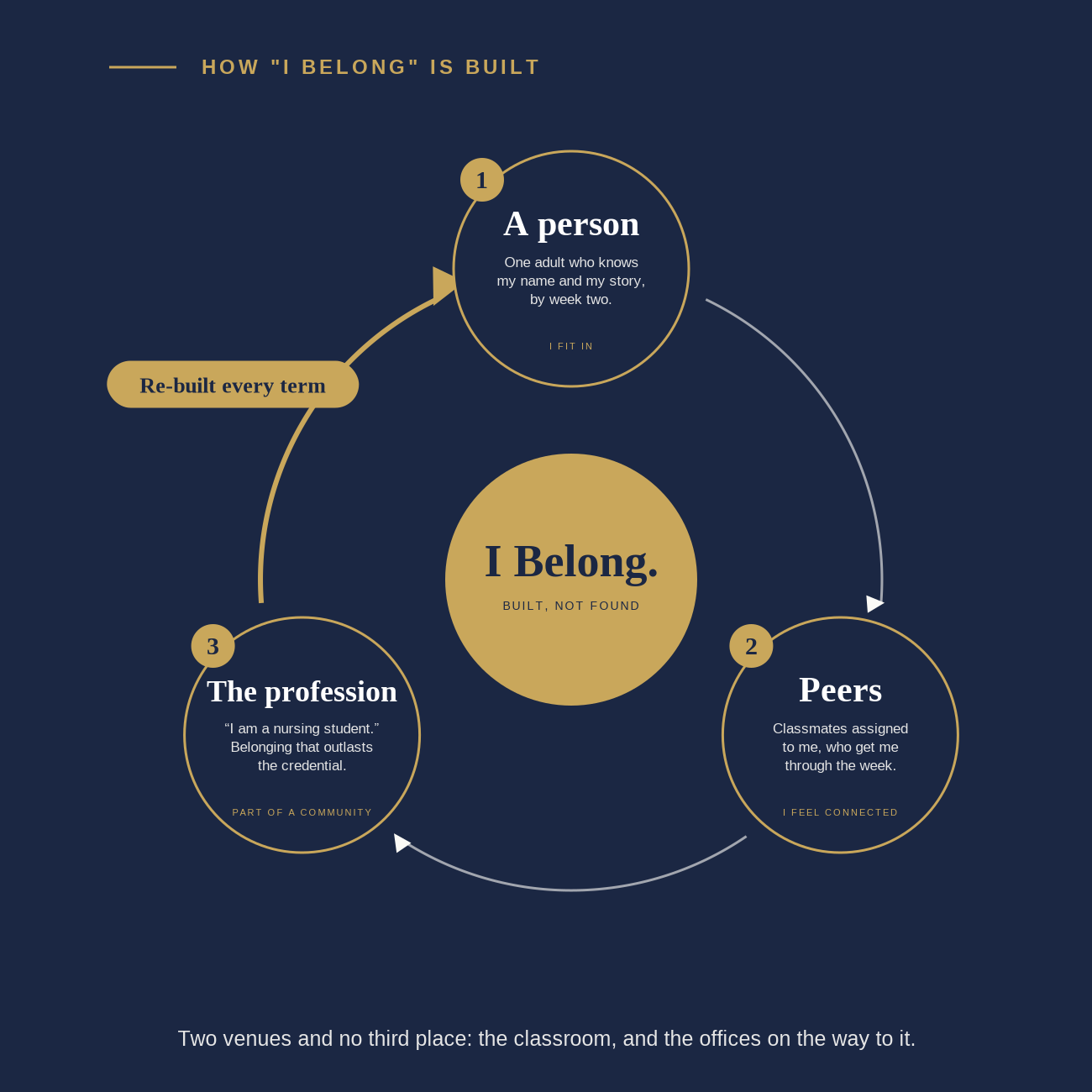
Connection to a person comes first. Before a student belongs to a campus, they belong to someone on it: an instructor who knows their name and their story, an advisor they would call, a staff member who greets them. One reliable adult relationship is the foundation of everything else, and it can be built in the first two weeks if the campus decides to build it.
Connection to peers comes second. Students persist in the company of other students. A cohort that moves through the program together, a lab partner, a study group that formed because the instructor formed it: these are the relationships that get a student through the week the instructor never hears about. They are also the relationships most campuses leave entirely to chance.
Connection to the institution and the field comes last. A student who has a person and has peers can come to feel they are part of the school and, more durably, part of the profession they are training for. “I am a nursing student” or “I am a welder” is a belonging statement that outlasts graduation. It is the goal, and it cannot be reached by skipping the first two layers.
Campuses that try to build institutional belonging directly, through branding, spirit, and events, without the person and the peers underneath, produce students who own the sweatshirt and leave in week six.
Inside the Classroom
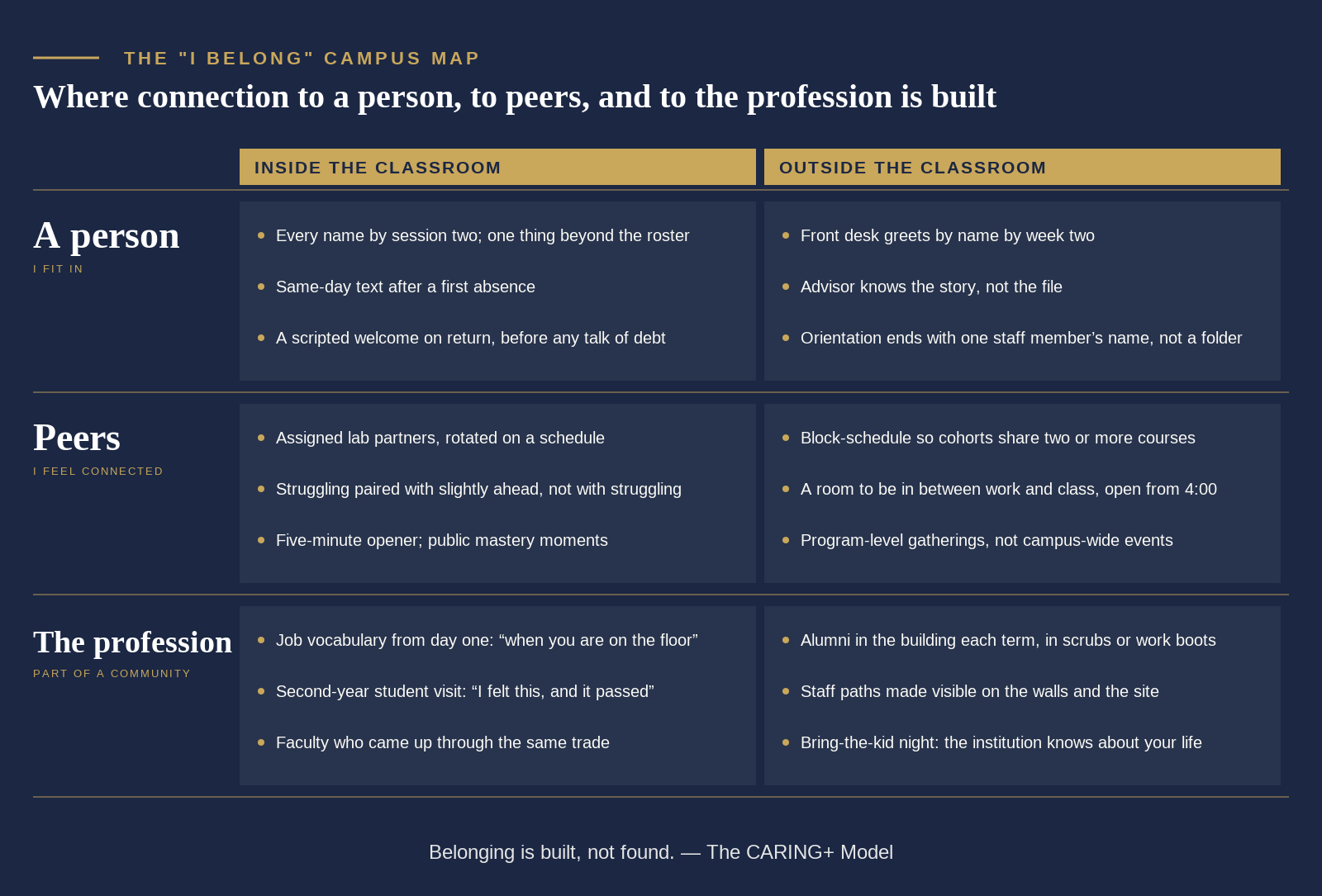
Learn the names by the second session, and use them. Nothing communicates “you are expected here” faster than an instructor who knows who you are. Name tents, a seating chart used for the first week, a roster with photos: the method does not matter. The standard does. By the second class, every student is addressed by name, and by the third, the instructor knows one thing about each of them beyond the roster.
Build the peer structure; do not wait for it. Assign lab partners and change them on a schedule so every student works with every other. Form study groups in class and give them a task that requires meeting once outside it. Put students who are struggling with students who are slightly ahead, not with each other. The student who would never have introduced themselves now has three people who know their name, because the instructor arranged it.
Normalize the struggle, out loud, with stories. The belonging research turns on how students interpret difficulty, and the most effective reframing comes from people who were recently where the student is. Instructors who bring a second-year student or a recent graduate to talk about their own hard first term, or who tell their own story, are doing the intervention in person. The message that lands is not “you belong” but “I felt exactly this, and it passed.”
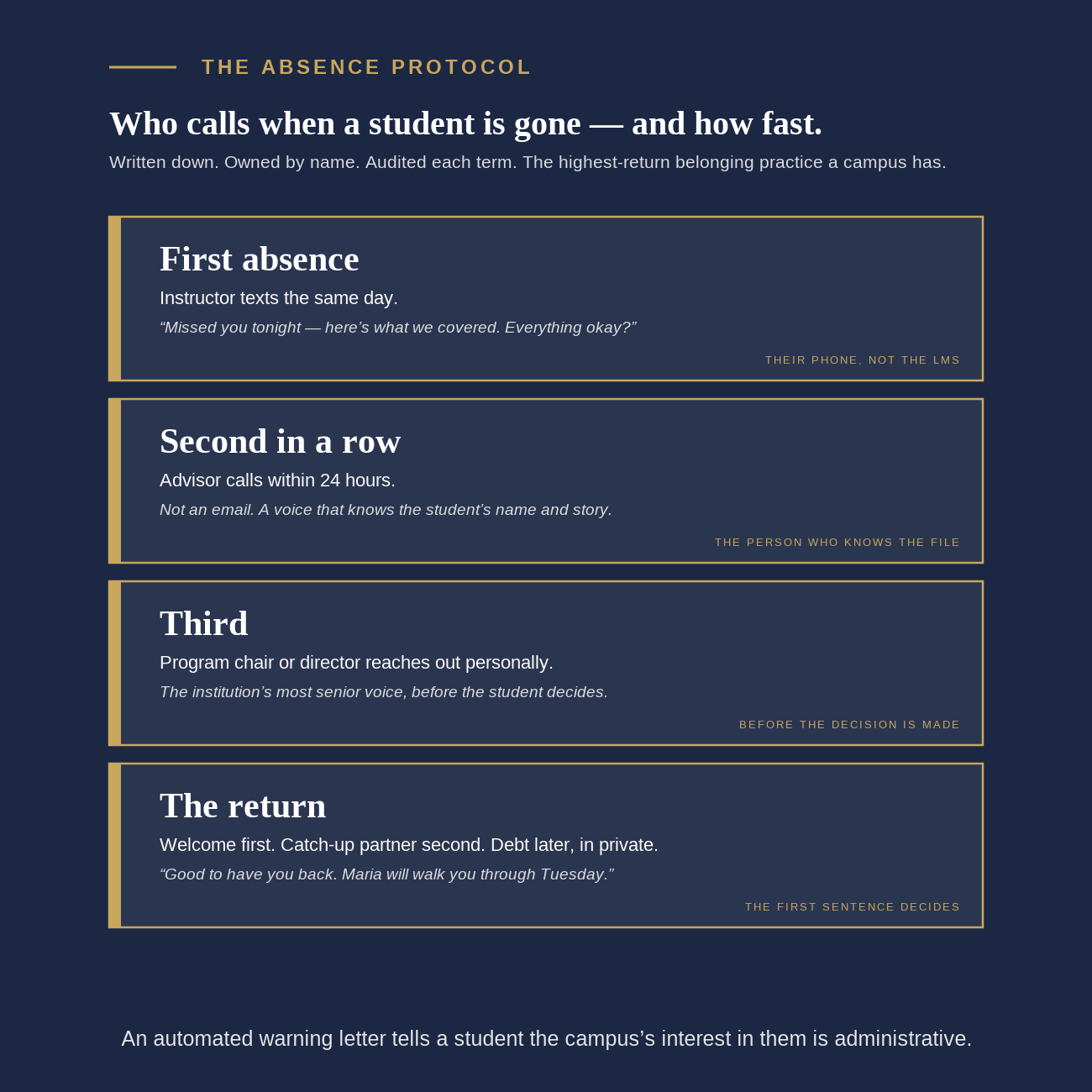
Notice the absence and act on it the same day. A student who misses class and hears nothing learns that their presence was not registered. A student who gets a text from the instructor that afternoon, “missed you today, everything okay?”, learns the opposite. Same-day contact after a first absence is the highest-return belonging practice a campus has, and it costs nothing but the decision to do it.
Make the return easy. When a student comes back after an absence, the first interaction decides whether they stay. An instructor who says “good to have you back, here is what you missed and who can help you catch up” has rebuilt the connection. An instructor who says nothing, or who leads with what is owed, has confirmed the doubt the student walked in with.
Connect the classroom to the profession. Students who see themselves as future members of a field belong to something larger than the section. Industry-active faculty do this by treating students as junior colleagues: using the vocabulary of the trade, describing the workplace as “when you are on the floor,” inviting students into the professional identity before they have earned the credential. “Learn from a pro to be a pro” is a belonging mechanism as much as a growth one.
Outside the Classroom
Admissions and orientation: belonging before day one. The belonging question opens before enrollment, in whether the student sees people like themselves in the school’s materials, in whether the admissions representative treats them as someone who will succeed here, and in whether orientation is designed to produce connections or to deliver information. Orientation that ends with every new student knowing the names of three classmates and one staff member has done its job. Orientation that ends with a folder has not.
Cohorts and scheduling: the structure that does the work. The single most powerful institutional lever for belonging is scheduling students so they move through the program with the same people. Cohort models do this by design. Programs that cannot run true cohorts can still block-schedule so the same students share two or three courses, which is enough for relationships to form. Scheduling software optimizes for room use; someone has to tell it to optimize for belonging.
Advising: the person who knows your story. An advisor who knows a student’s name, program, family situation, and what nearly made them leave last term is a belonging anchor. An advisor who opens the file to remember who the student is is not. Caseload size matters, but so does the decision to know students rather than track them. The strengths-based opening from the second post, “here is what you have built,” is also a belonging move: it tells the student that someone has been paying attention.
The front desk and every encounter. Students belong to a campus where the people at the front know their name, ask about the exam, notice the new haircut. This sounds small and it is not. For a working adult who spends four hours a night on campus and the rest of their life elsewhere, the front desk may be the most consistent relationship they have with the institution. Staff who treat every arrival as a stranger are spending belonging. Staff who greet students by name are building it, daily, at no cost.
Absence response: who calls when you are gone. Every campus should be able to answer one question: when a student misses a week, who contacts them, how fast, and what do they say? If the answer is “the automated attendance system sends a warning letter,” the campus has told the student that its interest in them is administrative. If the answer is “the instructor texts the same day and the advisor calls by the second absence,” the campus has told them they were missed. The second answer retains students. The first produces the returning-student conversation from the first post, except that many of those students never return.
Life outside the campus: belonging for working adults. Career college students carry jobs, children, aging parents, and commutes. Belonging for them is not built by clubs and events that assume a free evening. It is built by an institution that acknowledges their lives: schedules that hold, childcare arrangements or referrals, a place to eat between work and class, staff who ask about the kid’s game and remember the answer. A student who feels the institution has made room for the rest of their life belongs to it in a way no lounge produces.
Alumni and the profession: belonging that outlasts the credential. Graduates who return to speak, to mentor, to hire are proof that the community extends past graduation and into the field. A student who has met three alumni working in their trade belongs to something they can see. Career services that keep alumni connected are building belonging for current students, not just placement for future ones.
The staff. As with every condition in the model, staff cannot reliably produce for students a belonging they do not feel. Faculty who are isolated from one another, adjuncts who never meet the full-time team, front-desk staff who are not included in campus decisions: these people cannot make students feel part of a community they are not part of themselves. The campus where this model was developed found that the associates’ sense of belonging to each other was the foundation the student experience was built on. Leaders who want students to belong have to build a staff community first.
What Undermines the Condition
Anonymity. An instructor who does not know names in week four. A front desk that asks for the student ID every time.
Scheduling that scatters. Sections assembled by room availability, so no student sits with the same people twice.
The unnoticed absence. A week away, and no one reached out. The student learns exactly how much their presence registered.
The hard return. Coming back to “here is what you owe” instead of “good to have you back.”
Peer structure left to chance. Study groups that form among students who already know how to form them, and no one else.
Belonging that assumes a free evening. Clubs and events built for a traditional student a career college does not enroll.
Staff who do not belong to each other. Adjuncts who never meet the team. A front desk excluded from the campus conversation.
The sweatshirt without the person. Branding, spirit, and slogans built on top of no actual relationships.
Making It Observable
Following the six lenses of the model, a campus can ask of any instructor or staff member:
- Does this person know every student’s name by the second week, and one thing about each beyond the roster?
- Has this person built peer connections deliberately, or waited for them to form?
- When a student is absent, does this person make contact the same day, and what do they say?
- When a student returns, is the first thing they hear a welcome or a debt?
- Does this person treat students as future members of the profession?
- Does this person feel part of the campus community themselves?
The behavioral interview question: Tell me about a student or colleague who was on the edge of leaving. How did you know, and what did you do? Candidates who build belonging will describe noticing early, reaching out personally, and connecting the person to others. Candidates who do not will describe a referral.
The student feedback question, in the student’s voice: Is there someone on this campus who would notice if you stopped coming? Ask it in the third week and again at midterm. Any student who answers no is at risk regardless of their grades, and the campus knows exactly what to do about it.
Where to Begin
- Set the name standard: every instructor knows every student’s name by the second session. Check it.
- Write the absence protocol: who contacts a student after the first missed class, by when, and with what words. Make it same-day and personal, not automated.
- Ask the scheduler to block-schedule so students share two or more courses with the same people, and build peer structures inside every course.
- Redesign orientation to end with connections, not a folder: three classmates’ names and one staff member’s, for every new student.
- Ask students in week three whether someone would notice if they stopped coming, and act on every no.
- Build the staff community first. Include adjuncts and front-line staff in the campus conversation, and let students see a team.
None of these requires new budget. All of them require the campus to decide that belonging is its responsibility to build, not the student’s to find.
What an Administrator Should Know Before Adopting This
Everything above is an argument and a list. A campus leader who is persuaded by the argument still has to run the list, and there are four things worth knowing before starting.
It costs time, not money, and the time should be named. The honest accounting for an instructor is fifteen to twenty minutes a week: the five-minute opener, two or three absence texts, and keeping the pairing rotation current. For the campus, it is one scheduler change, one staff meeting a term, and a front-desk roster. Say this out loud when the model is introduced. “No new budget” is credible when the real cost is stated; it is suspicious when it is not.
Set the guardrails before the first text is sent. Several practices here ask staff to contact students personally and to know things about their lives, and the objections that will surface are reasonable: boundaries, privacy, hours, and adjunct labor. Answer them in advance. A contact policy that names the channel (a school-provided number or messaging tool, not a personal phone), the hours, and what is logged. A clear line between noticing and counseling, with a referral path for the student whose situation is beyond what an instructor should hold. A plain statement of what the first-night index card is for and where it lives. Faculty who hear “I am not their therapist” forming in their own minds need to be told, before they say it, that they are right, and that the model does not ask them to be.
Start with three, not twenty-two. The model’s own rule is to develop before evaluating, and a campus that mandates every practice at once will get compliance: name tents on the desks, texts that read like the automated letter, pairings assigned and ignored. Start with the three that carry the most weight and cost the least to explain: names by the second session, the written absence protocol, and block scheduling. Run one term. Measure with the week-three question. Then add. The staff who see the first three work will ask for the rest.
Expect the resistance and have the answer ready. Full-time faculty will hear extra work; the answer is the fifteen minutes and the fact that same-day contact is less work than the withdrawal it prevents. Adjuncts will say they have no time; the answer is that the three starred items are the whole ask and the campus will onboard them in fifteen minutes each term. Experienced staff will say they already do this; the answer is that they probably do, and the model exists so that the student whose instructor does not gets it anyway.
What Requires Training
Most of the checklist is a decision. Five things are skills, and campuses that skip the training on them get the form of the practice without the effect.
The absence text and the return conversation. Left to write it themselves, most staff produce “you have missed two classes and are at risk of failing,” which is the automated letter with a name attached. Three scripts, ten minutes, rehearsed once, fixes it.
Validation language. Nontraditional students need active affirmation from the institution, and most staff default either to neutrality or to empty praise. “You handled that check-off the way a working tech would” is a learned sentence, and it is different in kind from “good job.”
Structuring peer work so it holds. Rotated pairings and study groups fail when the instructor assigns them and walks away. Faculty need to know how to give a group a task that requires meeting, how to handle the pairing that does not work, and when to intervene.
Noticing. Withdrawal has early signals: arriving late and leaving early, sitting apart, camera off, the student who stopped asking questions, the one who used to talk before class and no longer does. Staff can be taught what to watch for. Most never were.
The hard cases, rehearsed. The returning student who is embarrassed to be back. The student who answers the week-three question with “no one.” The student whose life is coming apart and needs a referral, not encouragement. Teams that have run these together before they happen hold the standard and the relationship at once. Teams that have not improvise, and improvisation under pressure usually protects the staff member rather than the student.
One more item is not a skill but is training: onboarding for adjuncts and front-line staff. These are the people students see most and the people campuses train least. Fifteen minutes at the start of every term, covering the three starred items and the contact policy, is the entire requirement, and it is the difference between a model the full-time faculty run and a model the campus runs.
Frequently Asked Questions
Isn’t belonging mostly about the student’s personality? Some students connect easily and some do not, but the research is consistent that belonging is produced by the environment, not just brought to it. The same student who is isolated in a scattered schedule with anonymous instructors will belong in a cohort with an instructor who knows their name. Personality decides how much the institution has to do. It does not excuse the institution from doing it.
Where does belonging fit with the other conditions in the model? Independent research has arrived at nearly the same structure. Tinto, whose work defined the retention field, later reframed persistence from the student’s point of view and named three things a student needs to stay: belief in their ability to succeed, a sense of belonging, and confidence that what they are learning is worth the effort (Tinto, 2017). Those are “I can do,” “I belong,” and the learning-experience part of “I trust.” The CARING+ Model was developed on a campus, not from the literature, but it is reassuring that the literature has landed in the same place.
How does belonging relate to “I can do”? They build each other. Every one of the four sources of capability from the first post depends on belonging: watching someone like you succeed requires that you see them as like you; credible feedback lands only from someone you feel connected to; isolation is itself a threat state that reads as incapability; and the early completed wins that build belief depend on asking for help before the struggle becomes unrecoverable, which students who belong do and students who do not tend not to. The belonging interventions work by changing how students interpret a hard week, from proof they do not fit to a normal part of a hard program, and that reinterpretation is exactly what lets a setback become information instead of a verdict. The link runs the other way too: completing something real, especially in front of peers, is a membership signal. “I can do this” becomes “I am one of the people who does this,” which is why professional identity sits at the top of the belonging layers. The research bears this out: in first-year students, class-level belonging and academic self-efficacy rise together, with instructor warmth and encouragement of participation predicting both (Freeman, Anderman, and Jensen, 2007), and the pathway runs from perceived instructor and peer support to belonging to self-efficacy and, from there, to engagement (Zumbrunn et al., 2014). The practical consequence is that the two conditions share practices. Assigned peer structure, same-day absence contact, the second-year student visit, and the returning-student plan appear in both posts because they build both at once.
How is “I belong” different from “I matter”? “I matter” is about being seen as an individual who counts. “I belong” is about being connected to others and part of something. A student can be seen and still be alone; a student can be surrounded and still feel invisible. The model treats them as separate conditions because they are built by different practices. The next post takes up “I matter” directly.
We run evening and weekend programs for working adults. Does this apply? More, not less. Working adults have the least time to build belonging on their own and the most reasons to interpret a hard week as a sign they should stop. The practices that matter most for them are structural: cohorts, instructors who know their names, same-day absence contact, and an institution that visibly makes room for the rest of their lives.
What about online students? The layers are the same and the design has to be more deliberate. Connection to a person: an instructor who uses names in discussion, responds personally, and holds a live check-in. Connection to peers: small assigned groups with a real task, not an open forum. Connection to the profession: alumni and industry guests on video. Absence response matters most of all online, because absence is invisible unless someone is watching for it.
Does telling students they belong actually work? Only when it is true. The large trials found that belonging messages help students who have reason to doubt their belonging, and help most where the campus environment backs the message up. A campus that says “you belong here” and then scatters students across sections, misses their absences, and greets their return with a bill has made the message worse than saying nothing.
Sources
Baumeister, R. F., and Leary, M. R. (1995). “The Need to Belong: Desire for Interpersonal Attachments as a Fundamental Human Motivation.” Psychological Bulletin, 117(3), 497–529.
Bean, J. P., and Metzner, B. S. (1985). “A Conceptual Model of Nontraditional Undergraduate Student Attrition.” Review of Educational Research, 55(4), 485–540.
Freeman, T. M., Anderman, L. H., and Jensen, J. M. (2007). “Sense of Belonging in College Freshmen at the Classroom and Campus Levels.” Journal of Experimental Education, 75(3), 203–220.
Gopalan, M., and Brady, S. T. (2020). “College Students’ Sense of Belonging: A National Perspective.” Educational Researcher, 49(2), 134–137.
Hurtado, S., and Carter, D. F. (1997). “Effects of College Transition and Perceptions of the Campus Racial Climate on Latino College Students’ Sense of Belonging.” Sociology of Education, 70(4), 324–345.
Murphy, M. C., Gopalan, M., Carter, E. R., Emerson, K. T. U., Bottoms, B. L., and Walton, G. M. (2020). “A Customized Belonging Intervention Improves Retention of Socially Disadvantaged Students at a Broad-Access University.” Science Advances, 6(29).
Osterman, K. F. (2000). “Students’ Need for Belonging in the School Community.” Review of Educational Research, 70(3), 323–367.
Rendón, L. I. (1994). “Validating Culturally Diverse Students: Toward a New Model of Learning and Student Development.” Innovative Higher Education, 19(1), 33–51.
Strayhorn, T. L. (2019). College Students’ Sense of Belonging: A Key to Educational Success for All Students (2nd ed.). Routledge.
Tinto, V. (1993). Leaving College: Rethinking the Causes and Cures of Student Attrition (2nd ed.). University of Chicago Press.
Tinto, V. (2017). “Through the Eyes of Students.” Journal of College Student Retention: Research, Theory & Practice, 19(3), 254–269.
Walton, G. M., and Cohen, G. L. (2007). “A Question of Belonging: Race, Social Fit, and Achievement.” Journal of Personality and Social Psychology, 92(1), 82–96.
Walton, G. M., and Cohen, G. L. (2011). “A Brief Social-Belonging Intervention Improves Academic and Health Outcomes of Minority Students.” Science, 331(6023), 1447–1451.
Walton, G. M., Murphy, M. C., Logel, C., Yeager, D. S., et al. (2023). “Where and With Whom Does a Brief Social-Belonging Intervention Promote Progress in College?” Science, 380(6644), 499–505.
Zumbrunn, S., McKim, C., Buhs, E., and Hawley, L. R. (2014). “Support, Belonging, Motivation, and Engagement in the College Classroom: A Mixed Method Study.” Instructional Science, 42(5), 661–684.
Explore Topics
Written by
John P. Girard
John P. Girard is the founder of Girard Advisory Group and a thirty-year veteran of career and proprietary higher education, with hands-on leadership across enrollment growth, campus operations, accreditation and compliance, curriculum development, brand and marketing, and P&L management. Over three decades he has held roles spanning Campus Director, Campus President, Regional Campus Director, and National Director of Marketing & Digital Media Brand Management, leading multi-campus organizations through growth, accreditation, and operational turnarounds. That range — from the admissions floor to the boardroom — is what shapes his advisory approach: strategy that has to hold up in daily campus operations, not just on a slide. John holds a Master's degree in Teacher Education from the University at Albany, SUNY, and has served on the Board of the Ohio-Michigan Association of Career Colleges and Schools.