The Bottom Rung Is Getting Sawed Off: What AI Means for Entry-Level Careers — and for the People Who Build Curriculum

John P. Girard
Founder, Girard Advisory Group
AI isn’t eliminating jobs wholesale — it’s eliminating the entry-level tasks that used to teach people how to do them. Here’s what that means for career college curriculum, and six moves worth making before the next catalog goes to print.

Every conversation I have about AI and jobs starts in the wrong place. People want to know which occupations disappear. That’s the wrong question, and it’s why so many program reviews end with a shrug and a decision to “keep an eye on it.”
The disruption showing up right now isn’t mass layoffs. It’s a hiring pattern. Employers aren’t firing the people who do routine work — they’re quietly deciding not to hire the next person who would have done it. Anthropic’s labor-market research found no systematic unemployment spike in the most AI-exposed occupations, but job-finding rates for workers aged 22 to 25 entering those fields fell roughly 14% relative to 2022. ZipRecruiter’s 2026 employer survey put a finer point on it: 38% of employers have moved basic data processing off entry-level workers and onto AI, and 31% have raised experience requirements for entry-level roles as a direct result.
Read those two numbers together and you get the actual problem. We are removing the tasks that entry-level workers used to do while simultaneously demanding more experience from entry-level workers. That is a closed loop, and our graduates are standing inside it.
For anyone who builds curriculum for a career college, trade school, or CTE program, this is not a technology story. It’s a program-design story, and it has a deadline.
The two-track labor market and what it means for career college programs
The picture splits along a line most commentary misses. It isn’t “safe jobs” versus “doomed jobs.” It’s predictable, screen-based, produce-a-first-draft work versus variable, physical, judgment-under-conditions work.
On one side, entry-level knowledge work is compressing. Postings for entry-level roles in the U.S. have fallen sharply over the past 18 months, internships are harder to land, and the first rung of the ladder — the year of grunt work where you learned by doing the simple version badly — is being automated away.
On the other side, demand for hands-on technical labor is climbing, partly because of AI. The data-center buildout is pulling hard on the same small pool of tradespeople as infrastructure spending and reshoring. A Randstad analysis this year showed demand for robotics technicians up 107%, HVAC up 67%, and construction-related roles up 30%. Roughly half a million skilled trade positions sit open nationally, against a pipeline thinned by thirty years of steering every kid toward a bachelor’s degree. Vocational enrollment is rising as students make an entirely rational bet.
That’s the good news for our sector, and it’s also the trap. “AI-proof” is a marketing line, not a curriculum strategy. No occupation is being replaced wholesale — but the task mix inside every occupation is being rewritten, including in the trades. The diagnostic tech who can’t interpret an AI-generated fault prediction, the media graduate who can’t direct and quality-check generative editing tools, the medical assistant who can’t catch an AI scribe’s error in a chart — those graduates are exposed even in “safe” fields.
The dividing line isn’t the industry. It’s whether the worker owns the judgment or just executes the steps.
What AI disruption means for career college curriculum developers
Here’s the uncomfortable structural fact: most career-school curriculum operates on a two-to-five-year revision cycle, governed by committee calendars, catalog deadlines, and — for accredited institutions — substantive change thresholds. The tools our graduates will use are iterating in months. You cannot close that gap by revising faster. You close it by changing the architecture of the curriculum so that fast-moving content lives somewhere that can move fast.
Six moves worth making now — and by “now” I mean before the next catalog goes to print, not in the 2029 revision cycle. If your program is on a standard three-year cycle, your next meaningful update lands in 2029. Go look at what your curriculum said in 2023 and ask whether it would still graduate an employable person today. That’s the distance. Same gap, running the other direction, and this time the technology is moving faster.
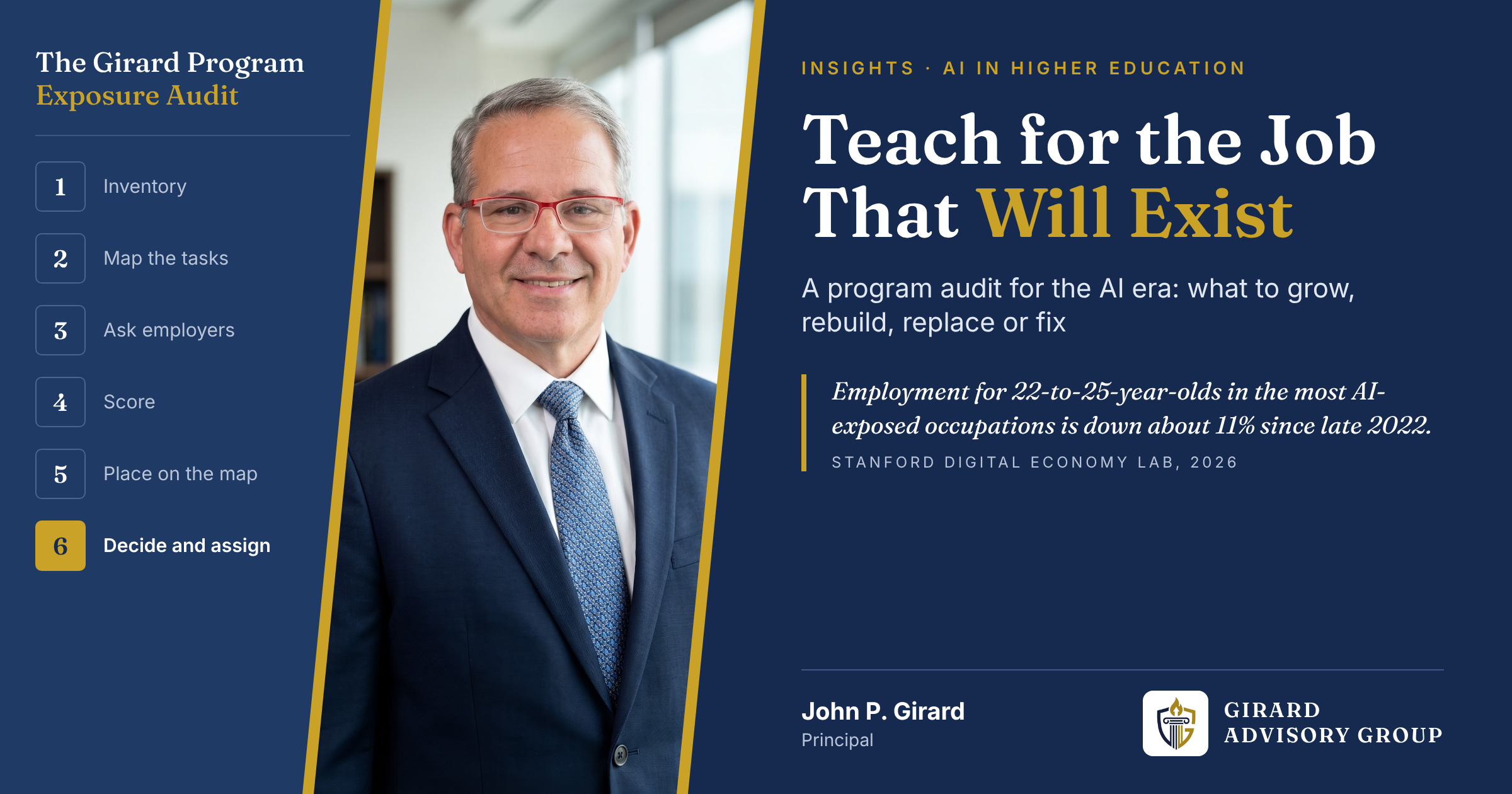
1. Design at the task level, not the course level
Stop asking “should we add an AI course?” Start with a task inventory for each program: list what a graduate actually does in the first 12 months on the job, then sort every task into three buckets — automated (AI does it now), augmented (AI drafts, human directs and verifies), and anchored (human judgment, physical skill, licensure, liability).
The automated bucket tells you what to stop spending instructional hours on. The augmented bucket is where your new content goes. The anchored bucket is your program’s durable value proposition — and it’s what your admissions team should be selling.
Do this with employers in the room, not from a curriculum office. And redo it annually, not triennially.
2. Split the curriculum into a stable core and volatile modules
Build your programs so that 70–80% of the credit hours sit in durable competencies — diagnostics, safety, systems reasoning, client communication, professional judgment, the physical craft — and the remaining 20–30% sits in explicitly designated tool modules with a documented short refresh cycle.
Write the tool modules so the competency is stable and the platform is a variable: “produces and validates a rough cut using an AI-assisted editing suite,” not “completes Adobe Premiere Firefly module 3.” Then you can swap the tool without a curriculum revision, without a new course number, and without triggering a substantive change filing. That single design decision buys you years of agility.
3. Teach verification as a graded competency
This is the one most programs are getting wrong. Teaching students to use AI tools is table stakes and takes about four hours. The employable skill is knowing when the output is wrong.
That means assessments where the student is handed AI-generated work containing plausible errors — a miswired schematic, a hallucinated code reference, a chart note that contradicts the vitals, an estimate with a bad load calculation — and is graded on catching, correcting, and documenting them. It means requiring students to state what they verified and how. Verification is a teachable, assessable, and highly marketable competency, and almost nobody is credentialing it.
4. Rebuild the rung that employers deleted
If employers no longer hire people to do the simple version of the work, students can’t learn from doing the simple version of the work. That learning has to move inside the program.
Practically: more simulation, more live-work labs, more client projects with real deliverables and real deadlines, more employer-supervised capstones, more externship hours. Portfolio over transcript. A graduate who can show 40 documented service calls, 15 finished client pieces, or a supervised project log is answering the “we need experience” objection directly — and that objection is now the primary barrier between your graduates and their first job.
5. Upgrade the advisory board from a signature to a co-design function
Most program advisory committees exist to satisfy a standard. Meet twice a year, review the curriculum, sign the minutes. That cadence cannot track a labor market moving this fast.
Change the ask. Bring employers a task inventory and have them mark what their new hires no longer do. Ask what they’re now expecting a first-year employee to handle that they weren’t expecting two years ago. Ask to see the AI tools in their shop. Offer faculty externships. Have employers co-write and co-score at least one capstone rubric. Document all of it — you’ll want that documentation for accreditation reasons I’ll get to below.
6. Solve for faculty before you solve for students
Your constraint is not content. It’s that many instructors — who came from industry precisely because they were excellent practitioners — are less fluent in these tools than their students. Curriculum that faculty can’t teach with conviction becomes a checkbox and dies quietly.
Budget real professional development hours. Pair instructors with the employer partners actually using the tools. And write a clear, program-level AI use policy that tells students where AI is required, permitted, and prohibited, so the classroom conversation stops being about cheating and starts being about competence.
Allied health programs and AI: what career college curriculum must address now
Whenever I make this argument, someone in allied health raises a hand and says none of it applies — you can’t automate a med pass. True. But the honest answer splits three ways inside the same catalog, and only one of those three is comfortable.
Medical assistant and LPN are genuinely anchored roles. Licensure, scope of practice, physical contact, and legal accountability for the record all require a credentialed human in the room. Demand reinforces it: HRSA projected in late 2025 that the U.S. will be short roughly 500,000 healthcare workers, including RNs and LPNs, by 2037. Nobody is automating wound care or a physical assessment.
But the task mix inside those roles has already been rewritten. Ambient documentation went from pilot to plumbing this year. athenahealth launched its ambient scribe free to all customers in February 2026, Epic has more than 150 AI features in development for the year, and the VA is deploying ambient scribes across every medical center nationwide. The structural pattern is consistent: AI produces the first draft of notes, summaries, and orders, and the licensed human moves to validation and interpretation. When a tool becomes free and bundled into the dominant EHR, your students meet it on day one of externship — not in five years.
And the real exposure in most career-college catalogs isn’t the MA or the LPN. It’s medical billing and coding, and medical office administration. Routine, high-volume coding is precisely what’s being absorbed. The growth role is the coder who validates AI-suggested output, works HCC and risk adjustment, and defends audits — a job that demands more coding knowledge than the average coder has, not less. The industry conversation has already moved from “will AI replace coders” to which encounter types require human review and how confidence thresholds get set. A program that trains someone to look up a code is training for the shrinking bucket. That program needs repositioning toward validation, denial prevention, and compliance — or it needs an honest conversation about whether it should continue.
For MA and LPN curriculum specifically, four competencies to build in now:
- Attestation literacy. When an ambient tool drafts the note, signing it is a legal act. Students need repetitions reconciling a draft against what actually happened — the vital transcribed wrong, the intervention the microphone missed, the finding that isn’t there. Assess it directly: hand them a plausible AI-generated note with seeded errors and grade the catch.
- Algorithmic alert response. Sepsis and deterioration prediction, fall-detection monitoring in long-term care, interaction flags. The teachable skill is escalating with clinical justification — and recognizing when the alert is wrong. Automation bias and alarm fatigue are now patient-safety topics, not IT topics.
- Documentation-by-exception vigilance. If the machine writes what happened, the human skill inverts: noticing what’s missing. That’s a different cognitive task than charting, and almost nobody is teaching it.
- The patient-facing side. Patients now arrive having already consulted a chatbot. Front-line staff need scripting for that conversation the same way they’re scripted for everything else at intake.
Two cautions. First, protect the clock hours. The temptation will be to trade lab time for technology modules, and that is exactly backwards — the hands are the anchor, and venipuncture, injections, EKG, and assessment are what employers cannot source anywhere else. Second, LPN programs answer to state boards of nursing, whose approval cycles are slower than any accreditor’s. That makes the modular architecture argument more urgent in nursing than in the trades: keep the tool content in the swappable layer, well clear of board-approved course descriptions.
One detail should settle the debate. The Next Generation NCLEX already pivoted to measuring clinical judgment. The licensure exam itself has decided that the thing worth testing is the one capability AI cannot supply. Build toward that and you’re aligned with the boards, the employers, and the technology all at once.
AI and accreditation risk: the compliance angle career colleges aren’t talking about yet
If you’re at an accredited institution, understand where this lands. Accreditors are going to arrive at your next visit asking about AI — not as a technology question, but through the standards they already have: are your program learning outcomes current with industry practice; does your advisory committee documentation demonstrate genuine employer input; are your graduates achieving employment in field; is your assessment measuring what you claim to certify?
If AI has moved the definition of “entry-level competence” in your field and your PLOs haven’t moved with it, that’s an outcomes-currency finding waiting to happen. Conversely, a program with a documented annual task inventory, employer-validated outcomes, and a modular refresh process has a very clean story to tell at a site visit. Build the process now and the accreditation review takes care of itself.
The bottom line
The credential’s value used to be that it proved you could do the work. Going forward, its value is that it proves two things: what you can do without the machine, and how well you can direct and check the machine when you have one.
Curriculum that trains only the first is nostalgic. Curriculum that trains only the second is disposable. The programs that thrive over the next five years will be the ones deliberately built to do both — and designed from the start to be changed.
Working through a curriculum review or program redesign? Let’s talk.
Frequently Asked Questions: AI, Entry-Level Careers, and Career College Curriculum
How is AI affecting entry-level hiring in career-college fields?
The primary effect is not mass layoffs but a shift in hiring patterns. Employers are not firing workers who do routine tasks — they are deciding not to hire the next person who would have done those tasks. ZipRecruiter’s 2026 employer survey found that 38% of employers have moved basic data processing off entry-level workers and onto AI, and 31% have raised experience requirements for entry-level roles as a direct result. Simultaneously, Anthropic’s labor-market research found that job-finding rates for workers aged 22 to 25 entering AI-exposed fields fell roughly 14% relative to 2022. The result is a closed loop: the tasks that used to teach entry-level workers how to do the job are being automated away, while employers simultaneously demand more experience from entry-level candidates.
Which career college programs are most exposed to AI disruption?
The highest exposure is in programs that train for predictable, screen-based, produce-a-first-draft work — medical billing and coding, medical office administration, and entry-level business and technology roles. The lowest exposure is in programs that train for variable, physical, judgment-under-conditions work: skilled trades, allied health clinical roles, and any occupation where licensure, physical contact, or legal accountability requires a credentialed human. The important nuance is that even low-exposure programs are seeing their task mix rewritten — the question is not whether AI touches the occupation but whether the worker owns the judgment or just executes the steps.
What is the most important curriculum change career colleges should make right now?
The single highest-leverage change is teaching verification as a graded competency. Teaching students to use AI tools takes about four hours. The employable skill — and the one almost no program is credentialing — is knowing when the output is wrong. That means assessments where students are handed AI-generated work containing plausible errors and are graded on catching, correcting, and documenting them. A graduate who can demonstrate that competency is answering the primary objection employers now have about AI-assisted workers: that they will accept bad output without checking it.
How should career colleges structure curriculum to keep pace with AI tool changes?
The key architectural move is splitting the curriculum into a stable core and volatile modules. Roughly 70–80% of credit hours should sit in durable competencies — diagnostics, safety, systems reasoning, physical craft, professional judgment. The remaining 20–30% should sit in explicitly designated tool modules with a documented short refresh cycle. Write those modules so the competency is stable and the platform is a variable: “produces and validates a rough cut using an AI-assisted editing suite,” not “completes Adobe Premiere Firefly module 3.” This lets you swap the tool without a curriculum revision, a new course number, or a substantive change filing.
How does AI affect accreditation risk for career colleges?
Accreditors will arrive at the next site visit asking about AI through the standards they already have: are program learning outcomes current with industry practice, does advisory committee documentation demonstrate genuine employer input, are graduates achieving employment in field, and is assessment measuring what the program claims to certify. If AI has moved the definition of entry-level competence in a field and the program learning outcomes have not moved with it, that is an outcomes-currency finding waiting to happen. A program with a documented annual task inventory, employer-validated outcomes, and a modular refresh process has a clean story to tell. The compliance case for curriculum modernization is as strong as the workforce case.
Are medical assistant and LPN programs safe from AI disruption?
The clinical roles themselves are genuinely anchored — licensure, scope of practice, physical contact, and legal accountability for the record all require a credentialed human. HRSA projects a shortage of roughly 500,000 healthcare workers by 2037. But the task mix inside those roles has already been rewritten by ambient documentation tools now bundled into major EHR platforms. The competencies that need to be added are attestation literacy (reconciling an AI-drafted note against what actually happened), algorithmic alert response (escalating with clinical justification and recognizing when an alert is wrong), documentation-by-exception vigilance (noticing what the AI missed), and patient-facing communication about AI-generated health information. The hands-on clinical skills remain the anchor and should not be traded for technology modules.
What should career college program advisory boards be doing differently because of AI?
Most advisory committees meet twice a year, review the curriculum, and sign the minutes. That cadence cannot track a labor market moving this fast. The more useful ask is to bring employers a task inventory and have them mark what their new hires no longer do, ask what they now expect a first-year employee to handle that they were not expecting two years ago, ask to see the AI tools in their shop, offer faculty externships, and have employers co-write and co-score at least one capstone rubric. Document all of it — that documentation supports both curriculum currency arguments and accreditation evidence of genuine employer engagement.
Explore Topics
Written by
John P. Girard
John P. Girard is the founder of Girard Advisory Group and a thirty-year veteran of career and proprietary higher education, with hands-on leadership across enrollment growth, campus operations, accreditation and compliance, curriculum development, brand and marketing, and P&L management. Over three decades he has held roles spanning Campus Director, Campus President, Regional Campus Director, and National Director of Marketing & Digital Media Brand Management, leading multi-campus organizations through growth, accreditation, and operational turnarounds. That range — from the admissions floor to the boardroom — is what shapes his advisory approach: strategy that has to hold up in daily campus operations, not just on a slide. John holds a Master's degree in Teacher Education from the University at Albany, SUNY, and has served on the Board of the Ohio-Michigan Association of Career Colleges and Schools.