
What a student should be able to say. What a client should be able to say.
The same standard we built for students is the standard for how we serve the leaders responsible for them. The CARING+ Model of Campus Engagement holds that a student's lasting experience of a school is a belief about their own capability. Girard Advisory Group holds itself to the same test: what a campus leader believes about their own capacity to run their school after working with us. Values that cannot be observed cannot be coached or kept. So each value below names the commitment it carries and the behavior a client should be able to see.
Five conditions. One outcome.
Each of the five statements is a condition a campus either creates or fails to create. None of them alone is sufficient. A student who matters but does not belong will leave. A student who belongs but cannot do the work will not succeed. The five reinforce each other — which is why the model is a system, not a checklist.
When all five are present, the outcome at the center becomes predictable: a student who succeeds — in the program, in the credential, and in the career that follows.
I Matter.
Your campus, not a template.
What you can observe
The first conversation is diagnosis, not a pitch deck.
Recommendations cite your data, your processes, and your people by name.
Nothing arrives pre-written before we have listened.
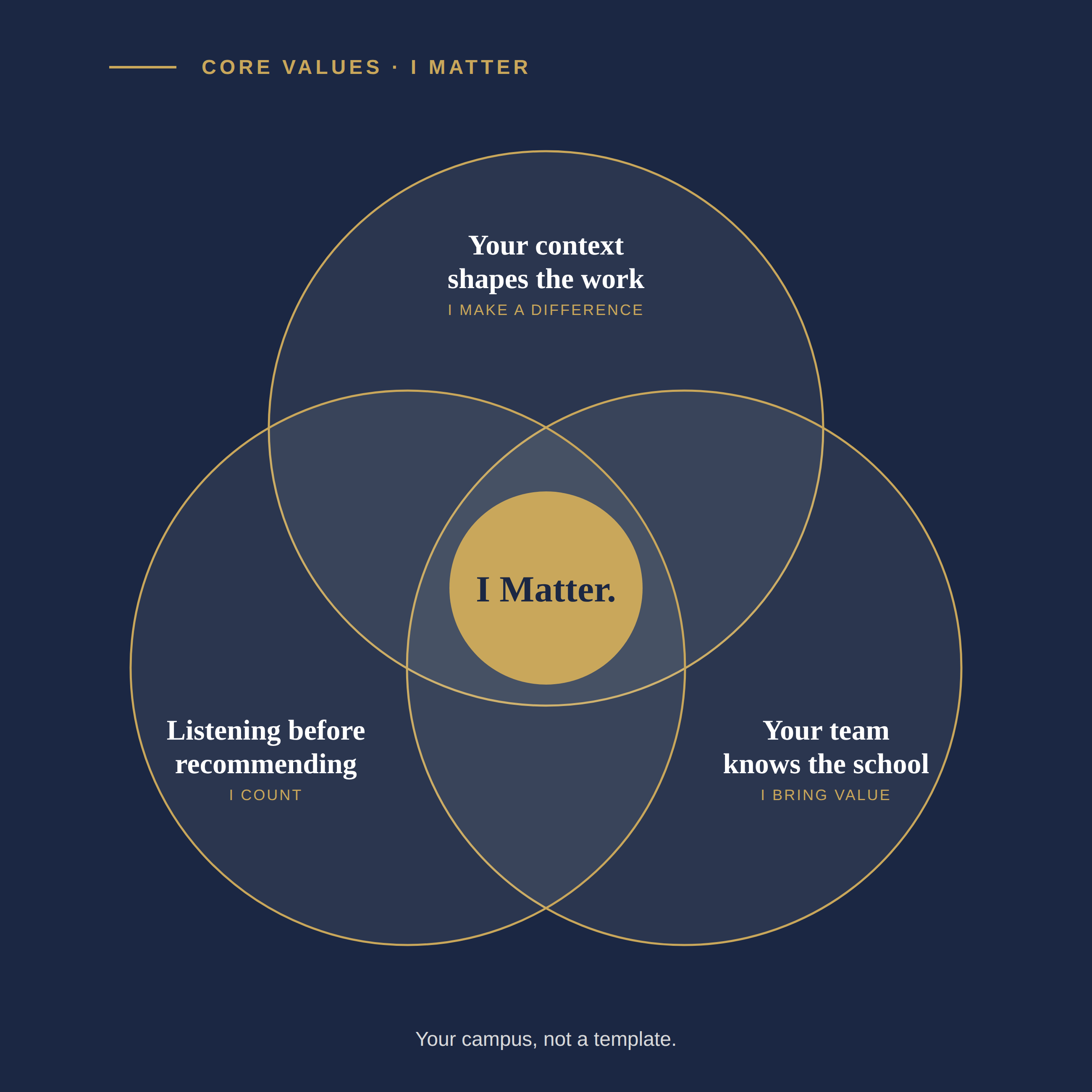
Every engagement begins with your institution's actual students, staff, market, and accreditor. Career colleges share patterns, but no two campuses fail or grow for the same reasons, and advice that ignores that difference is advice that will not be used. You bring value to the work. Your team's knowledge of the campus is the raw material of every recommendation we make.
I Belong.
A partner inside the team, not a vendor above it.
What you can observe
Seed carriers are identified and equipped from the first month, not the last.
Credit for progress goes to the campus, publicly and in writing.
The model is built to run without us.
Staff model belonging by treating one another with the same standard
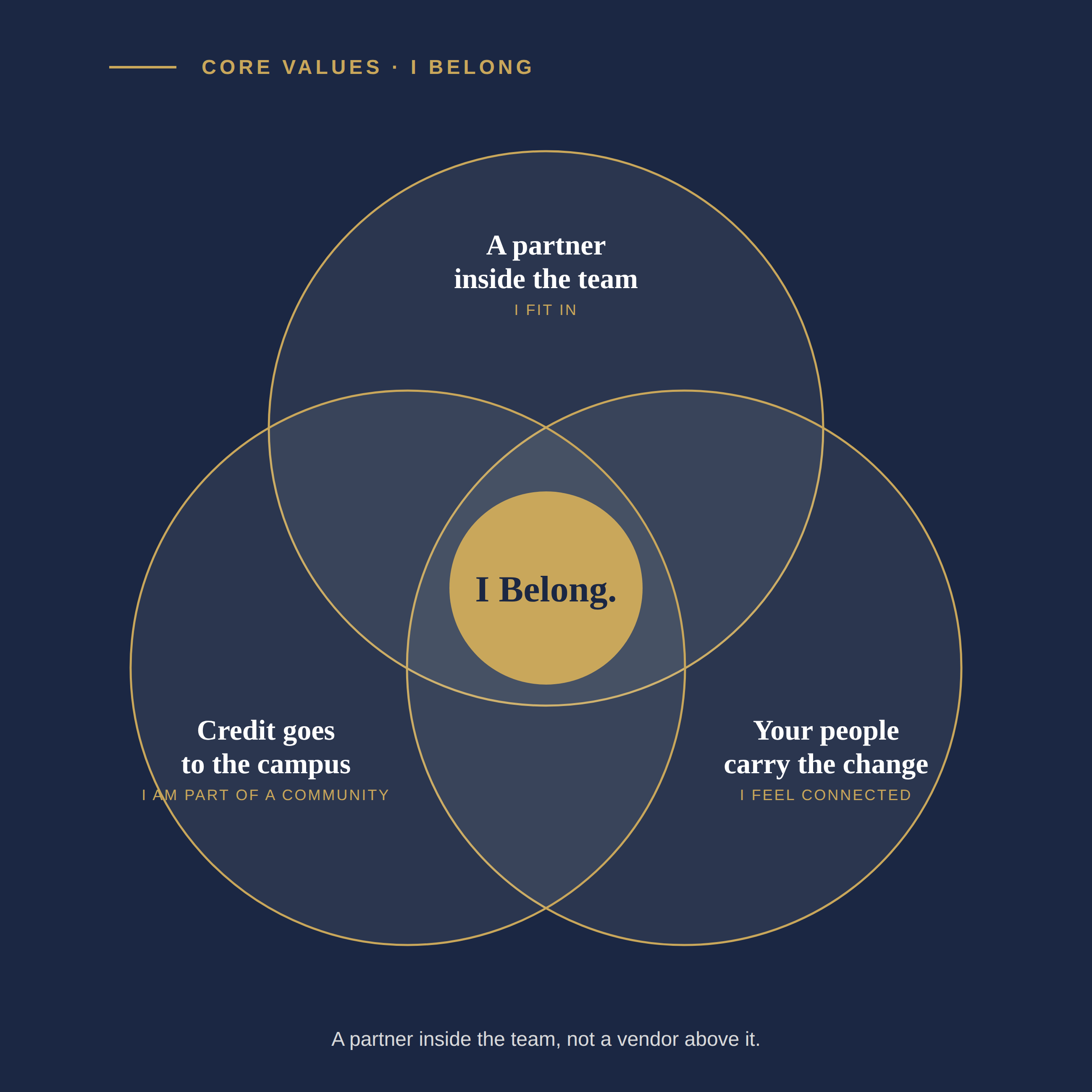
Culture change does not survive a consultant's departure unless the campus owns it. We work alongside your staff, in your meetings, on your timeline, and the wins belong to the people who will still be there next year. Belonging works in both directions. A leadership team that feels connected to the work will carry it further than any plan we could hand over
I Trust.
Candor with dignity.
What you can observe
Risks are named in the first report, not discovered in the site visit.
No guarantee is offered that an accreditor or a market cannot honor.
A written plan with milestones exists before work starts, and scope, timeline, and cost do not change without a conversation.
Every recommendation shows its reasoning; disagreements are worked through, not overridden
Nothing about a client is used as a case study, reference, or post without written permission
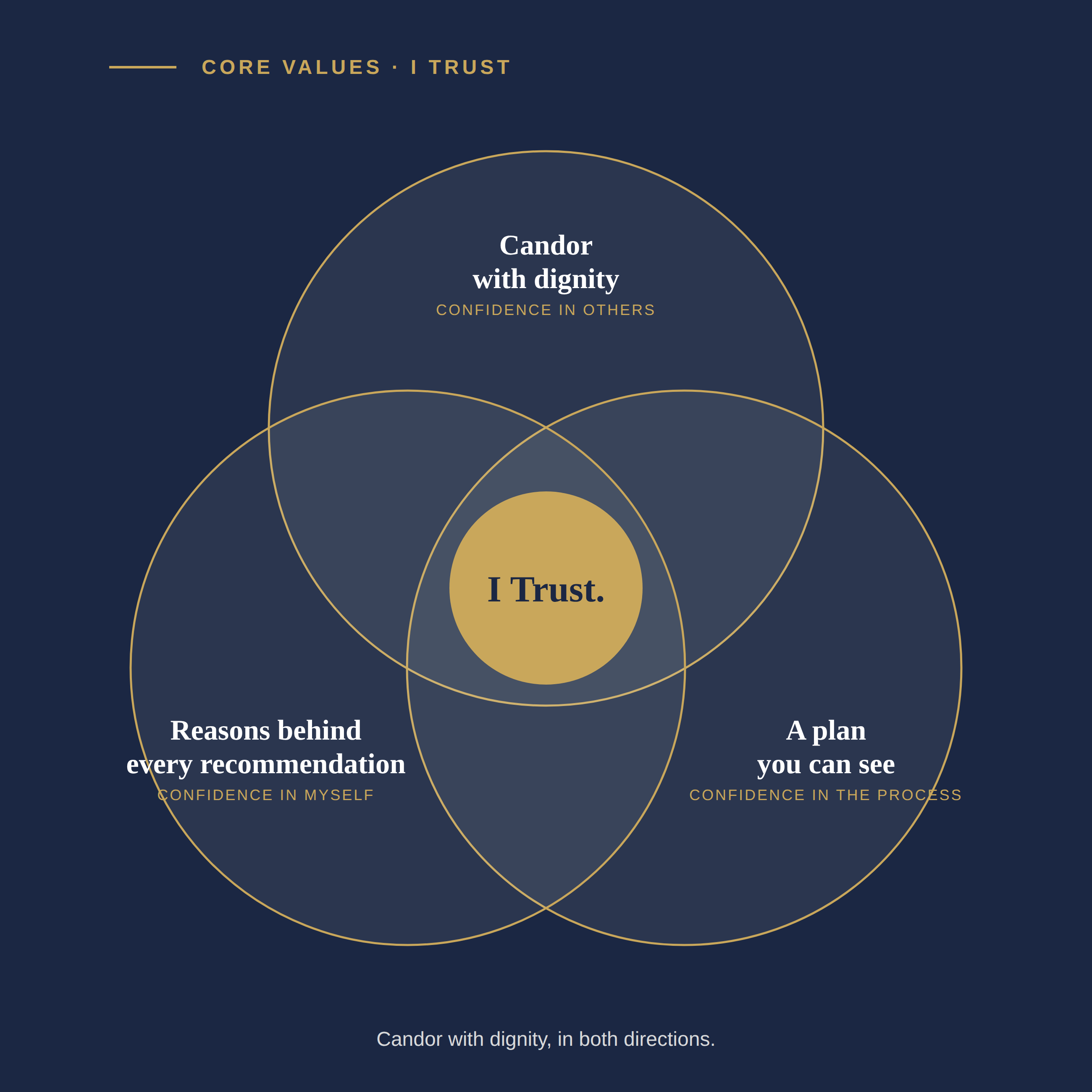
Trust has three parts: confidence in the people you work with, in the process, and in yourself. We owe you all three. You get the truth about what an accreditor, a prospective student, a reviewer, or an AI assistant will actually find when they look at your school, delivered early, specifically, and without false promises. Hard news handled with respect builds more confidence than good news handled carelessly. You also get a method you can see. Every engagement has a written shape before work begins, so you always know what is happening and what comes next. And every recommendation comes with its reasoning, because the goal is not for you to trust us. It is for you to leave the engagement trusting your own judgment about your own campus. Trust runs both ways. We trust your team to know your school, and we treat their instincts as evidence. What we learn about your institution stays with your institution.
I Grow.
Grow the team, and the school follows.
What you can observe
Every framework is introduced as development first; nothing becomes an evaluation tool until the team has practiced it.
Each deliverable names who runs it next and how it is reviewed.
Training uses your real cases, including the hard ones, not generic scenarios.
Team capability milestones are reviewed alongside campus metrics, so progress in people is as visible as progress in numbers.
The engagement has a planned end and a follow-up check after it.
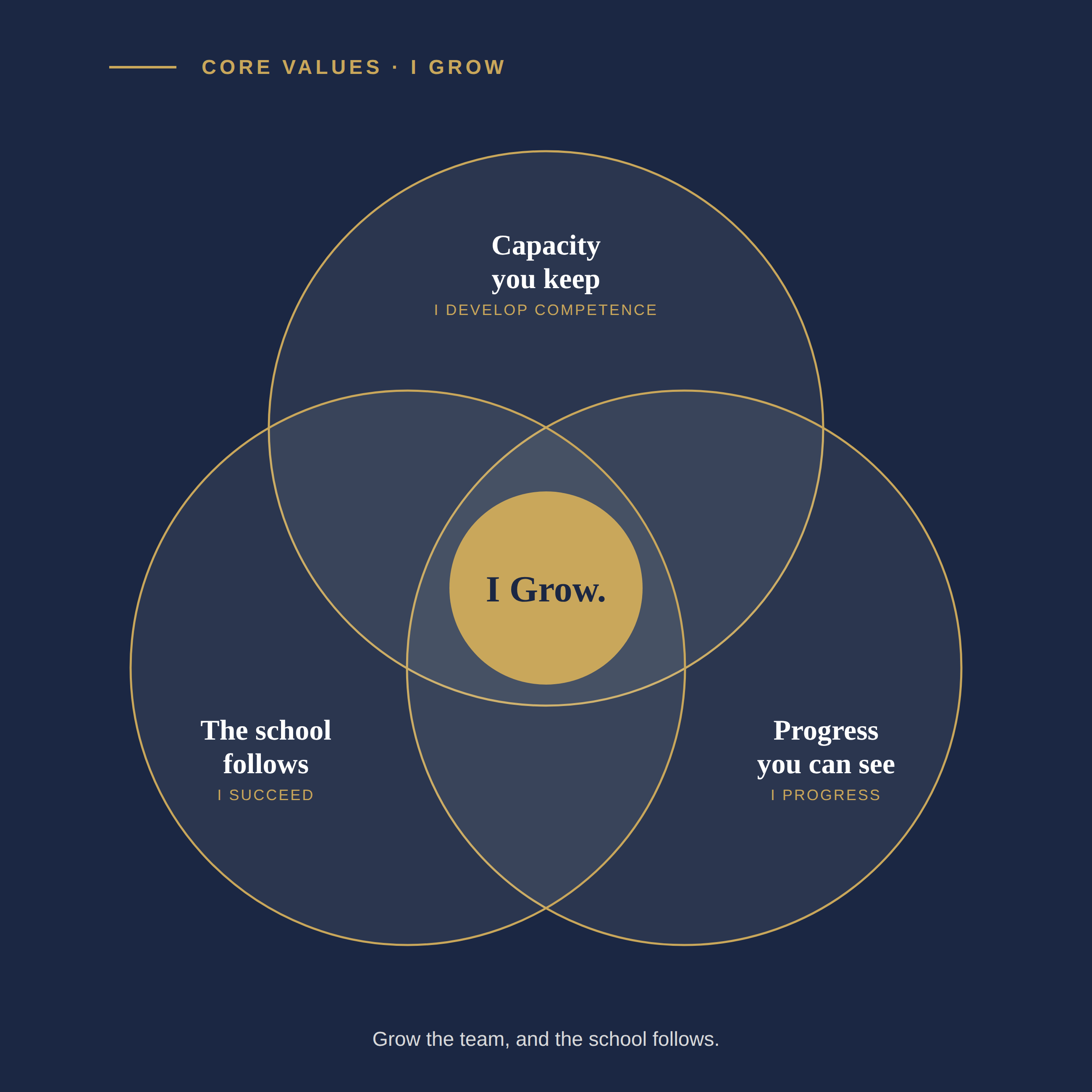
The measure of an engagement is not the deliverable; it is what your team can do afterward that it could not do before. Every framework we introduce leaves behind an owner, a review cadence, and staff who can coach it to the next hire. Enrollment and outcomes grow when the people responsible for them have grown first, and growth built on a stronger team is the only kind that lasts. Growth initiatives launch only after the team that will run them has been developed to run them. How a framework is introduced decides whether it takes. If staff first meet it as a scorecard, they perform compliance. If they meet it as a shared way to help students succeed, they build the skill together. We start with development and hold off on evaluation until the team has practiced. Dependence on an advisor is a failure of the advisor...so we measure ourselves partly by how little you need us at the end. Growth means the campus develops its own competence, sees its own progress, and reaches its own results.
I Can Do.
Confidence built on wins your team earned
What you can observe
The first ninety days are sequenced to produce completed wins the team executed themselves, before harder work begins.
Feedback is specific and comes from experience in the role, not general encouragement.
Initiatives are limited so they can be finished; what is started gets completed or deliberately stopped.
The decision to move from fixing to growing is made on evidence the team produced, not on the calenda
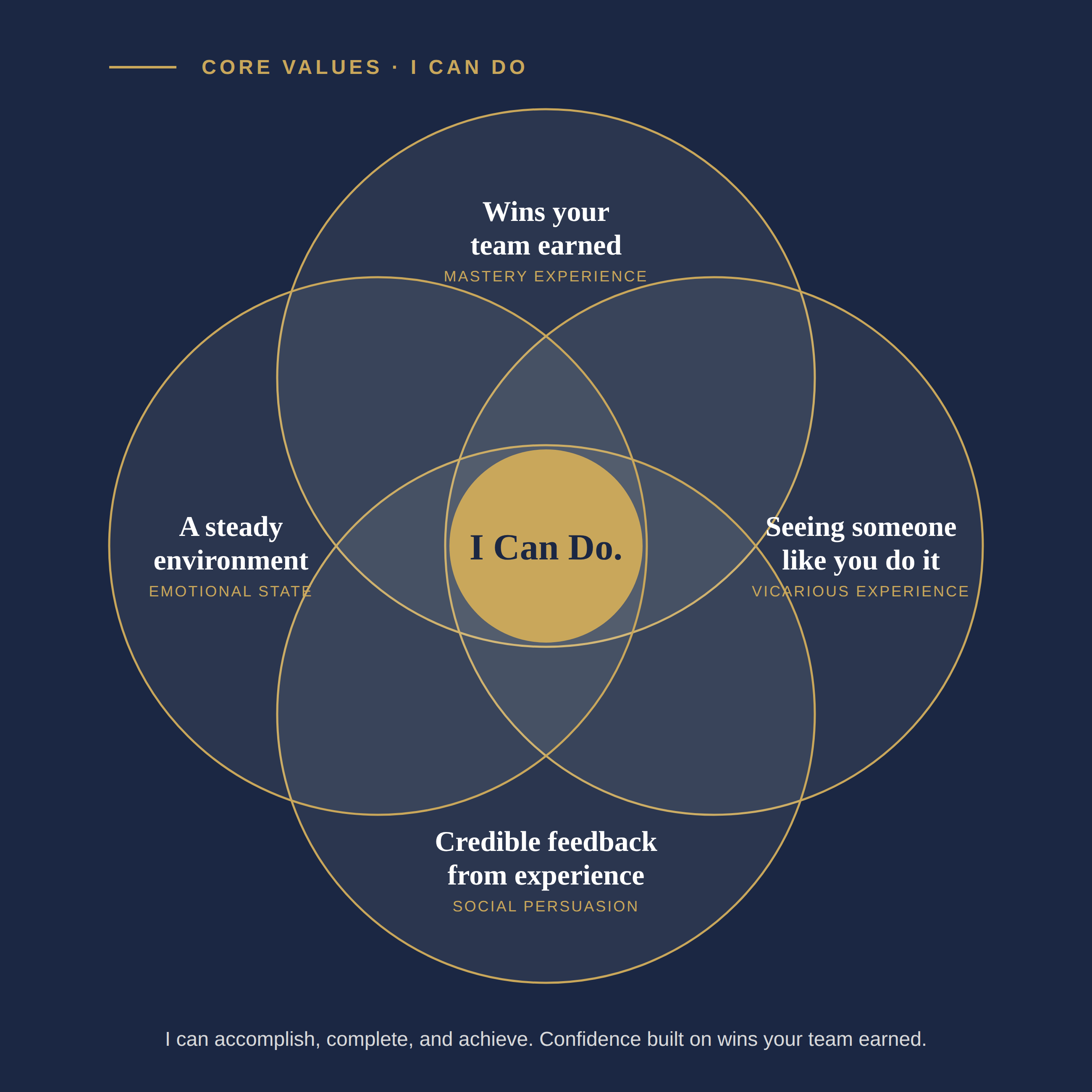
Capability is a belief before it is a result, and that belief is built in a specific way. It comes from finishing real things, from watching someone like you do the hard part, from credible feedback by someone who has done the job, and from working in an environment steady enough that people can think. We design engagements around all four. Fix what is broken before you try to grow, not only because growth on a broken process amplifies the break, but because early, completed wins are how a team starts to believe the larger turnaround is possible. Struggling campuses are usually full of initiatives that were started and abandoned; we would rather see three things finished than ten begun. A leader who has watched their own leading indicators move, because of work their own team completed, knows the turnaround is working. That knowledge is the outcome we are after.
The plus is the reciprocal standard.
When the CARING+ Model was rolled out at the Albany campus of Bryant & Stratton College, the most surprising result was not the gain in student retention or satisfaction. It was how staff began treating each other.
The most surprising outcome of the original implementation was not on the student side. It was what happened among the people who worked there. Year-over-year turnover under one percent. Employee satisfaction at an all-time high. A culture of care, applied consistently, does not distinguish between the person delivering it and the person receiving it. It changes both.
“The part of the journey that was most satisfying and the toughest was getting all associates to buy into the concept. The most surprising outcome was how we as associates treated each other. Our turnover rates year over year were less than 1% and employee satisfaction was at an all-time high.”
Michael Gutierrez
Mildred Elley College
How we put these to work
These values appear in every proposal as an engagement charter, so a client knows what to expect before signing. They are also the lens for every case we write about: what did I Matter, I Belong, I Trust, I Grow, and I Can Do look like in the first 90 days of a turnaround, in a renewal of accreditation, in a brand rebuild?
If an engagement is not producing those five beliefs in the people we work with, the engagement is not working, regardless of the deliverables.
Where this comes from
The CARING+ Model of Campus Engagement is a student-centered framework for turning a culture of care into observable behaviors that strengthen belonging, persistence, and graduation outcomes. Read the full model on Insights.
The CARING+ Model was developed collaboratively at the Albany campus of Bryant & Stratton College by John P. Girard, Mike Gutierrez, and Gina Cassidy.
Girard Advisory Group · Chagrin Falls, Ohio
Measurement instrument
Five questions, in the student’s voice
Asked every term, these five questions tell a campus where it stands on every condition in the model. None of them requires new budget. All of them require the campus to decide that a student’s belief about their own capability is an outcome the institution is responsible for.
Download the I Matter checklist (PDF)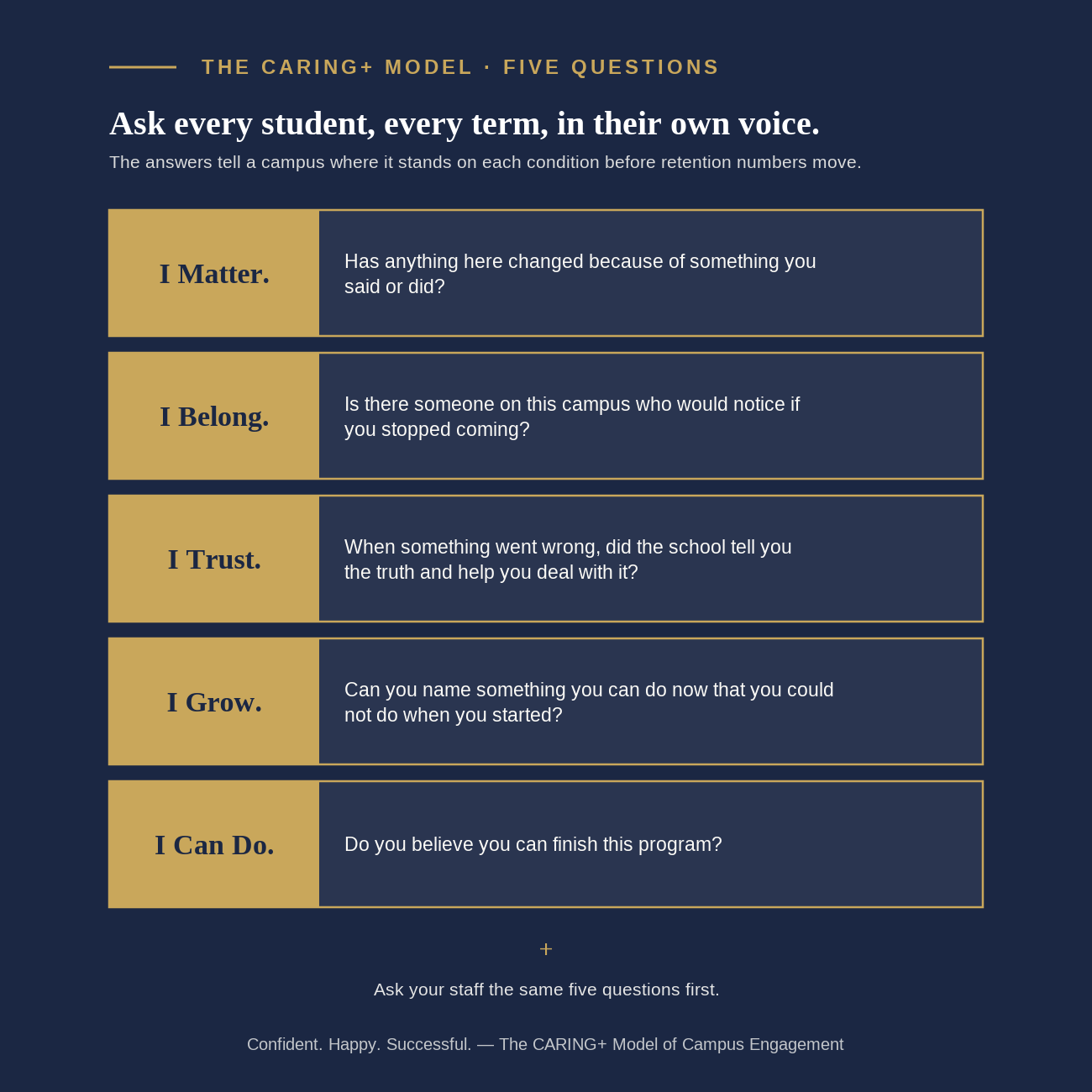
The CARING+ Model of Campus Engagement was developed collaboratively at the Albany campus of Bryant & Stratton College by John P. Girard, Mike Gutierrez, and Gina Cassidy.