The Inquiry Is Not the Beginning of the Funnel Anymore: The TRUSTED Model for Building Pre-Inquiry Trust at Career Colleges

John P. Girard
Founder, Girard Advisory Group
Today’s prospective student has usually reached a working verdict on your school before they ever contact you. The inquiry is not the beginning of the funnel — it’s the middle. Here is how to influence the trust that forms upstream.

Ask most admissions teams where the funnel starts and they will say the inquiry. A form is submitted, a call comes in, a chat opens, and the work of persuading a prospective student begins.
That was true fifteen years ago. It is not true now.
Today’s prospective student has usually reached a working verdict on your school before they ever contact you. They have read your Google reviews, watched your students on TikTok or Instagram, searched your name alongside the word “scam,” and increasingly asked an AI assistant whether you are worth it. The inquiry is not the beginning of the funnel. It is the middle. Admissions is inheriting a decision, not shaping one.
I have written about the symptoms of this shift before. In The Contactability Problem: Why So Many Inquiries Go Cold Before You Ever Speak to Them, I made the case that unreachable inquiries are usually not a phone-number problem; they are students who have not yet decided you are worth a conversation. In AI Is Now Your Prospective Student’s First Advisor: What Campus Leaders Should Be Asking Their Marketing Team, I described how AI assistants are assembling a summary verdict on your school from whatever they can find, and delivering it before you get a word in. And in the reputation and review management post, I covered the headwind every for-profit school starts behind. This post is about the remedy. Specifically: the tools and activities a campus can actually deploy to influence trust in the window before a student raises their hand.
I have organized it around the places where the verdict gets formed, because that is where the work has to happen, and I have given those places a name — the TRUSTED model — so a campus team can hold all seven in mind at once.
Start With the Question They Are Really Asking
Before any tactic, be clear about what the prospective student is trying to resolve. It is not “what programs do you offer.” It is some version of these five questions:
- Is this school real, or is it the kind I’ve been warned about?
- Do graduates actually get jobs in this field?
- Will the people teaching me know the industry, or just the textbook?
- What will it actually cost me, and will I be able to pay it back?
- Will I be treated like a person or like a number?
Every tool below exists to answer one or more of those questions before the student has to ask. If a tactic doesn’t map to one of them, it is probably marketing for its own sake.
The TRUSTED Model
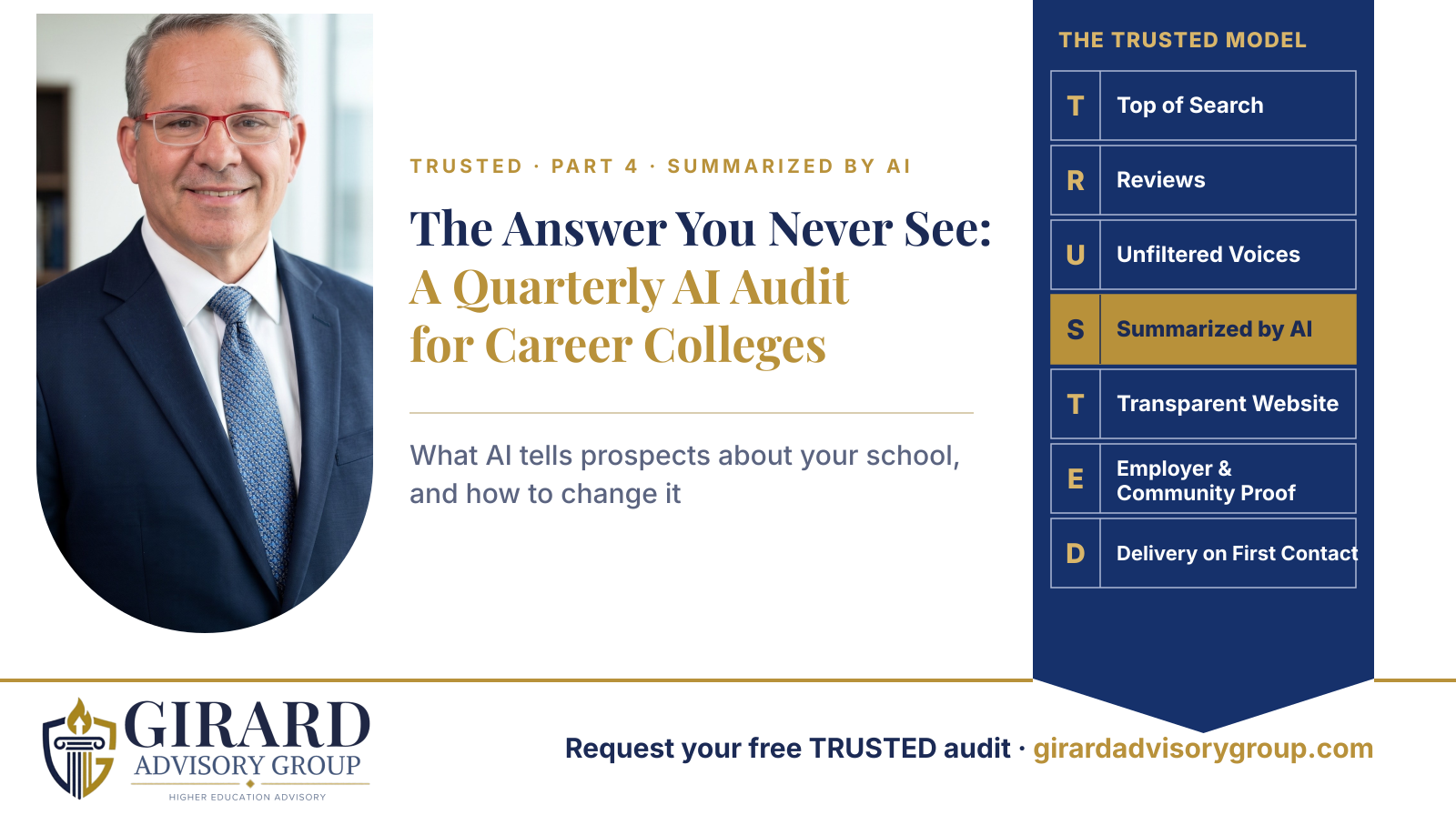
The answers to those five questions get formed on seven surfaces, and a prospective student moves through them in a fairly predictable order: a name search, the reviews, the social feeds, an AI assistant, the website, whatever employers and industry people they know, and finally the first contact with admissions. I have organized the rest of this post around those seven surfaces, and together they spell out what the student is deciding at each step:
- T — Top of search. What Google shows when they type your name.
- R — Reviews. The verdicts of people who came before them.
- U — Unfiltered voices. Real students and instructors on social and video.
- S — Summarized by AI. What an assistant says when they ask about you.
- T — Transparent website. Cost, outcomes, and faces, in plain sight.
- E — Employer and community proof. Who vouches for you that isn’t you.
- D — Delivery on first contact. Whether admissions confirms the verdict or breaks it.
A prospective student decides whether you are TRUSTED before they ever inquire. The model is deliberately sequential. Weakness on an early surface means the student may never reach a later one, and strength on the last surface cannot repair a verdict formed on the first six. Work them in order.
The TRUSTED Model
The Inquiry Is Not the Beginning of the Funnel
Girard Advisory Group
T — Top of Search: Google Results and the Business Profile
For most prospective students the first serious act of research is typing your school’s name into Google. What appears in that results page is the single most influential trust signal you have, and most schools treat it as an afterthought.
Own your Google Business Profile for every campus. Claimed, verified, complete, and reviewed weekly. Correct hours. Current photos taken by a person, not a stock library. Every program listed as a service. A Q&A section that you have seeded with the real questions and answered honestly.
Watch the “People also ask” and autocomplete results for your name. If “[your school] scam” or “[your school] lawsuit” autocompletes, you have a problem you need to address head-on, not ignore. Publish a plain-language page that answers the accusation directly. Students will find the accusation either way; the only question is whether they also find your response.
Build a real FAQ page on your site, one question per section, with schema markup. Answer the five questions above in the language a student would use. This is what shows up in featured snippets and, increasingly, what AI assistants cite.
Publish your outcomes plainly. Graduation and placement rates, by program, on a page a human can find. If the accreditor already requires disclosure, you are already publishing them; the difference is whether you bury them in a PDF or present them as evidence. Directional honesty (“most of our graduates in this program are working in the field within a year”) builds more trust than a number with an asterisk.
R — Reviews
Reviews are the closest thing to a verdict a prospective student can find, and they read them the way you read a restaurant’s before booking a table: skim the rating, then read the worst ones.
Build a review generation cadence, not a campaign. Ask at moments of genuine satisfaction: after a milestone project, at a graduation, when a student lands a job. Make asking a defined step in someone’s job, with a target volume per month per campus. Reviews accumulate through discipline, not inspiration.
Respond to every review, especially the bad ones. A thoughtful, non-defensive response to a one-star review is read by far more prospective students than the review itself. Acknowledge, explain what changed, invite the conversation offline. Never argue.
Diversify the platforms. Google is primary, but Niche, Indeed, Facebook, and industry-specific boards all show up in a name search. A school with a strong Google rating and nothing anywhere else looks managed. A school with consistent ratings across platforms looks real.
Monitor Reddit and the community forums for your field. Prospective students trust an anonymous Redditor in r/audioengineering more than any page on your website. You cannot control these conversations, but you can know what is being said, correct factual errors politely, and, over time, encourage graduates to participate as themselves. The goal is presence, not control.
U — Unfiltered Voices: Social and Video
This is where the “is it real” and “will I be treated like a person” questions get answered, and it is where the most expensive mistakes get made.
Show the actual campus, the actual students, the actual instructors. I learned this the hard way. Stock and AI-generated imagery looks clean, and current prospective students spot it in a second. To a nineteen-year-old who has spent their life online, polish reads as inauthenticity. A slightly shaky phone video of a student running a live board or finishing a project does more for trust than any produced brand spot.
Lead with faculty. The most credible trust signal a career college has is an instructor who has done the job. Short videos of instructors talking about their industry experience, what they teach, and why, answer question three directly. The pillar we built this around at one network was simple: learn from a pro to be a pro. If that is true of your school, prove it on camera.
Let students and graduates speak in their own voice. Not scripted testimonials. Real students answering “what surprised you” or “what would you tell someone considering this.” Imperfect is more convincing.
Be where the field lives. If you train audio engineers, your content should be on the platforms where audio engineers talk. If you train welders, it is a different set. Generic presence on every platform is worse than focused presence on the two that matter to your students.
Answer the money question in content, not just in admissions. A plain-language video from a financial aid officer on what the program costs, what aid is typical, and how repayment works is rare — and its rarity is exactly why it builds trust.
S — Summarized by AI: What the Assistants Say About You
A growing share of prospective students now ask ChatGPT, Gemini, or Perplexity some version of “is [school] a good choice for [field]” before they ever visit your site. The answer they get is assembled from whatever the model can find: your site, your reviews, news coverage, forum threads, and accreditor data.
Audit what the assistants say about you. Ask them the questions a prospective student would ask, across several assistants, quarterly. Record the answers. This AI summary is your pre-inquiry reputation in its purest form, and as I argued in the first-advisor post, it is now the closest thing to a first impression most schools get.
Make your site citable. AI assistants favor clear, structured, factual content: program pages that state what is taught, how long it takes, what it costs, and what graduates do, in plain sentences. FAQ pages with schema. Outcomes stated plainly. A school that publishes this becomes a source. A school that hides it lets the forums speak for it.
Feed the ecosystem the assistants draw on. Accreditor listings, industry directories, press coverage of student projects and employer partnerships, and your own published thought leadership all become inputs. Consistency across those sources matters; an AI assistant that finds contradictory information will say so.
The short version: the question to ask your marketing team is not “what is our SEO strategy” but “what does an AI assistant say when a student asks about us, and what are we doing about it.”
T — Transparent Website
By the time a student reaches your site, they are often verifying, not discovering. Design for that.
Answer the five questions above the fold on every program page. Not a hero image and a tagline. What you learn, who teaches it, what it costs, what graduates do, how long it takes.
Show real faces, and name them. Instructors with bios that cite industry work. Graduates with names and employers, with their permission. Anonymized proof is not proof.
Make the outcomes and cost pages easy to find. If a student has to hunt for what it costs, they assume you are hiding it — and they are usually right.
Retire the stock library. Every image on the site should be a real place, a real person, or a real project. If you cannot fill the site with real imagery, that is a content problem to solve, not a design problem to paper over.
E — Employer and Community Proof
The most persuasive trust signal is one you do not deliver yourself. Third-party validation from employers and the local industry answers “do graduates get jobs” more convincingly than any placement rate.
Put employer partnerships on the record. Advisory board members named on the site. Employers who hire graduates quoted, with permission, on why. Externship sites listed. This is not a brochure item; it is evidence.
Get students’ work in front of the industry. Student projects showcased at industry events, published, or entered in competitions generate press, social content, and word of mouth all at once. A student whose project got noticed becomes an advocate.
Be physically present. Open houses that are actual workshops. High school and community partnerships. Instructors speaking at industry meetups. A school that is visible in its field’s community is presumed real by the people in that community, and prospective students ask those people.
D — Delivery on First Contact: The Handoff
Everything above shapes the verdict before contact. The last piece is making sure the first contact does not undo it.
Speed and tone of first response. This is where the contactability problem actually gets solved. A student who has decided you are credible and then waits two days for a reply reconsiders. A student who gets a scripted sales call reconsiders faster. Speed to contact matters, and so does sounding like the people in your videos.
Consistency between what they saw and who they meet. If your content led with instructors and students, put an instructor on the first campus visit. If your content was honest about cost, be honest about cost on the first call. The pre-inquiry work built an expectation; the inquiry either confirms it or exposes it.
How to Measure Any of This
Pre-inquiry trust does not show up on a lead report, which is why it gets neglected. Here is what to track instead, quarterly at minimum:
- Branded search volume — and the ratio of your name searched alone to your name searched with “reviews,” “scam,” “cost,” or “worth it.” A rising share of plain-name searches is a trust signal.
- Review velocity and average rating, per campus, across platforms, with response rate.
- AI assistant audit results: what they say, whether it is accurate, whether it improves.
- Share of inquiries that are contactable on first attempt. This is the most direct downstream measure, and the one I built the contactability post around: students who trust you pick up.
- Show rate and first-week attendance for new starts. Students who arrived with accurate expectations stay.
- Referral share of starts. Students referred by graduates and employers are the purest outcome of pre-inquiry trust.
Each of these maps back to a surface in the TRUSTED model, so when one slips you know where to look. If these move, cost-per-start will follow, usually with a lag of two or three terms. If you only watch cost-per-start, you will keep optimizing the lead channel while the constraint sits upstream.
Where to Start
You cannot do all of this at once, and you should not try. If I were building this from zero at a single campus, the sequence would be:
- Fix the Google Business Profile and publish plain outcomes and cost pages. Two weeks.
- Start the review cadence with a named owner and a monthly target. Ongoing from week three.
- Replace stock imagery with real faculty and student content, starting with the program pages. One quarter.
- Audit what AI assistants say and rebuild the FAQ and program pages to be citable. Same quarter.
- Put employer relationships on the record. Second quarter.
- Add branded search, review velocity, and contactability to the weekly leadership dashboard. Immediately.
None of this requires new budget so much as reallocated attention. Most of the money career colleges spend on marketing goes to generating inquiries. A meaningful share of it would return more if it went to earning the trust that makes those inquiries answer the phone.
The funnel did not shrink. It moved. The schools that follow it upstream — and work the seven TRUSTED surfaces in order — will be the ones still enrolling students five years from now.
Frequently Asked Questions
Isn’t this just SEO and reputation management by another name?
It overlaps, but the frame is different. SEO optimizes for being found; reputation management optimizes for looking good. Pre-inquiry trust optimizes for being believed by a skeptical student before they contact you — which means answering their real questions honestly and visibly, and letting third parties vouch for you.
How do we handle legitimately negative history, such as a past lawsuit or accreditation action?
Address it directly on your own site in plain language: what happened, what changed, and where things stand now. Students will find the history regardless. A school that acknowledges it is far more credible than one that pretends it is not there.
We can’t afford a video team. How do we produce authentic content?
You do not need one. The most effective content in this space is shot on a phone by a staff member with the instructor’s or student’s consent. Authenticity is the point; production value can actively work against it.
How much of our marketing budget should shift toward this?
Enough to fund a named owner for reviews and content at each campus and to replace stock imagery within a quarter. In most schools that is a reallocation of attention more than money. Judge it by contactability, show rate, and referral share — not by lead volume.
How do we influence what AI assistants say about us?
Publish clear, structured, factual content about programs, cost, faculty, and outcomes; keep it consistent across your site, accreditor listings, and directories; and build the review and press footprint the assistants draw on. Audit the results quarterly.
What is the TRUSTED model?
A seven-surface framework for pre-inquiry trust: Top of search, Reviews, Unfiltered voices, Summarized by AI, Transparent website, Employer and community proof, and Delivery on first contact. It follows the order in which a prospective student actually encounters a school and is meant to be worked in that sequence.
Does this replace lead generation?
No. It makes lead generation work. Paid channels still bring prospective students to your name; pre-inquiry trust determines what they conclude when they get there. The complete seven-surface model is documented on the TRUSTED Pre-Inquiry Framework page.
Explore Topics
Written by
John P. Girard
John P. Girard is the founder of Girard Advisory Group and a thirty-year veteran of career and proprietary higher education, with hands-on leadership across enrollment growth, campus operations, accreditation and compliance, curriculum development, brand and marketing, and P&L management. Over three decades he has held roles spanning Campus Director, Campus President, Regional Campus Director, and National Director of Marketing & Digital Media Brand Management, leading multi-campus organizations through growth, accreditation, and operational turnarounds. That range — from the admissions floor to the boardroom — is what shapes his advisory approach: strategy that has to hold up in daily campus operations, not just on a slide. John holds a Master's degree in Teacher Education from the University at Albany, SUNY, and has served on the Board of the Ohio-Michigan Association of Career Colleges and Schools.